
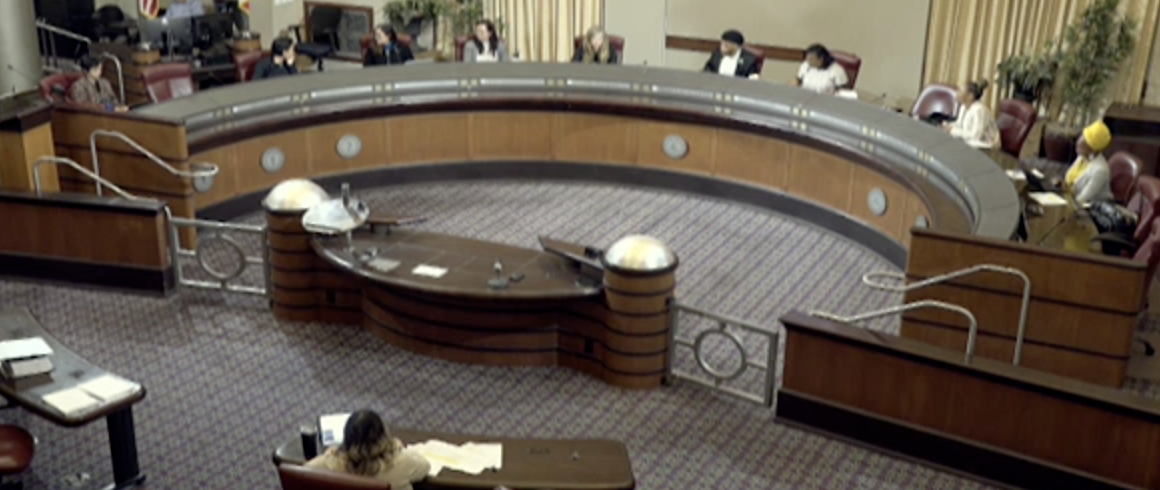
Rules & Legislation Committee - May 28, 2026 - Meeting
Rules & Legislation Committee • OaklandMay 28, 2026
Locunity is a independent informational service and is not an official government page for this commission.We use AI-assisted analysis and human editorial review to publish information.
Transfer Tax Ballot Measure Hits Pause as Committee Demands More Rigor
Oakland's Rules & Legislation Committee spent the bulk of its May 28 session wrestling with a proposed ballot measure to close a foreclosure transfer tax loophole — ultimately sending it back for more homework. The committee also routed 34 items to upcoming agendas, fast-tracked an election code cleanup, and heard that Oakland police have reached full compliance with a decades-old federal consent decree for the first time.
- Foreclosure transfer tax ballot measure delayed to June 11 after committee members demand sharper revenue projections and proof of community outreach
- OPD reaches compliance with all 51 federal consent decree tasks for the first time in over 20 years of oversight
- Sanctuary city ordinance reaffirmation scheduled for June 23 Public Safety Committee with expanded title
- Three special budget meetings set for June to shape the FY 2026-27 midcycle budget
- Election code urgency ordinance approved unanimously, clearing the way for the July nomination period
- Community Violence Reduction Plan and East Oakland Arts Center contract placed on non-consent for full council debate
Wong's 'Wall Street Loophole' Measure Sent Back for More Analysis
The basics: Councilmember Wong brought a two-part proposal to the November 2026 ballot: one measure would amend the Oakland Municipal Code to close a real property transfer tax exemption for foreclosure transactions, and a separate, non-binding advisory measure would direct the resulting revenue toward interim shelter, transitional housing, addiction treatment, and job readiness programs. Under current law, properties purchased at foreclosure auctions are exempt from Oakland's transfer tax — a gap Wong argues primarily benefits institutional investors like REITs and hedge funds that can pay all cash at auction.
Why it matters: The measure targets a structural inequity in how foreclosed properties change hands. Wong estimated revenue between $1 million and $5 million per year, but the money is inherently countercyclical — it flows most during downturns, precisely when the city's other revenue sources shrink. Each ballot measure costs roughly $600,000 to administer, and the two-measure structure doubles that tab.
Where things stand: Wong presented floor amendments to exempt natural persons and family trusts purchasing four or fewer units, carve out community banks to preserve local credit flow, and ensure that foreclosed-upon homeowners are not penalized. She also proposed removing the tax for properties converted to interim housing, shelters, SROs, or health care facilities.
"It's a lack of tax equity. It's these higher capitalized trust funds that have the ability to acquire these foreclosed properties because the auctions require 100% cash. So it's structurally blocking out families who rely on traditional finance," said Councilmember Wong.
She described the advisory spending measure as targeting a service gap: people who fall into homelessness for a few months and need rapid-response transitional help rather than the permanent supportive housing model. "We need more rapid response models. And that is what this is designed to do," she said.
The other side: Councilmember Carroll Fife, District 3, pushed back hard — not on the policy goal, but on the process. She argued that ballot measures historically require months of deliberation with the chamber, community groups, and labor, and that Wong had not demonstrated sufficient engagement.
"I remember when we were working on the business tax ballot measure — there were meetings with the chamber, with community groups and labor, which I think is important around RETT. That happened for a very long time," said Councilmember Fife.
She committed to intense scrutiny: "I'm going to be extremely rigorous about how I investigate this particular item, because I think right now in the city of Oakland, voters are very skeptical about their government."
Council President Kevin Jenkins, District 6, supported advancing the discussion but flagged two concerns: the cost of running two separate ballot measures — "So we have to pay for two separate ballot measures there" — and his longstanding opposition to the city performing county functions like addiction treatment. "When we talk about addiction treatment, I think that's fundamentally a role of behavioral health in the county," he said.
Councilmember Janani Ramachandran, District 4, preferred more time as well: "We have a very impacted June 2nd calendar. I would prefer the July 7th date."
Kieran Chinoy, representing the Bridge Association of Realtors, thanked Wong for the natural persons exemption but warned the measure could hurt small operators. "Many smaller LLCs and closely held entities are simply local families, partnerships, or small operators using standard liability structures to acquire and rehabilitate distressed properties," he said, cautioning that higher transaction costs could discourage lending for rehabilitation projects during the downturns when revitalization is most needed.
Public commenter Blair Beekman offered general support but flagged the paradox of a revenue source that depends on economic distress, echoing Fife's call for more study.
The city attorney clarified that the tax measure must remain a general tax, with the advisory component being legally non-binding. The parliamentarian noted that any ballot measures need to be finalized before July so the consolidation ordinance can pass in two readings before the August county deadline — meaning further delays could jeopardize placement on the November ballot entirely.
Decisions: The committee voted 4-0 (Brown, Fife, Ramachandran, Jenkins) to continue the item to the June 11 Rules & Legislation Committee. Councilmember Rowena Brown, At Large, brokered the compromise: "Could we just reschedule this in rules for the 11th, continue the item to the 11th, and then kind of based on some of the questions that were asked, whether it be a list of all of the community organizations you've engaged — the work that you said that is yours."
Wong accepted, noting, "I don't think know how we have that public debate and engagement and amendments or whatever this body wants to do unless we at least agendize it."
What's next: Wong must compile answers to the committee's outstanding questions — including a detailed list of community organizations engaged, sharper revenue projections, and responses to the Realtors' concerns — before the June 11 hearing. If the committee advances the item, it could go to the June 16 full council meeting, but the July consolidation deadline looms.
Oakland Police Hit Historic Federal Compliance Milestone
During the agenda review and open forum, public commenter Raj Mundal, a District 4 resident, announced that Oakland's police department has achieved something unprecedented in the more than two decades since the federal Negotiated Settlement Agreement was imposed.
"For the first time in the history of the NSA process, OPD has reached compliance with all 51 tasks. That reflects years of work and more recently, remarkable collaboration across city leadership," said Mundal, who recognized Mayor Lee, Chief Beard, ACA Phillips, and other city leaders.
Why it matters: Full compliance with all 51 tasks could eventually lead to OPD's exit from federal court oversight — a process that has shaped the department's policies, training, and accountability structures for over 20 years. The milestone arrives as the city also debates the scope of its civilian oversight apparatus.
Mundal urged the committee to reschedule the Sept. 29 council meeting to avoid conflicting with the next federal NSA compliance hearing at 3:30 p.m. that day.
During open forum, Mundal also weighed in on the proposed midcycle SIPRA staffing adjustments, supporting a freeze on vacant civilian oversight positions. "The question before council is not whether oversight matters. It absolutely does. The question is whether Oakland should continue expanding bureaucracy before foundational systems are fully stabilized," he said, noting that both the Commission on Police Accountability leadership and the city auditor have identified infrastructure and governance concerns within the oversight structure.
Sanctuary City Protections Get a New Name and a Date
Bridget Ruiz Revezo from Councilmember Wong's office requested the sanctuary city ordinance be moved from the no-date-specific Public Safety Committee pending list to June 23. The item will carry a new, more comprehensive title: the "City of Refuge Ordinance."
Why it matters: The ordinance would consolidate Oakland's existing sanctuary city protections — currently scattered across multiple resolutions and ordinances — into a single chapter of the Oakland Municipal Code. It would also prohibit the use of city property for non-city purposes and establish additional requirements for how the city responds to transfer requests.
What's next: The Public Safety Committee will take up the item on June 23.
Minor Items
- Three special budget meetings announced for June 1 (9 a.m.), June 12 (noon), and June 17 (noon) to address the FY 2026-27 midcycle budget. The Budget Advisory Commission report and Mayor's proposed midcycle budget are both scheduled for the June 1 session via Rule 24.
- East Oakland Arts Center construction contract amendment — a 56% increase over the original amount — forwarded to June 2 council on non-consent after receiving a dissenting vote in the Public Works committee. (Approved as part of Item 3, 4-0.)
- Community Violence Reduction Plan (required by Measure NN) placed on June 2 council non-consent with no committee recommendation, at Councilmember Fife's request.
- Mayor's Commission on Persons with Disabilities annual report moved to June 2 non-consent at Councilmember Fife's request because the report includes a budget ask. "I think it would be good to hear for the entire council to hear the presentation from the Mayor's Commission on Disabilities. There is a budget ask," said Councilmember Fife.
- Item 3.29 (amortization plan to relocate CWS and CASS industrial recycling facilities from West Oakland) moved to consent at Councilmember Fife's request.
- SB 1095 (supporting sanctuary policy regarding fusion center data sharing) forwarded to June 2 council consent with Councilmember Brown added as co-sponsor.
- National Homeownership Month resolution advanced with Councilmember Unger added as co-sponsor.
- Urgency election code ordinance (Item S6) approved 4-0 and forwarded to June 2 council on consent. City Clerk Nasher Reed presented the measure, which removes a duplicative ballot title and summary requirement already covered by state law, updates nomination petition language, and clarifies candidacy forms. The urgency finding was necessary because the ordinance must take effect before the July nomination period opens.