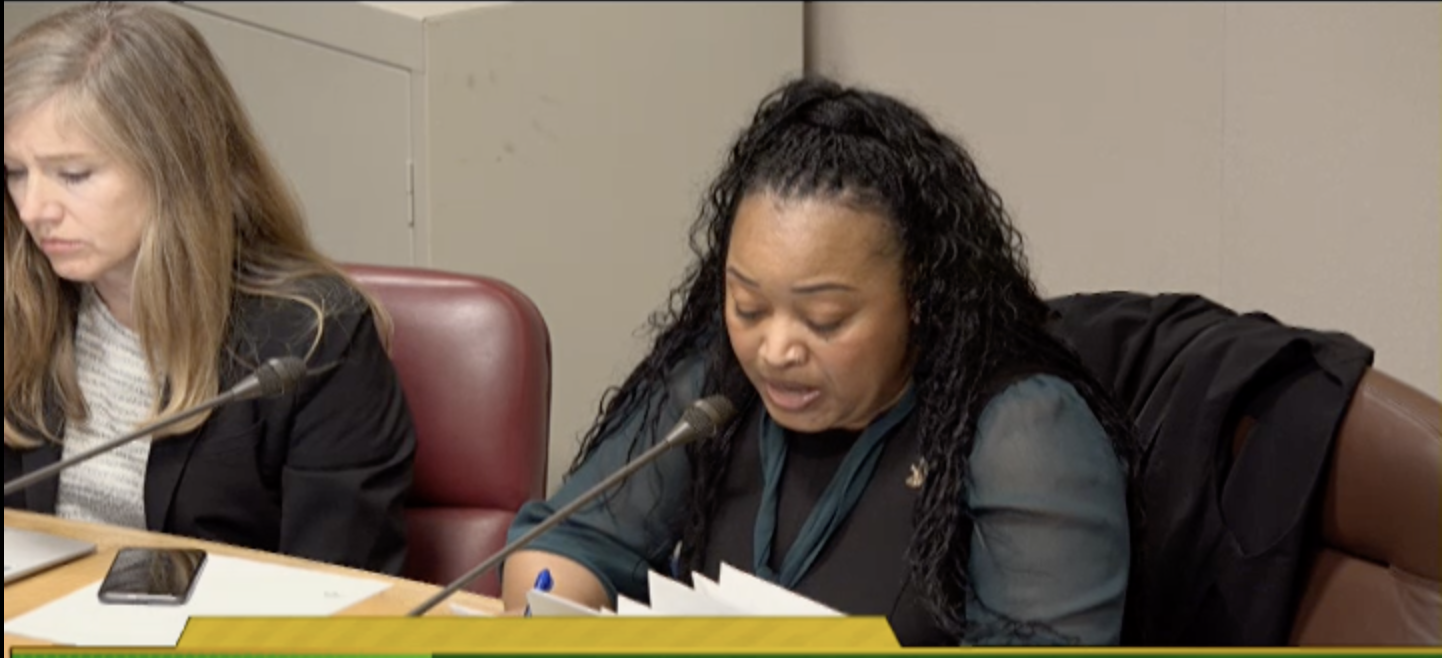
Rules & Legislation Committee - Mar 12, 2026 - Meeting
Rules & Legislation Committee • OaklandMarch 12, 2026
Locunity is a independent informational service and is not an official government page for this commission.We use AI-assisted analysis and human editorial review to publish information.
Oakland Tackles Illegal Dumping, Tightens Homelessness Accountability
Oakland's Rules and Legislation Committee moved 31 items through its scheduling gauntlet on March 12, but the real action lay in the amendments: a sweeping illegal dumping crackdown backed by Mayor Barbara Lee, new racial equity performance mandates for homelessness service providers, and a standoff over the city's parking division reorganization. Three members were present; Councilmember Carroll Fife was excused but left her mark through detailed written questions that delayed the city's 2026 Homelessness Strategic Action Plan.
Three-pronged illegal dumping offensive — a state bill, tougher local fines, and an AI surveillance pilot — advances to March 24 Public Works with the mayor's personal co-sponsorship
Homelessness Strategic Action Plan delayed to April 28 after administration can't answer council questions on no-camping zones, county accountability, and encampment pilots
Homelessness service providers face contract termination under new amendments requiring six-month performance reports with racial equity data and exit-to-housing benchmarks
Parking division reorganization stalls as the administration pulls the item and Councilmember Brown demands it go to full council, not back to committee
$3.5M library acquisition moves forward — city eyes 3105 San Pablo Avenue for new Hoover Branch Library using Measure KK bond funds
OPD GPS dispatch policy heads to Public Safety Committee as a resident asks why Oakland Fire already piloted similar technology without council approval
Dumping Down: Oakland Layers State, Local, and AI Tools
Three related items heading to the March 24 Public Works and Transportation Committee represent Oakland's most coordinated effort yet to combat illegal dumping — combining state legislative muscle, stiffer municipal penalties, and automated surveillance technology.
The basics: Item 3.4 is a resolution supporting SB 1218, a state bill by State Senator Jesse Arreguín that would block vehicle registration renewals for people with unpaid illegal dumping fines. Item 3.6 amends Oakland Municipal Code Chapter 8.1 to increase penalties for illegal dumping and make transporting waste in vehicles without license plates a separate offense. Item 3.7 approves a surveillance impact report and use policy for Aerbits, a pilot program that uses automated technology to detect and report dumping incidents, incorporating Privacy Advisory Commission recommendations.
Why it matters: Mayor Lee is personally co-sponsoring the state bill resolution, signaling City Hall's alignment with Sacramento on using DMV enforcement as a deterrent. "The mayor is requesting to co-sponsor this item. She's working closely with Senator Arreguín on the state bill," said Preston Kilgore, Deputy Chief of Staff to Mayor Barbara Lee.
Where things stand: The three items move as a package to the March 24 committee, where they'll get their first substantive public hearing. The Aerbits surveillance pilot waives local small business enterprise requirements, a trade-off that could draw scrutiny. The Privacy Advisory Commission has already reviewed the technology. Council Member Charlene Wong's office initially requested co-sponsorship on the penalties ordinance but withdrew after checking with the item's author.
What's next: March 24 Public Works and Transportation Committee will hear all three items. If Oakland's approach works, linking vehicle registration holds to dumping fines could become a model for other California cities struggling with the same problem.
Homelessness Accountability: Plan Delayed, Providers Put on Notice
Two homelessness items took different paths — the city's big-picture strategy got pushed back six weeks while funding for current programs moved forward, but with the most detailed performance requirements Oakland has ever attached to homelessness spending.
Why it matters: The split signals a council that is willing to keep spending on services but increasingly impatient with the lack of measurable results — and willing to build in consequences.
Strategic Plan Hits a Wall
The 2026 Homelessness Strategic Action Plan was originally headed for March 16 consent, but the administration requested a delay to April 28. "The administration would like to request to move this item to the April 28 special city council meeting," said administration staff.
The delay follows a detailed set of supplemental questions submitted by Councilmember Carroll Fife, who was excused from the meeting. Her questions probe several of the plan's most consequential — and politically sensitive — proposals:
Rapid diversion interventions for newly homeless individuals;
The plan's proposed "priority non-camping zones" within high-sensitivity areas and what they would actually accomplish;
Whether the co-managed encampment pilot follows models at Third and Peralta and East Lake;
Whether the county has formally agreed to its assigned roles
How Oakland will coordinate with the county on addiction and mental health services.
Fife also asked that feedback from the February 2026 Commission on Homelessness meetings be incorporated.
The other side: The administration's request for more time suggests it doesn't yet have satisfactory answers to these questions — particularly around county collaboration and the legal and operational mechanics of no-camping zones. The unanswered questions could reshape the plan's final form before it reaches the full council.
Providers Face New Performance Mandates
The HAP Winter Relief and OPRI funding item moved forward but with three substantial new further-resolved clauses. The amendments require homelessness service providers to submit six-month written reports to the Life Enrichment Committee with program-level metrics including: the percentage of clients who identify as Black or African American, exit-to-permanent-housing rates, retention outcomes at six and 12 months, and capacity utilization with benchmarks.
Providers that miss benchmarks face escalating consequences — default notices, corrective action plans, performance improvement plans, or contract termination. The performance data must also be incorporated into future funding recommendations.
"On 3.30, I talked with the chair of the committee. This is going to go on consent as opposed to non-consent," said Chair Kevin Jenkins, City Council President, who moved the item from non-consent after consulting with the Life Enrichment Committee chair.
Decisions: The item was approved as amended, 3-0, with Fife excused. The racial equity reporting requirement — specifically tracking outcomes for Black and African American clients — creates Oakland's most detailed equity accountability framework for homeless services.
What's next: The Homelessness Strategic Action Plan goes to the April 28 special council meeting. Providers receiving HAP and OPRI funds will face their first six-month reporting deadline under the new framework.
Parking Overhaul Stalls in Procedural Tug-of-War
The reorganization of Oakland's parking division hit a wall when the administration pulled the item from its scheduled March 16 council hearing, asking instead that it be placed on the Rules Committee's pending list with no date while staff complete a supplemental report.
Councilmember Rowena Brown, pushed back sharply: "Through the chair to the administration — my ask on this item is for it to go to the full council and not back to committee."
The standoff reflects more than scheduling logistics. The Public Works and Transportation Committee had already approved the reorganization and forwarded it to the full council on non-consent — a signal that members expected substantive debate. The administration's move to pull it back suggests unresolved policy questions about how parking enforcement should be restructured.
Chair Jenkins mediated, placing the item on the pending list with no date specific. "We are pending, no date specific. And then I'll work with administration and Council Member Brown's office on where it goes after that," he said.
What's next: Jenkins committed to broker where the item lands — full council or committee — but no timeline is set.
GPS Dispatch and Police Oversight Draw Public Scrutiny
The OPD vehicle GPS tracker surveillance use policy, which would enable dispatchers to identify and send the closest available patrol unit to 911 calls, was scheduled for the March 24 Public Safety Committee. The policy has been pending since a 2024 Privacy Advisory Commission review — the only public hearing it has received.
Public commenter Rajni Mandal, a District 4 resident, spoke in support but raised a pointed question about an apparent double standard. "Oakland Fire Department appears to have already implemented a pilot using GPS-enabled dispatch capability without council approval," Mandal said. "Could staff explain how that program moved forward operationally while OPD policy is still pending approval?"
Why it matters: The city auditor specifically recommended enabling GPS location in patrol vehicles to cut 911 response times. Mandal noted that the auditor's report "specifically recommended enabling GPS location capability in patrol vehicles so dispatchers can identify and send the closest available unit."
During the review of draft agendas and open forum, Mandal also requested that two police oversight reports be scheduled for council review: the Police Commission's militarized equipment use report under AB 481 and Oakland's Militarized Equipment Ordinance (OMC 9.65), and the CIPRA biannual report referenced in the city auditor's recent audit of police oversight agencies. He urged council members to consider governance and accountability structures across the city's oversight bodies — the Police Commission, CIPRA, and the Office of Inspector General.
What's next: The OPD GPS tracker policy goes to the March 24 Public Safety Committee. No response was given at the meeting to Mandal's question about the fire department's pilot.
Minor Items
Two litigation settlements totaling $350,000 approved via Rule 24 bypass for March 16 council: O'Neal and Page v. City of Oakland ($100,000) and Filmman Hagos v. City of Oakland ($250,000), both related to dangerous conditions on public property.
$3.495 million acquisition of 3105 San Pablo Avenue for the Hoover Branch Library scheduled for March 24 Life Enrichment Committee, using $242,000 in Measure KK bond funds. Councilmember Fife added as co-sponsor.
Mayor's Charter Reform Working Group informational report scheduled for March 26 Rules and Legislation Committee.
Oakland Alameda Access Project maintenance agreement moved to March 16 consent due to project urgency.
Education Partnerships Committee rescheduled to April 13 at 3:30 p.m.
CED relocation agreement item rescheduled to April 21; Life Enrichment Committee ordinance impact report also moved to April 21.
Both votes at the meeting — Item 3 (scheduling of 31 items as amended) and Item 4 (draft agendas and pending list as amended) — passed 3-0 (For: Brown, Ramachandran, Jenkins; Absent: Fife).