
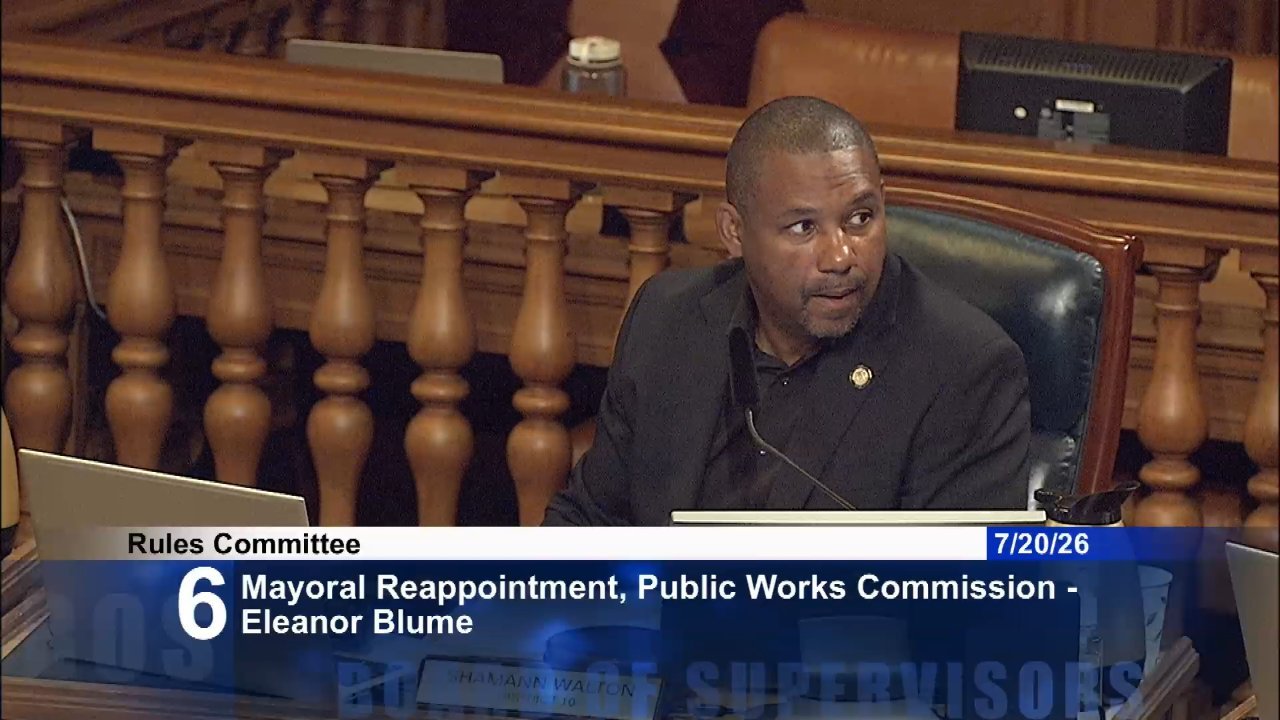
Rules Committee - Jul 20, 2026 - Regular Meeting
Rules Committee • San FranciscoJuly 20, 2026
Locunity is a independent informational service and is not an official government page for this commission.We use AI-assisted analysis and human editorial review to publish information.
Grocery Affordability Push Stalls at City Hall as Mahmoud Pivots
The San Francisco Rules Committee moved briskly through seven commission reappointments Monday but hit a political wall on food policy — tabling Supervisor Mahmoud's twin grocery affordability proposals after he acknowledged the votes had slipped away. The defeat sets up a legislative pivot: Mahmoud announced a new package of grocery-access measures for the next day, while community advocates alleged corporate pressure killed the original bills.
- Supervisor Mahmoud's Affordable Groceries Act — a new fund and a vacancy tax on "zombie stores" — tabled 3-0 after losing votes at Budget Committee
- Tenderloin advocate alleges Amazon/Whole Foods pressured the mayor's office to kill the grocery vacancy tax
- Board of Appeals president reports appeals down 50% from 10-year average, citing state and local legislation
- PUC President Joshua Arce reappointed, touting $12.5 billion capital plan and ratepayer affordability
- Planning Commissioner Lydia So advances as committee report, praised for Stonestown approval and Cantonese community engagement
Affordable Groceries Act Dies on the Table
Supervisor Mahmoud brought two linked proposals he branded the Affordable Groceries Act: an Affordable Grocery Fund (file 260694) to subsidize corner store conversions, fund grocery build-outs, and purchase property for affordable grocery leasing, and an excise tax (files 260693/260823) targeting large corporations holding former grocery stores and pharmacies vacant — what he called "zombie stores."
Why it matters: Food deserts are expanding in neighborhoods like the Tenderloin and Fillmore as chain grocers leave. The proposals were modeled on New York City's approach to grocery access, and would have created the city's first dedicated funding mechanism to fight grocery inflation at the neighborhood level.
Where things stand: Mahmoud revealed the vacancy tax had been blocked before it could even reach the Budget Committee — a procedural move he said was unprecedented for a ballot measure before the Board. He acknowledged he no longer had the votes to advance the measures.
"They came in years ago, priced out local grocers. They raised prices that contribute to the affordability crisis that we are in now today. And then they left the neighborhoods they claimed to support and maintained the properties they left as zombie stores to deter competition," said Supervisor Mahmoud.
He framed the setback as ideological rather than substantive: "I recognize that while there is not consensus in City Hall on how to address this issue today due to ideological differences on the utility of taxation and corporate accountability as solution frameworks, I know and believe that there is a will in our city to still address the underlying issues of food insecurity."
Chair Shamann Walton shut down Mahmoud's attempt to continue the items rather than kill them outright. "I know you want to ask for continuance, but I see no reason to continue items that we won't be hearing anymore. So I'm going to make a motion to table," Walton said — a move that signals a permanent end to the current legislative vehicle rather than a postponement.
The other side: Public commenters rallied behind the measures. A speaker from Indivisible SF cited Zillow data showing San Francisco rents up 19% in 12 months, urging the committee to prioritize community health over corporate interests. David Elliot Lewis, chair of the Tenderloin People's Congress, painted a bleak picture of his neighborhood — no pharmacy, no full-service grocery store, only corner stores selling unhealthy food. He alleged that Amazon and Whole Foods had pressured the mayor's office to block the legislation, pointing directly to the shuttered 54,000-square-foot Whole Foods on Market Street.
"It appears that because part of this act would involve a tax against Amazon's very large 54,000-square-foot property on Market Street, the closed grocery store, Whole Foods, that they pushed back on the mayor to kill this," Lewis said.
What's next: Mahmoud announced he would introduce alternative legislation the next day, including restoring the Healthy Retail Program for corner store conversions, expanding a "first year free" permit program for grocery startups, creating a Storefront Opportunity Grant for capital build-outs in food desert neighborhoods, and legislating density bonuses for housing developments that incorporate grocery stores — modeled on New York's FRESH program. The tabling vote was 3-0 (Supervisors Sherrill, Mandelman, and Walton all voting aye).
Appeals Down 50%: Trasvina Flags a Structural Shift in Land Use
Board of Appeals President John Trasvina was unanimously reappointed, but his testimony doubled as a policy briefing that should interest anyone tracking development in San Francisco.
Why it matters: Trasvina reported that the Board of Appeals handled just 53 cases in the past year — a 50% decline from the 10-year average. He attributed the drop directly to state and local legislation that has reduced public opportunities to challenge land use decisions. That's a significant structural shift: fewer appeals means faster project timelines, but also less community-level oversight of development.
"This past year, we have 53 appeals. That's down by 50% over our 10-year average. And it's indicative of the legislation, both at the local level and the state level, that you have passed to reduce the opportunities for the public to challenge various matters," Trasvina said.
He noted that 89% of cases involve land use and 87% are decided within 75 days. Despite the declining caseload, Trasvina emphasized the stakes for individual appellants, quoting former Mayor Art Agnos, who told him the Board of Appeals was "the people's court."
Board of Appeals Vice President Rebecca Soroyan praised Trasvina's perfect attendance record. Forrest, a public commenter, cited Trasvina's work on Stop Asian Hate and the Vijay Tanapakhti case. The committee voted 3-0 to forward the reappointment to the full board.
PUC President Arce Reappointed, Eyes $12.5B Capital Plan
Joshua Arce, president and ratepayer advocate of the San Francisco Public Utilities Commission, won unanimous reappointment to a four-year term after outlining three priorities: keeping rates affordable amid long-term cost pressures, leveraging the PUC's massive capital plan for local jobs and contracting, and increasing the agency's contribution to the city's Climate Action Plan.
"We have a $12.5 billion ten-year capital plan at the Public Utilities Commission that can do so much good in terms of economics along the way," Arce said, pointing to local business enterprise policies and the local hire ordinance as tools to spread that investment.
He also offered a striking geographic fact: only one-third of PUC water customers are San Franciscans. The remaining roughly 1.7 million customers are spread across San Mateo, Santa Clara, and parts of the East Bay — a dynamic that shapes rate-setting politics and infrastructure priorities.
Olga Miranda, president of SEIU Local 87 and secretary-treasurer of the San Francisco Labor Council, testified in strong support, praising Arce's work ethic and community dedication. Chair Walton suggested reviving PUC water system tours for community partners. The vote was 3-0.
Planning Commissioner Lydia So Advances as Committee Report
Commissioner Lydia So, who has served on the Planning Commission since April 2024, was reappointed and sent to the full board as a committee report — a procedural step that signals strong confidence and fast-tracks confirmation.
So highlighted her role in approving the Stonestown redevelopment, which will bring more than 2,500 homes at all income levels, as well as office-to-housing conversions and the Housing Trust Fund. She noted attending a Sunset Community Town Hall conducted entirely in Cantonese.
"I'm proud to have supported projects and policy that are helping move our city forward. That includes approving the Stonestown redevelopment, which brings more than 2,500 homes for residents at all income levels, advancing office-to-housing conversions and adaptive reuse to help revitalize downtown," Commissioner So said.
Board President Rafael Mandelman praised her broad support across communities that don't always agree. Brian Kwon, a democratic club organizer, emphasized So's Cantonese literacy as essential for engaging monolingual immigrant communities. The vote was 3-0.
A Commission That Oversees a Department That "No Longer Exists"
Kimberly Hartwig Shulman was reappointed to the Sanitation and Streets Commission after four years of service as member, vice chair, and chair. But Board President Mandelman delivered a notable aside that underscored the odd bureaucratic moment.
"I want to thank Commissioner Hartwig Shulman for your service on this commission, which is important even if you are overseeing a department that no longer exists," Mandelman said. "We'll see what the voters want to say in November about the continued existence of the commission."
Shulman cited 24 years as a San Francisco resident and 17 years working for city nonprofits, including a decade at community benefit districts. The vote was 3-0 — but the commission's own future heads to the November ballot.
Robin Abad Ocubillo Returns to Board of Appeals
Board President Mandelman reappointed Robin Abad Ocubillo to the Board of Appeals, reading an extensive civic résumé into the record: 10 years at the SF Planning Department working on Shared Spaces and the COVID response, the Central Waterfront/Dogpatch plan, and Eastern Neighborhoods Community Advisory Committee coordination. Ocubillo currently serves as citywide ombudsperson in Oakland's City Administrator's Office, working on permitting reform, outdoor vending, and vacant storefronts.
His community board affiliations include the Bicycle Coalition, Lyric, Friends of Harvey Milk Plaza, Youth Art Exchange, Illuminate the Arts, and Yerba Buena Center for the Arts, plus two decades volunteering with the Pink Triangle on Twin Peaks and Frameline.
Board of Appeals President Trasvina and Vice President Soroyan both testified enthusiastically, highlighting Ocubillo's technical planning expertise as a valuable asset to the board. The vote was 3-0.
Minor Items
- Lindsey Maclise reappointed to the Building Inspection Commission (3-0). Maclise, a structural engineer with 20 years of San Francisco experience, flagged particular interest in the planned DBI merger and its impact on permitting services.
- Eleanor Blume reappointed to the Public Works Commission in absentia (3-0).