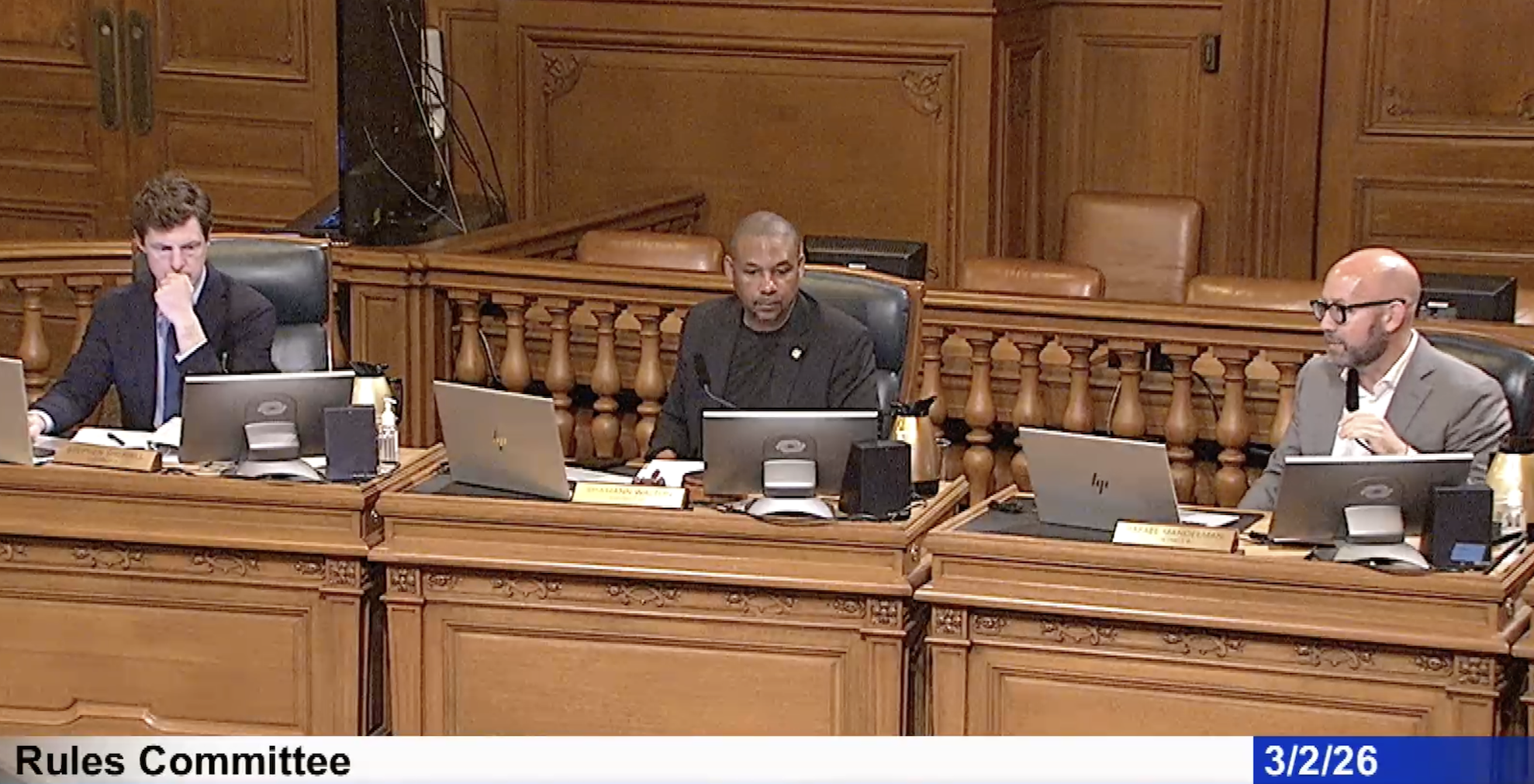
Rules Committee - Mar 02, 2026 - Regular Meeting

Rules Committee - Mar 02, 2026 - Regular Meeting

Rules CommitteeSan FranciscoMarch 2, 2026

Sources:

Locunity is a independent informational service and is not an official government page for this commission.We use AI-assisted analysis and human editorial review to publish information.

SFPD's GPS Pursuit-Alternative Heads to Full Board With Civil Rights Guardrails

The San Francisco Rules Committee moved quickly through a compact two-item agenda Monday, but the meatier debate centered on whether the police department's use of a GPS dart that attaches to fleeing vehicles has adequate privacy and civil rights protections. The committee also filled a vacancy on a property tax appeals board.

  • SFPD's StarChase GPS tracking policy, deployed 17 times in its first year, advances to full Board after Chair Walton presses on data security and immigration enforcement safeguards

  • Administrative law judge Elena Rifkin appointed to Assessment Appeals Board #3 with a residency waiver, filling a vacancy on the panel that hears property tax disputes

  • Both items passed 3-0 with no public comment on either


StarChase Policy Sets Rules for GPS Pursuit Alternative

The basics: San Francisco's Administrative Code 19B requires city departments to adopt formal surveillance technology policies before deploying certain tools. SFPD brought its policy governing electronic location tracking devices — GPS trackers, radio frequency identification, RF beacons, and the StarChase system — to the Rules Committee for review. StarChase fires a small GPS dart onto a fleeing vehicle, allowing officers to track its location and disengage from a high-speed chase.

Why it matters: Vehicle pursuits are among the most dangerous activities in urban policing, threatening officers, suspects, and bystanders. StarChase has been in pilot use under Proposition E, the 2024 ballot measure that expanded SFPD's technology toolkit. This policy formalizes the guardrails: who can use the technology, what data is collected, how long it's retained, and what uses are explicitly banned.

Where things stand: Lt. Brent Bradford, SFPD, told the committee that the policy limits are clear.

"These devices shall not be used to monitor, harass, intimidate or discriminate based on protected characteristics, to...enforce prohibitions of gender-affirming care, reproductive care or related travel, any civil immigrant enforcement purpose consistent with San Francisco Sanctuary City Ordinance and or the California Values Act."

Bradford made the operational case for StarChase as a pursuit alternative, stating it will:

  • provide officers with an alternative to high risk vehicle pursuits

  • allow officers to disengage while maintaining location awareness

  • supports safer apprehension methods reducing safety risk to the public

The deployment numbers back up the pitch. From December 2025 to December 2025, StarChase was deployed 17 times, all successfully. Officers were able to safely apprehend subjects, recover stolen vehicles, and coordinate officer efforts across the city (and with Oakland for at least one case).

Bradford walked through a Sept. 12, 2025, case that illustrated how SFPD layers its new technology. A Flock license plate reader flagged a stolen vehicle, a drone from the Real Time Investigative Center (known as ARTIC) monitored the car's movements, and a StarChase dart was deployed. The suspect was ultimately apprehended in Oakland — without a high-speed pursuit.

Data Security and Civil Rights Questions

Chair Shamann Walton (District 10), pressed SFPD on several fronts. He asked how the data is secured and who, SFPD would share the information with.

In his presentation Bradford claimed that SFPD is the sole "custodian" of the collected data, but when questioned, acknowledged that StarChase holds data on its own servers with a three-year retention period. Bradford said the company does not share data directly with outside agencies. On the question of who gets access, Bradford was specific:

"We would share only with other law enforcement agencies at a city or state level, not with a federal. Not when you're not dealing with an ICE sharing or anything that would impede upon someone's right for reproductive rights. It would just be through a law enforcement agency. And we'd have to have make sure the commanding officer of that unit that's doing the sharing is making sure all those criteria are met."

Walton also pushed on protections for uninvolved residents. "How do we ensure that regular everyday residents who are going on about their business, how do we ensure that their civil rights or their right to privacy is not violated?," he asked. Bradford responded that StarChase is GPS-only tracking with no video or audio capability: "In this instance, the StarChase itself is just a GPS or a tracker. So no one else outside of that would be involved or would have their civil rights even touched."

Decisions: Board President Rafael Mandelman (District 8), a co-sponsor of the ordinance, moved to send the policy to the full Board of Supervisors without recommendation. "I believe this technology is important and the policy is important to get this to the full board," he said. The motion passed 3-0.

What's next: The full Board of Supervisors will take up the surveillance technology policy at a future meeting. Approval would formalize the civil rights guardrails and oversight requirements for a GPS pursuit-alternative technology already in active use.


ALJ Appointed to Tax Appeals Board

Why it matters: Assessment Appeals Boards hear disputes from residents and businesses who believe their property tax assessments are wrong — work that demands both legal skill and patience. A vacancy on Board No. 3 needed filling.

Elena Rivkin, an Administrative Law Judge with the California Unemployment Insurance Appeals Board since 2023, presented her credentials. She described conducting approximately 31 hearings per week, primarily with self-represented litigants. Before her current role, she practiced real estate litigation handling title disputes, quiet title actions, partition actions, and mortgage finance. She noted foundational knowledge of Proposition 19 and a basic understanding of estate planning.

Chair Walton acknowledged the nature of the work and offered thanks that Rivkin was willing to serve: "Our appeals board, the work is necessary, but it can also be tedious. A lot of information and a lot of hours to be put into this work."

Decisions: The committee voted 3-0 to appoint Rivkin to seat three with a residency requirement waiver and forward the appointment to the full Board with a recommendation for approval..