
Hotel Cleaning Lawsuit Bill Advances as Labor, Industry Keep Negotiating
Rules Committee • San FranciscoNovember 9, 2026
Locunity is an independent informational service and is not an official government page for this commission. All information is sourced from public footage and an analysis of official agendas with the aid of responsible, fact-checked AI. to report an error or omission.
San Francisco hotel workers moved a step closer to taking their employers to court over skipped cleanings. On Nov. 9, 2026, the Rules Committee voted 3-0 to send the full Board an ordinance letting tourist hotel employees or their union sue to enforce the city's Healthy Building Ordinance. The committee also kept a duplicate version in committee so labor and hotel owners can keep negotiating. The panel also cleared a Port seawall exemption and four Immigrant Rights Commission appointments, all unanimously.
- Hotel worker private right of action forwarded 3-0 after UNITE HERE Local 2 housekeepers faced off with hotel owners
- Duplicate hotel bill held in committee for talks on Department of Public Health (DPH) complaint findings, inspections and notice
- Port seawall projects win exemption recommendation 3-0; staff say each year of delay could cost $31M to $110M
- Four Immigrant Rights Commission appointments advance 3-0, including one new member and a residency waiver
Hotel Workers Move Closer to Suing Over Cleaning
The basics: The 2020 Healthy Building Ordinance set cleaning standards for hotels. A "private right of action" lets workers or their union sue to enforce a law directly instead of waiting for a city agency to act.
Why it matters: Bill sponsor Supervisor Chan said the existing standards are hard to enforce. The bill would give hotel workers court leverage and expose hotel owners to new litigation risk.
Where things stand: Chan proposed splitting the bill in two. "I am therefore asking the committee to duplicate the file and forward the original to the full board with a positive recommendation," said Supervisor Chan. Both versions were amended to delete page 9 language listing factors courts may consider when setting civil penalties. On the duplicate, Chan is working with the City Attorney on three more changes: a DPH finding that a complaint is credible, a timely inspection and notice to the person who complained.
"Our city has already established the standard, and we are now needing to make sure that those standards are enforceable," Chan said.
Supervisor Matt Dorsey said his 14 years in the City Attorney's Office left him with mixed feelings about the bill. He said requiring a DPH finding addressed concerns about baseless lawsuits. He also noted that city laws already allow private suits over minimum wage, paid sick leave, stormwater flood risk disclosure, and residential demolition and tenant protections. "I'm unsympathetic to shielding violators of duly enacted laws," Dorsey said. He argued that outdated rules should be changed through legislation, not left unenforced.
Labor shows up in force: Lizzie Tapia, president, UNITE HERE Local 2, said the union narrowed the bill after its 2024 hotel negotiations and a three-month strike, so that it now focuses only on enforcing the existing ordinance. Kim Cavallone of the San Francisco Labor Council said the bill targets only bad actors. Housekeepers described the toll of cleaning rooms that go days without service. Janet Wong, a Hilton housekeeper of 26 years, said those rooms are harder and more painful to clean. Housekeeping inspector Rose Sia warned that skipping daily cleaning leads to layoffs. Servers Gloria Leung and Kamucha King tied daily housekeeping to guest trust and the tourism recovery.
The other side: Alex Bashian, CEO, Hotel Council of San Francisco, presented a gallery of hotel owners and operators. He urged a compromise worked out together and said the industry has not yet recovered. Ike Kwan of San Francisco Travel asked for time for hotels to respond to complaints and for clarity on how fines apply to rooms and time periods. Ankit Panchal of the Asian American Hotel Owners Association warned of litigation costs and uncertainty. He asked for clear notice and a chance for hotels to fix problems before facing suits.
Decisions and stakeholder impacts: The amendment, the forwarded original and the continued duplicate each passed 3-0 (For: Dorsey, Mandelman, Walton; Against: 0). "I am prepared to support this moving to the full board with positive recommendation," said Supervisor Rafael Mandelman, District 8. Supervisor Shamann Walton, District 10, who chairs the committee, said, "It not only protects our workers, but it also protects the public and the people who utilize our hotels."
What's next: The original bill heads to the full Board. The duplicate stays in committee until the chair schedules it, which keeps a negotiated alternative available.
Port Seawall Work Skips Repeat Feasibility Studies
The basics: Chapter 29 of the city's Administrative Code requires a fiscal feasibility study before environmental review under the California Environmental Quality Act (CEQA). The rule applies to projects over $25M that use at least $1M in public funds. The Port's Waterfront Resilience Program meets both thresholds.
Why it matters: Helen Balawager, an analyst with the Port's Waterfront Resilience Program, said each Chapter 29 report takes six to nine months. She said the requirement would be triggered repeatedly over the program's 30-year span, and that "each year of project delivery delay could add $31 to $110 million in present value terms to the program as well."
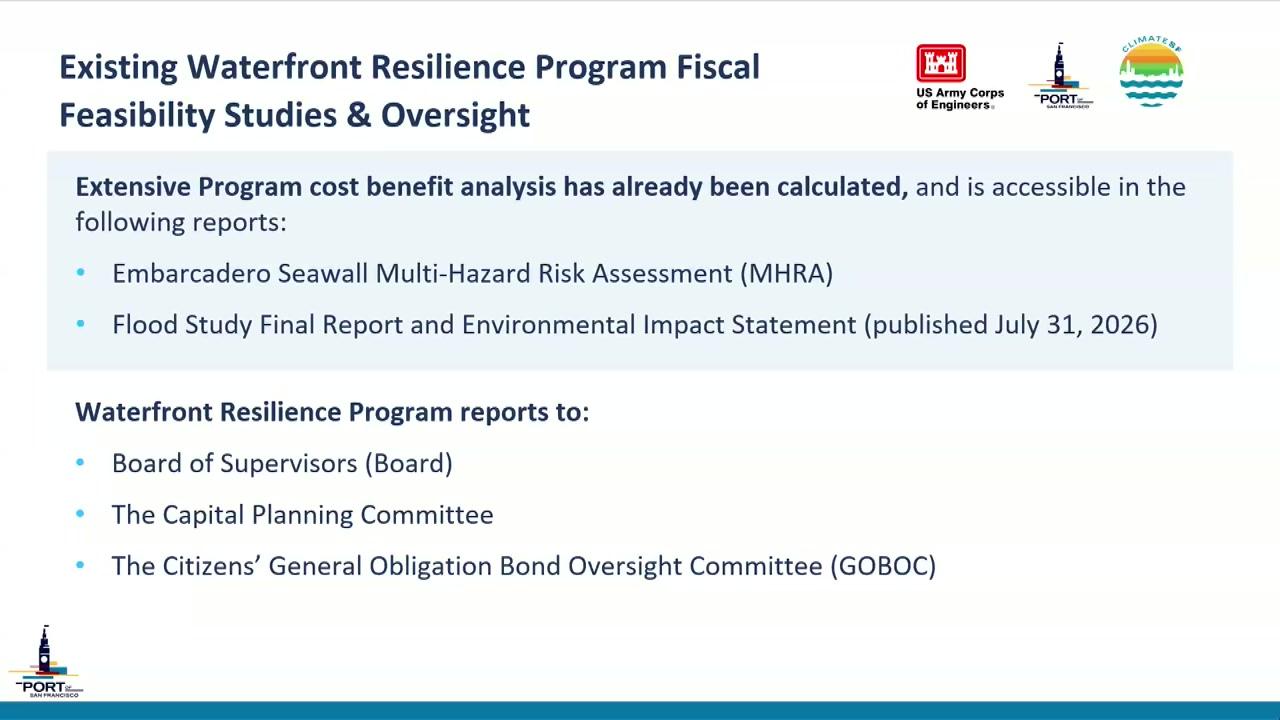
Where things stand: Balawager said the Port has already done feasibility and cost-benefit work. That includes the 2020 Embarcadero Seawall Multi-Hazard Risk Assessment and a July 2026 flood study final report and environmental impact statement. The Port also reports regularly to oversight bodies on the 2018 Prop A $425M seawall bond. She noted the Board granted similar exemptions to SFMTA and SFPUC in 2018. Port staff said completing CEQA makes the program more competitive for outside funding.
Co-sponsor Dorsey, who carries the bill with Mandelman, called it a good-government fix. He said the safeguard still applies to discretionary projects. He cited king tides, El Niño and flood exposure in South Beach, Mission Bay and Mission Creek. "Strengthening the seawall and defending our waterfront against flooding and earthquakes isn't discretionary," Dorsey said.
The other side: One public commenter supported the exemption but asked that data and figures stay available to the public over the long-term program.
Decisions and stakeholder impacts: The committee forwarded the ordinance with a positive recommendation (For: Dorsey, Mandelman, Walton; Against: 0). Waterfront neighborhoods and bond watchdogs gain speed but lose one formal checkpoint.
What's next: If the Board approves, the Port plans to submit its CEQA application to SF Planning by year end.
Immigrant Rights Commission Gets Three Returns, One Newcomer
Where things stand: Five seats were open, and four applicants applied. The committee recommended:
- Reappointing Jesse Ruiz Navarro (seat 1)
- Appointing Cesar Perez Marino (seat 2)
- Reappointing Laura Padilla (seat 5)
- Reappointing Adubo Traore (seat 9), with a residency waiver
Perez, a Venezuelan immigrant who works at Meta, described how the city helped him. Padilla, a District 11 resident, cited her work on protections and language access. Ruiz Navarro was absent due to an emergency.
Jorge Rivas, director, Office of Civic Engagement and Immigrant Affairs, backed the three reappointments. Sarah Souza, chair, Immigrant Rights Commission, cited the commission's focus on economic opportunity, health access and human rights. Public commenter John Ellis urged appointees to use data to fix problems that span city agencies and to report results publicly.
Decisions and stakeholder impacts: The appointments passed 3-0 (For: Dorsey, Mandelman, Walton; Against: 0). One seat remains unfilled.
Minor Items
- Vice Chair Sherrill excused, 3-0; Dorsey substituted and cast votes on every item.
Looking Ahead
The full Board will take up the hotel enforcement bill, the Port exemption and the commission slate. Watch whether labor and hotel owners reach a deal on the duplicate bill before the Board votes on the original.