Rules Committee - Mar 23, 2026 - Regular Meeting
Rules Committee • San FranciscoMarch 23, 2026
Locunity is a independent informational service and is not an official government page for this commission.We use AI-assisted analysis and human editorial review to publish information.
Treasure Island's Future Takes Shape as New Board Members Weigh Tolling, Housing Expansion
The San Francisco Rules Committee unanimously advanced five mayoral nominations on March 23 — two SFMTA board reappointments, two new Treasure Island Development Authority board members, and one redevelopment oversight seat — but it was the unresolved question of congestion tolling on Treasure Island that dominated the hearing. The TIDA appointments surfaced a sharp policy split: one nominee backs tolling as essential demand management, the other warns it would hurt lower-income residents, and supervisors acknowledged the city has debated the issue for nearly eight years without resolution.
Two new TIDA board members approved as island weighs major housing expansion and congestion pricing
SFMTA board reappointments advance amid fiscal uncertainty; first Latina member highlights equity for Latinx riders
Supervisor Mandelman says a decision on Treasure Island tolling "is going to have to get made" after nearly eight years of debate
TIDA Board president teases major development announcements in the coming months
All five nominations head to the full Board of Supervisors on April 7
Tolling Divide Defines New TIDA Board Appointments
The two new appointments to the Treasure Island Development Authority Board of Directors consumed the bulk of the committee's time — and produced the meeting's substantial policy exchange.
Why it matters: Treasure Island's development plan envisions housing tens of thousands of people on roughly one square mile. Decisions about congestion tolling, transit investment, and the number of units built will shape San Francisco's housing supply and transportation network for decades. The two new board members land on opposite sides of the tolling question.
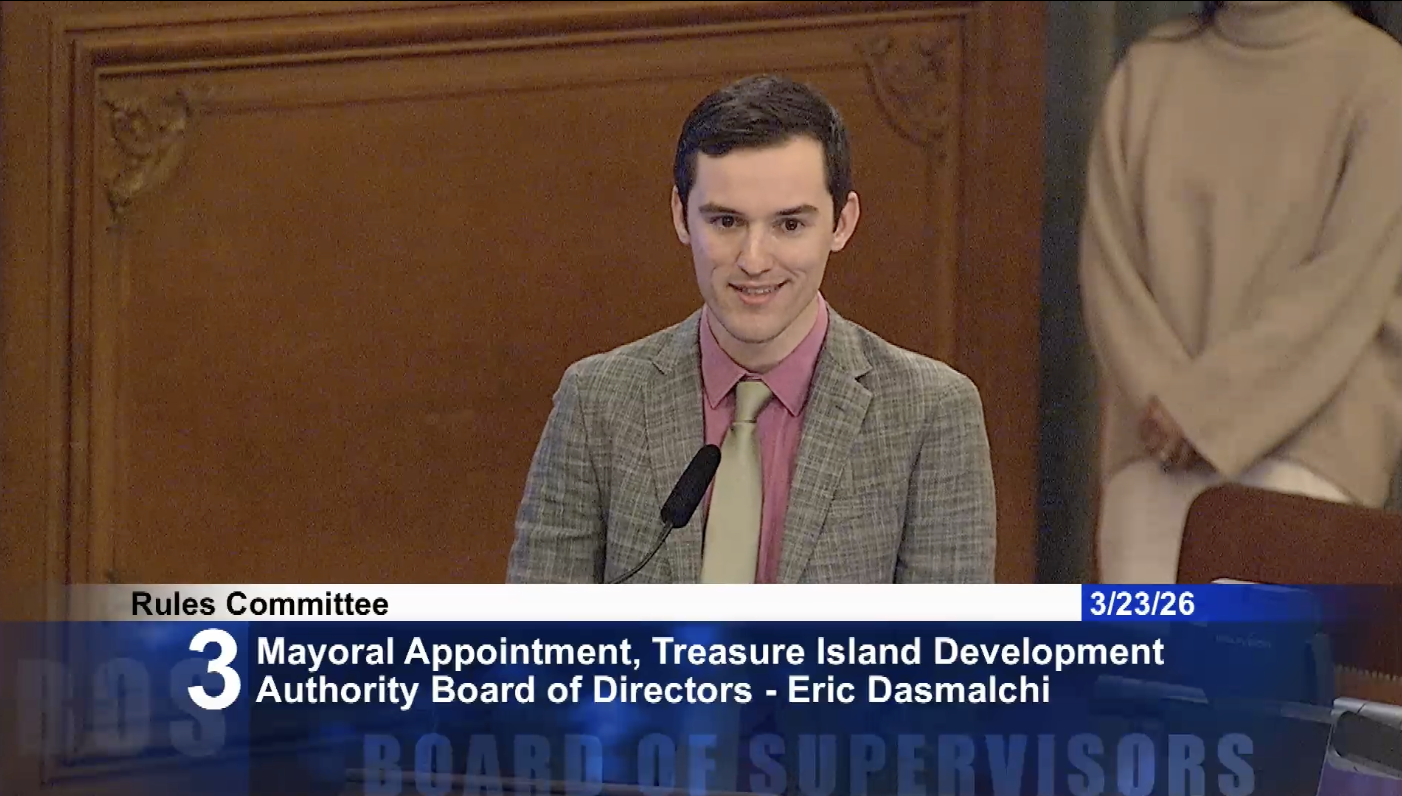
Where things stand: Eric Dasmalchi, a Treasure Island resident with urban planning degrees from UC Berkeley and UCLA, told the committee the island needs to be treated like any mainland neighborhood with equal city services. He supports the congestion toll that was mandated by the project's environmental impact report, framing it as both a traffic management necessity and a revenue source.
"I want to make sure we have the transit. I want to make sure we have other options. And I also know that when people are sitting in traffic, that time disappears. When people pay a toll, that creates revenue," said Dasmalchi.
He also flagged a proposal to substantially increase the number of housing units planned for the island beyond the current entitlements.
Timothy Kojo Minta, a tech executive at Adobe with degrees from the University of Pennsylvania and the London School of Economics, took a different view. Drawing on his experience observing London's congestion charge, he expressed concern about disproportionate impacts on lower-income communities.
"My gut reaction is I am not really leaning towards the idea of a toll just because of the disproportionate impact it has on lower-income communities," said Koja Minta. "But I think it's an issue that I really want to study in depth and understand every aspect of it before coming to a full conclusion."
The other side: Chair Shamann Walton pressed both nominees, making clear his skepticism about tolling residents to reach their own homes. "I definitely hope that looking at alternatives for resources other than taxing people just to get home — taxing people to go to and from work — is something that is always prioritized when we have this conversation," Walton said.
Walton also tested Kojo Minta's independence, asking directly whether he intended to serve the mayor or the residents. Kojo Minta responded: "It's for the residents of the island. I'm grateful for the opportunity that the mayor has provided me, but ultimately it comes down to being able to make an impact on the community."
Supervisor Rafael Mandelman offered the meeting's most pointed institutional commentary, noting the Board of Supervisors and Transportation Authority have spent nearly eight years discussing island tolling without reaching a conclusion. "We've spent a lot of time talking about tolling at Treasure Island," Mandelman said. He acknowledged that congestion pricing "can be a good tool, and it can be used equitably if you're using the revenue that is generated from the tolling for equitable purposes. But it's been a very hard thing to do at Treasure Island."
TIDA Board President Linda Fadeke Richardson appeared in public comment to endorse both nominees and signaled that new development milestones are imminent. "Treasure Island development is driving San Francisco's economy," Richardson said. "We have major announcements that we'll be making in a couple of months."
Community voices reinforced support. Mi Sun Boyce, owner of Mercy restaurant on Treasure Island for eight years, described her deep ties to the island, including partnering with One Treasure Island to provide 200 free meals weekly for a year during the pandemic and hiring 60% of her staff from island residents through Health Right360 and Job Corps programs. Manuel Rodriguez, associate vice president of government relations at the YMCA of San Francisco, endorsed Kojo Minta based on his fundraising and board service for the Urban Services YMCA from 2012 to 2016.
Decisions: Both nominees were approved 3-0 (For: Walton, Sherrill, Mandelman; Against: none; Absent: none).
What's next: Both appointments go to the full Board of Supervisors on April 7. The tolling question remains unresolved, but Richardson's promise of major development announcements suggests decisions on the island's buildout are accelerating.
SFMTA Board Reappointments Advance Amid Fiscal Headwinds
Why it matters: The SFMTA faces significant budget deficits, and both reappointed board members framed transit as a tool for equity and neighborhood transformation during a period of fiscal austerity.
Dominica Henderson, a current SFMTA board member born and raised in San Francisco by public servants — including a retired Muni operator — highlighted recent agency achievements: the launch of the Baby Shuttle micro-transit service, ridership gains on the 22 line exceeding pre-pandemic levels, and lessons learned from revising street improvement projects.
"Speaker Emerita Nancy Pelosi said that transportation is transformation," Henderson told the committee. "Even during this time of fiscal uncertainty and difficulty financially for MTA, I'm really excited at the chance to continue to work, to use transportation as a transformation tool for neighborhoods and communities in San Francisco."
Chair Walton praised Henderson's genuine community engagement, noting she actually rides Muni and talks to residents about their concerns.
Stephanie Cajina, the current SFMTA vice chair, emphasized equity and representation. "I am a proud Latina and the first Latina to serve on the SFMTA Board of Directors," Cajina said. "Today, approximately 28% of the SFMTA's ridership is Latinx." She said equity must remain at the center of decisions on service reliability, safety, and financial sustainability.
Decisions: Henderson was approved 3-0; Cajina was approved 3-0 (For: Walton, Sherrill, Mandelman; Against: none; Absent: none). Both terms run through March 2030.
What's next: Both reappointments go to the full Board of Supervisors on April 7.
Minor Items
Redevelopment Oversight Board reappointment: Anna Van Degna, the city's public finance director, was unanimously reappointed (3-0) to the Redevelopment Successor Agency Oversight Board, where she has served since 2020. The board approves the annual Recognized Obligation Payment Schedule before submission to the state and reviews proposed tax increment debt issuance. No public comment. Heads to the full board April 7.