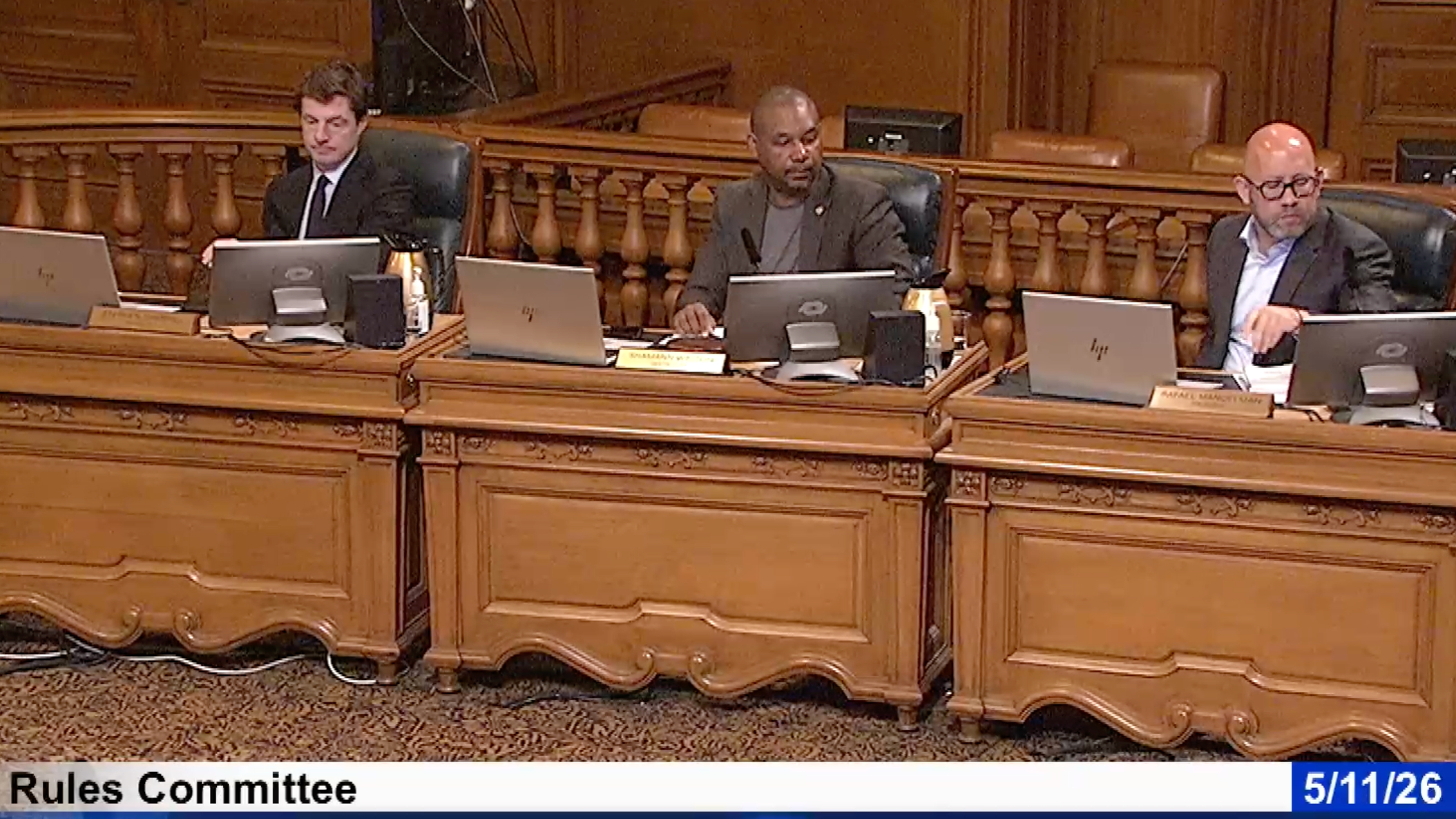
Rules Committee - May 11, 2026 - Regular Meeting
Rules Committee • San FranciscoMay 11, 2026
Locunity is a independent informational service and is not an official government page for this commission.We use AI-assisted analysis and human editorial review to publish information.
Downtown Liquor License Plan Advances Under Protest at Rules Committee
San Francisco's Rules Committee forwarded a mayor-backed ordinance creating up to 15 new below-market restaurant liquor licenses downtown to the full Board of Supervisors — but without a recommendation, a rare rebuke reflecting all three supervisors' frustration at being rushed. The committee also unanimously advanced a new hate crime reward fund and confirmed a Treasure Island board reappointment.
15 new low-cost liquor licenses for downtown restaurants sent to full board without recommendation after supervisors slam rushed process
Hate Crime Reward Fund modeled after existing homicide reward program advances unanimously
Existing bar and restaurant operators warn of oversupply as 40 unused liquor licenses already sit idle at the state
Supervisors Push Back on Downtown Liquor License Fast-Track
The basics: State Senator Scott Wiener's SB395 authorizes San Francisco to create a Downtown Hospitality Zone where the Department of Alcoholic Beverage Control could issue new, non-transferable restaurant liquor licenses at roughly $20,000 — a fraction of the $100,000–$150,000 price on the secondary market. California caps liquor licenses by county population, and San Francisco has exceeded its cap for 80 years, creating a costly barrier for new restaurant operators.
Why it matters: The ordinance sits at the intersection of downtown's post-pandemic recovery push and the financial survival of existing operators who invested heavily in their own licenses. With 40 full liquor licenses currently parked at the ABC and convention business still well below 2019 levels, the question is whether cheaper licenses would catalyze new restaurants or undercut businesses already struggling.
Where things stand: The Office of Economic and Workforce Development proposed amending the original 20-license cap down to 15 — a compromise between existing operators who wanted 10 and downtown stakeholders who supported 20. Ben Van Houten, OEWD Director of Nightlife Initiatives, explained the rationale:
"In talking with existing operators, they had requested 10. In terms of conversations that we've had with downtown stakeholders who have felt confident that the full area can absorb all 20, 15 felt like an appropriate compromise."
Van Houten emphasized that the licenses would be non-transferable, meaning they cannot be resold at a premium.
"The idea of the non-transferability of these licenses is intended to honor that it is not an asset to be sold at a price exceeding that application fee," he said.
But all three supervisors were visibly frustrated at the compressed timeline. Chair Shamann Walton admonished OEWD for contacting supervisors' offices only one week before the hearing:
"You reached out last week — that means we would have had no time to understand the policy, understand unintended consequences, understand how this may affect other businesses."
Van Houten acknowledged the delay, explaining that stakeholder engagement contributed to the March introduction:
"We had hoped to have a full sense of stakeholder feedback before we even introduce this item, which is what I think contributed to the delay."
Supervisor Stephen Sherrill questioned the demand basis for the license count.
"It would be great to understand what those numbers are because right now it feels like 10, 15, 20 is a bit of a finger in the air," he said.
He acknowledged the licenses appear attractive on paper, but said he lacked the information to vote with confidence.
Board President Rafael Mandelman was blunt:
"It feels a little bit like we're being jammed. We haven't had really an opportunity to wrap our brains around the legislation in the first place."
He proposed the dual-track strategy the committee ultimately adopted — sending the amended ordinance to the full board without recommendation while keeping a duplicate file in committee.
The other side: Public comment split sharply. Marisa Rodriguez, CEO of the Union Square Alliance, supported the ordinance, arguing the area could absorb 50 new businesses and that reducing barriers for new restaurants would signal to conventions and tourists that San Francisco has recovered. She noted 12,000 hotel rooms in the area and proximity to the convention center.
A public commenter who identified as a downtown bar and restaurant operator pushed back. He cited 40 full liquor licenses currently parked at the ABC with declining values — one recently sold at $90,000. The ABC had recently sent notices to those license holders requiring them to sell, deploy, or forfeit. He argued that high insurance costs, labor costs, and convention business still 300,000 room nights below 2019 levels make this the wrong time to flood the market, and he requested a continuance to help specify where licenses should go.
Deputy City Attorney Brad Russi added a legal wrinkle, noting that SB395's July 1 effectiveness date creates ambiguity:
"If it's required that the ordinance become effective by July 1, then there really isn't time because the second meeting will be the second of June and then the mayor has to sign and it's not effective until 30 days."
He said he needed to consult with the legislation's drafters for clarity.
Decisions: The committee took three votes on the item, all 3-0 (For: Sherrill, Mandelman, Walton; Against: none): accepted the OEWD amendment reducing licenses from 20 to 15; referred the amended ordinance to the full board as a committee report without recommendation; and continued a duplicate file at the call of the chair. The dual-track approach preserves the option for the full board to act if the July 1 deadline demands it, while keeping a file in committee for further deliberation.
What's next: The full Board of Supervisors could take up the amended ordinance as early as its next meeting. The city attorney's office is expected to clarify whether the ordinance must be fully effective by July 1 or merely adopted, which will determine how much time supervisors actually have.
Hate Crime Reward Fund Heads to Full Board
Why it matters: The San Francisco Hate Crime Reward Fund would create a financial incentive for public tips that lead to criminal charges in hate crime cases — a new tool in a city that has seen high-profile bias-driven incidents in recent years.
Where things stand: Bryan Dahl, legislative aide to Supervisor Matt Dorsey, presented the ordinance, which is modeled after the Homicide Reward Fund that Dorsey sponsored and the board unanimously passed last year. Dahl framed the legislation as both a victim-support measure and an accountability mechanism:
"It's important that we treat these incidents with the seriousness they deserve and send a clear message that San Francisco will not tolerate hate-driven violence or intimidation."
In response to Chair Shamann Walton's question about funding, Carl Nicita of SFPD Government Affairs explained that the ordinance establishes a Category 6 fund — meaning it would be funded by donations or future board appropriations but does not itself appropriate any money.
Decisions: No public comment was received. Board President Rafael Mandelman moved to forward the item with a positive recommendation, and the committee approved 3-0 (For: Sherrill, Mandelman, Walton; Against: none).
What's next: The ordinance goes to the full Board of Supervisors for final passage.
Minor Items
Jeanette Howard reappointment: The committee approved the mayor's reappointment of Jeanette Howard to the Treasure Island Development Authority Board of Directors for a term ending Feb. 26, 2029. The appointee was not present. Approved 3-0.
30-Day Rule items: Two ordinances remain under the 30-day review period and were not discussed: the Entertainment Zones and Downtown Activation Zone ordinance and the Fire Department Surveillance Technology Policy.