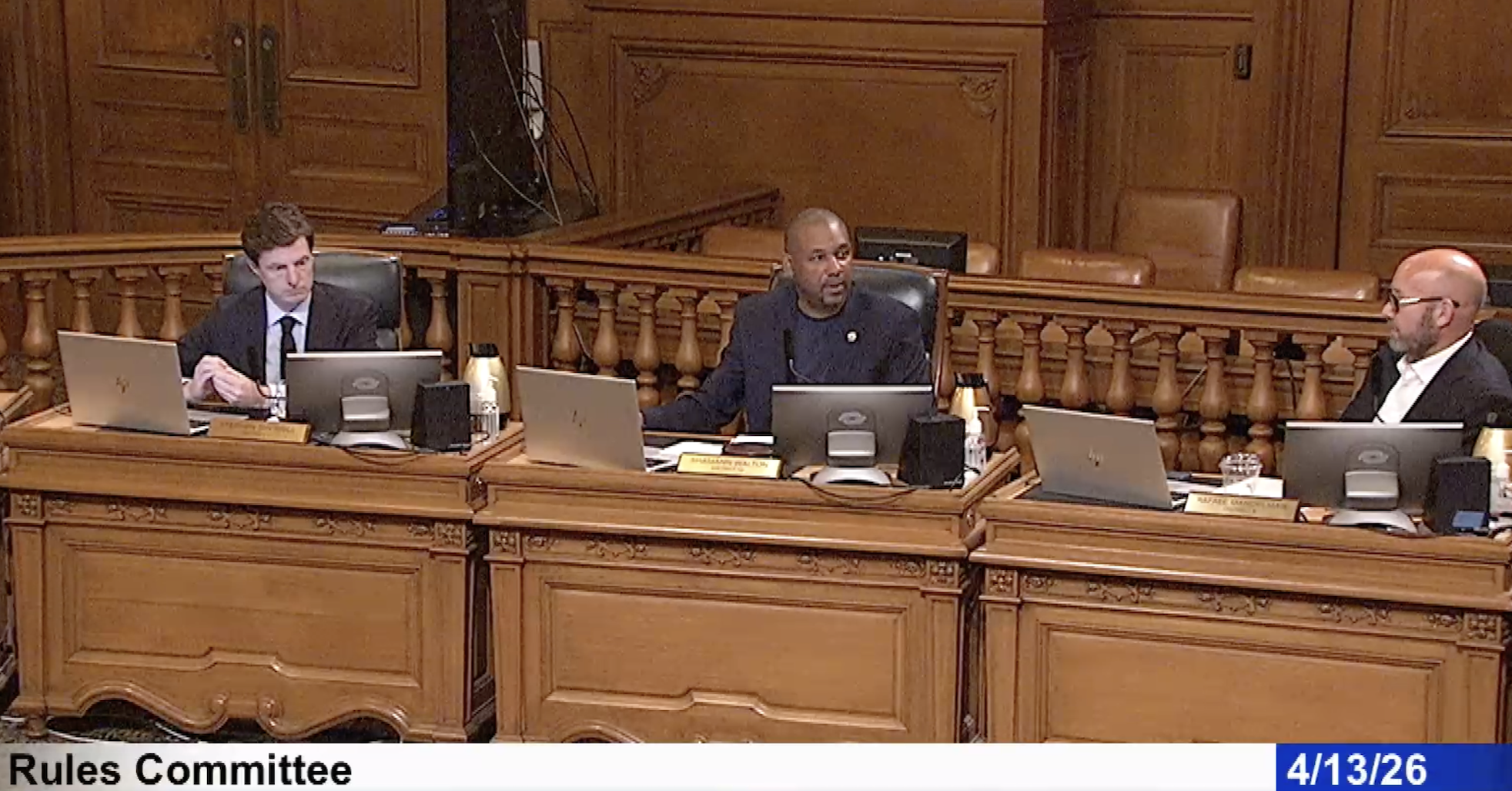
Rules Committee - Apr 13, 2026 - Regular Meeting
Rules Committee • San FranciscoApril 13, 2026
Locunity is a independent informational service and is not an official government page for this commission.We use AI-assisted analysis and human editorial review to publish information.
Police Oversight Resolution Advances After Tense Walton-Mandelman Exchange
The San Francisco Rules Committee sent a police oversight resolution to the full Board of Supervisors on April 13 — but not before Board President Rafael Mandelman stripped language opposing the mayor's push for hire/fire authority over the police chief, overruling Chair Shamann Walton in a 2-1 amendment vote. The committee also delayed a hotel cleaning enforcement ordinance that has labor and industry at odds, and forwarded a routine commission appointment.
Police oversight resolution amended to remove opposition to mayor's charter proposal, then forwarded unanimously to full board
Hotel workers' union and Hotel Council deliver dueling testimony on ordinance that would let employees sue over cleaning violations
Supervisor Chyanne Chen appointed to Local Agency Formation Commission through 2030
Civilian Oversight in a Charter Reform Year
The committee's main event was a resolution affirming the Board of Supervisors' support for independent civilian oversight of the San Francisco Police Department through the Police Commission. The resolution carried five co-sponsors — half the board's ten active members — and had been continued from a prior meeting to allow discussion of amendments proposed by Board President Rafael Mandelman.
Why it matters: Mayor Daniel Lurie is pursuing charter amendments that could give him hire/fire authority over the chief of police. This resolution was intended to stake out the board's position on civilian oversight during what is shaping up to be a pivotal charter reform year. The fight over its language previews the larger political battle to come.
Where things stand: Chair Shamann Walton, who represents District 10, wanted to send the resolution to the full board without recommendation, letting all supervisors weigh in on the record.
"There are five co-sponsors for this. We only have 10 members who are currently actively serving on the board. And I don't think it's fair that we don't allow this to go to the board and let everyone say how they feel about independent oversight," said Walton.
Mandelman, who represents District 8, said he supported the core principle of independent civilian oversight and agreed that changes to the police disciplinary process recommended by the Prop E Task Force should not move forward this year. But he objected to specific language he interpreted as opposing the mayor's proposed charter amendment.
"I am not okay voting for or encouraging the Board of Supervisors to say that we do not support the mayor having hire/fire authority," Mandelman said.
He argued the current charter creates a structural problem:
"It is a quirk of our existing charter that the mayor of the city and county of San Francisco, who is the chief executive, can lose the ability to direct policy and can have a majority of the police commission not agreeing with that person's position."
The other side: Walton pushed back sharply on what he saw as a contradictory procedural stance from Mandelman — unwilling to force amendments but also unwilling to let the resolution proceed clean.
"You're kind of talking out of both sides of your mouth. You don't want to force the amendments on me, but you won't let me send it out without recommendation," Walton said.
He also noted the symbolic weight of the fight:
"Even if statements are made, as you know, resolutions aren't binding. And I think sometimes my colleagues act like they are when it makes their points."
Mandelman signaled he was prepared to force the issue:
"I am going to move these amendments after public comment. I anticipate the chair will vote no, because I don't think the chair thinks that these are good amendments. But that will get the basic thrust of the resolution to the full Board of Supervisors with the arguably objectionable amendments in them."
No members of the public spoke on the item.
Decisions: Mandelman's amendments passed 2-1, with Vice Chair Stephen Sherrill (District 2) joining Mandelman in favor and Walton voting no. The resolution as amended was then forwarded unanimously to the full board, 3-0.
What's next: The full Board of Supervisors will take up the amended resolution. The vote signals that while the board broadly supports independent civilian oversight, there is no consensus on opposing the mayor's push for hire/fire authority — a dynamic that will shape charter negotiations throughout the year.
Hotel Workers and Hotel Industry Square Off Over Cleaning Enforcement
The committee took up an ordinance that would amend the Health Code to let employees of tourist hotels — or their labor organizations — file civil lawsuits against hotel operators for violations of cleaning and disease prevention standards under the Healthy Buildings Ordinance. The item's author requested a continuance, and the committee obliged, but not before two public speakers laid down their markers.
Why it matters: The Healthy Buildings Ordinance was adopted during the pandemic. This proposal would add a private right of action — a powerful enforcement tool that shifts some policing of the standards from city agencies to workers and unions. For the hotel industry, which generates critical tax revenue for San Francisco, the stakes are significant.
Where things stand: Cynthia Gomez of Unite Here Local 2, the hotel workers' union, argued the amendments are necessary because some operators have found ways to dodge enforcement.
"Adding extra enforcement powers will actually help those hotels that have already been in full compliance with the law because those properties have had to compete with those hotels that have been cutting corners by not fully complying," she said.
Gomez framed the issue as economic, not just about worker protections:
"Tourism, to quote Mayor Daniel Lurie, is the number one industry in San Francisco."
The other side: Alex Bastian, President & CEO of the Hotel Council of San Francisco, pushed back firmly. He characterized the ordinance as a pandemic relic being expanded at the wrong time.
"This particular ordinance before it's in front of you as a supersized ordinance was brought on again during that incredibly unknowing, crazy time in our lives. And since that time, we no longer are in a pandemic. Instead of doing away with the ordinance, it is now being looked at at supersizing it and enhancing it," Bastian said.
He urged the committee to consider the industry's recovery:
"If we really want the tax base to grow, we need to make sure that the hotels can thrive again. This legislation does the opposite of that."
Decisions: The ordinance was continued to the call of the chair, 3-0, with no date set for its return.
What's next: When the item comes back, expect a full-scale labor-industry lobbying fight. The core question — whether private lawsuits are a necessary enforcement tool or an unnecessary burden on a recovering industry — remains unresolved.
Minor Items
LAFCO appointment: Supervisor Chyanne Chen was forwarded unanimously (3-0) as an alternate member of the Local Agency Formation Commission, with a term ending Feb. 4, 2030.
30-day rule items — including the Department of Elections surveillance technology policy, Downtown Hospitality Zone, Hate Crime Reward Fund and Upper Fillmore Entertainment Zone — were not discussed during the meeting.