Rules Committee - Apr 06, 2026 - Regular Meeting

Rules Committee - Apr 06, 2026 - Regular Meeting

Rules CommitteeSan FranciscoApril 6, 2026

Sources:

Locunity is a independent informational service and is not an official government page for this commission.We use AI-assisted analysis and human editorial review to publish information.

Sprinkler Retrofit Advisory Council Advances as Residents Warn of Displacement

The San Francisco Rules Committee on April 6 forwarded a new advisory body that could reshape how 141 high-rise residential buildings comply with a costly sprinkler mandate — but not before roughly 15 residents packed the hearing to describe financial ruin. The same meeting exposed a sharp rift over police oversight that will spill into a coming charter amendment fight.

  • Fire sprinkler advisory council advances 2-1 after residents describe costs of up to $300,000 per unit and plead for relief

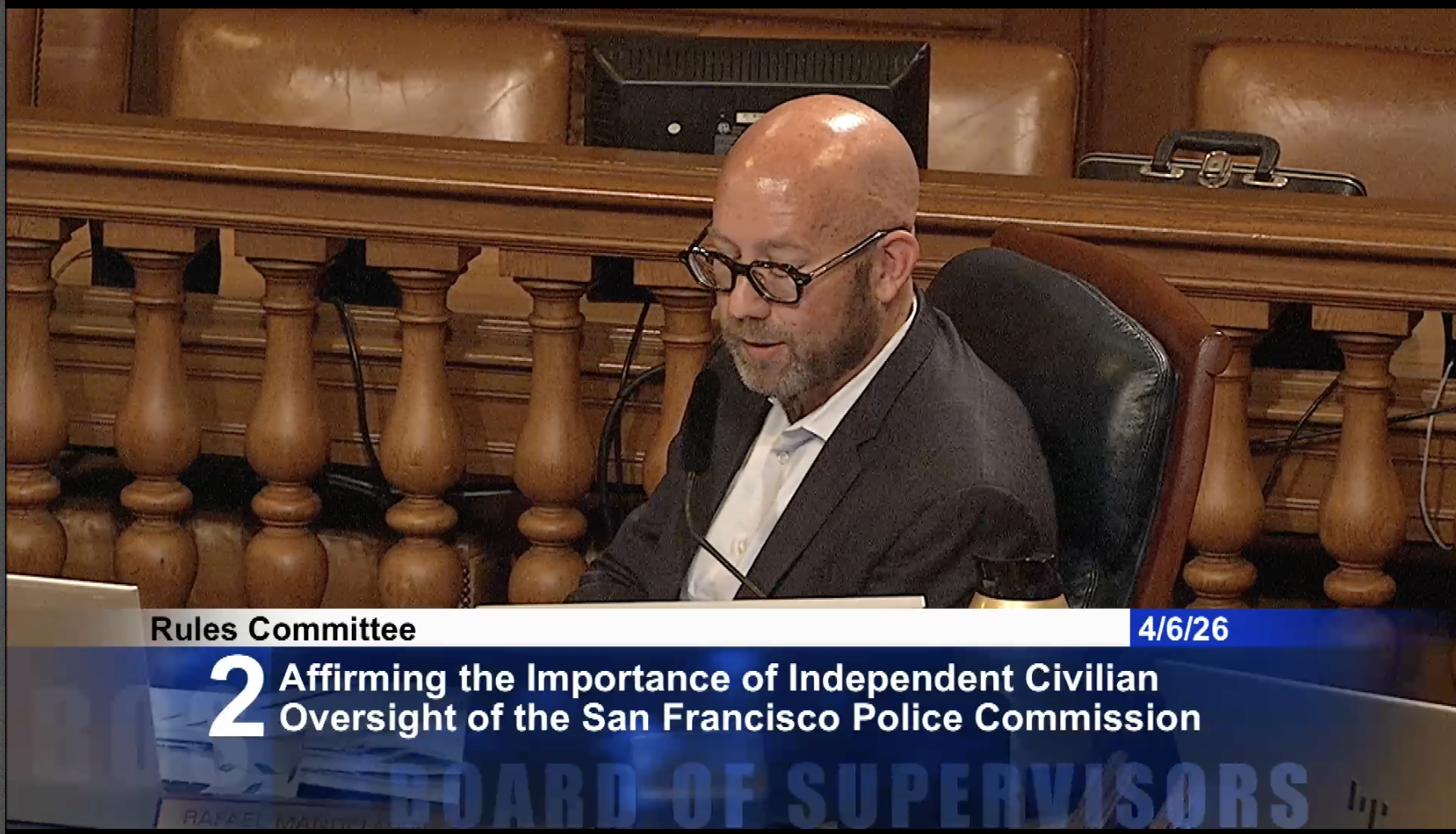
  • Police oversight resolution delayed one week as supervisors clash over whether the mayor should hire and fire the police chief

  • Walton calls Prop E task force recommendations "racist and ill-advised," invoking victims of police violence

  • Lily Wong unanimously confirmed for the Board of Appeals, praised for dispute resolution expertise


$300,000-Per-Unit Sprinkler Costs Loom Over New Advisory Council

The basics: A 2022 San Francisco ordinance requires 141 high-rise residential buildings to retrofit fire sprinkler systems. Supervisor Stephen Sherrill introduced an ordinance creating an 11-member Fire Code Technical Advisory Council to advise the fire marshal on whether to waive, modify, or delay compliance for buildings whose owners and residents face extreme hardship.

Why it matters: Roughly 20,000 residents are affected, many of them seniors on fixed incomes living in buildings like the Comstock, Fontana West, Fontana East, and the Hamilton. Speakers put the per-unit cost as high as $300,000 — a figure that could force displacement from buildings where some residents have lived for decades.

Where things stand: Supervisor Danny Sauter, a co-sponsor, said the council would tackle terms that were never defined when the mandate was adopted: "This body is also going to be tasked with looking at some of the language that was passed but not necessarily defined a few years ago. And I'm talking about terms like reasonable degree of fire protection, alternative protection."

The 11 proposed TAC seats split between six Board of Supervisors appointees — a property owner, non-owner tenant, HOA representative, fire protection contractor, construction professional, and architect or engineer — and five from city agencies: the Controller's Office, Fire Department, Department of Building Inspection, PUC, and a Board of Supervisors member or legislative aide.

Fire Chief Dean Crispin endorsed the body, acknowledging the difficulty of the decisions ahead. "What we've added is the financial hardship piece, which is in the latest amendment to legislation, as well as displacement. But I think those are challenging things to quantify. And that's the value of this technical advisory council," he said.

Residents Sound the Alarm

Public comment was dominated by affected residents who described anxiety, depression, and the threat of losing their homes. Dr. Joyce Glick, a 78-year-old physical therapist who still works, said she cannot afford $300,000 for sprinklers. Nadia Carey, a refugee living on Social Security in Fontana West, asked the committee to repeal the mandate entirely and investigate how it was adopted. Max Isaacman of the Comstock described residents suffering from depression and anxiety and argued no major city has an equivalent mandate.

Several speakers pushed beyond the TAC itself. Neil Bardack, president of the Comstock board, urged the council to explore alternative fire safety methods, arguing the sprinkler ordinance "is not necessarily the only way to achieve that safety." Bob Kozma asked the TAC to weigh the tradeoff between sprinkler costs and voluntary seismic upgrades for the same buildings. Jennifer Gelbard demanded Form 700 financial disclosures for all TAC members, citing an appearance of corruption from a former fire official who she alleged profited from the mandate. Jim Edlin urged the body be renamed a "feasibility analysis council," gain an economist seat, and report to the Board of Supervisors and mayor rather than the Fire Department. Ed Fish objected to what he described as two labor union seats on the TAC, calling them a "shocking and outrageous conflict of interest."

The Supervisor Seat Dispute

Chair Shamann Walton raised the sharpest institutional objection. He called having a supervisor serve on the advisory council "completely inappropriate," arguing the Board already has oversight authority. "When a supervisor makes a recommendation to a fire commissioner, it doesn't seem like a recommendation," he said, warning of an imbalanced power dynamic on a body meant to represent residents.

Walton also flagged that financial hardship criteria remain undefined. "If we're going to have the committee develop what a hardship is, that is concerning going into setting up the tech without really understanding what that criteria, what that formula may look like," he said.

Sherrill pushed back, framing the supervisor seat as active representation for residents who were blindsided by the original mandate. "How many of you got notified that this was under consideration?" he asked the room. He cast the broader issue as part of a citywide affordability crisis: "Are we just going to say here, solve a $1.8 billion problem on your own? Are we going to sync up as a city and figure out how to address this?"

President Rafael Mandelman praised the approach and asked to be added as co-sponsor: "I think that this is an elegant way of trying to tease apart the legitimate safety concerns and trying to respond to situations where sprinklers could make a building safer in a way that would not displace folks from their homes."

Decisions: The motion to forward the ordinance to the full Board of Supervisors with a positive recommendation passed 2-1 (For: Sherrill, Mandelman; Against: Walton).

What's next: The ordinance heads to the full Board of Supervisors. A new Budget and Legislative Analyst report on the mandate's costs is expected soon, which could further shape the debate.


Police Oversight Resolution Sparks Sharp Clash, Continued One Week

Why it matters: A Prop E streamlining task force recommended stripping the San Francisco Police Commission of its authority to hire and fire police chiefs and handing disciplinary power to the chief — recommendations that reopened deep wounds over racial equity in policing oversight.

Where things stand: Chair Walton introduced a resolution affirming the importance of independent civilian oversight, delivering a forceful denunciation of the task force. "The Prop E streamlining task force made one of the most heinous, backward moving, racist and ill-advised recommendations proposing changes to the Police Commission's authority and the removal of independent oversight over the department," he said, noting the task force was an all-white body. He invoked the names of Mario Woods, Alex Nieto, George Floyd, and Breonna Taylor, and referenced the Department of Justice's more than 200 reform mandates for the SFPD.

Walton framed the stakes in personal terms: "To take away that oversight is telling me people are okay with people that look like me being murdered by police. It 100% says that. And this was an all-white body that made that decision in 2026 in San Francisco."

The other side: President Mandelman agreed the Police Commission should retain independent disciplinary authority but broke with Walton on the hire/fire question. "Taking as an example the ability of a mayor to hire and fire the police chief, it seems to me that in olden times when the mayor appointed all of the members of the oversight bodies overseeing important city departments, having some distance between the mayor and those higher fire decisions maybe made some sense," he said — but argued that current governance dynamics, citing dysfunction during the Breed administration, justify giving the mayor direct authority over the chief.

Mandelman requested a one-week continuance to propose amendments, and confirmed he does not plan to include police discipline changes in the upcoming Prop E charter amendment: "I am not intending to include the recommendations around police discipline that the task force recommended."

Vice Chair Sherrill sided with Mandelman on the commission's disciplinary role: "I especially agree with him and with this resolution on the element of disciplinary authority for the commission. I think keeping the commission in charge of disciplinary authority is incredibly important."

In public comment, Susanna Rojas supported the resolution, sharing her experience witnessing a family view video of their son being shot by police and stressing the importance of accountability. Griffin Lee of Connected SF opposed it, calling independent civilian oversight "added government bloat."

Decisions: The item was continued unanimously (3-0) to April 13 for possible amendments by President Mandelman.

What's next: The resolution returns to the Rules Committee on April 13, where Mandelman is expected to offer amendments. The broader fight over police governance is likely to surface again in a November charter amendment.


Minor Items

  • Lily Wong confirmed to the Board of Appeals (3-0). President Mandelman nominated Wong, a lifelong San Franciscan with a master's in Alternative Dispute Resolution from Pepperdine Law School and director of the Sunset Chinese Cultural District. "I have a master's degree in Alternative Dispute Resolution from Pepperdine Law School, and I sought this degree purposely to learn how to solve problems before it reached the stage of litigation," Wong told the committee. Board of Appeals President John Trezvini called the board "the People's Commission" and praised Wong's qualifications. Her term runs through July 2028.