
Rules Committee - Jun 22, 2026 - Meeting
Rules Committee • San FranciscoJune 22, 2026
Locunity is a independent informational service and is not an official government page for this commission.We use AI-assisted analysis and human editorial review to publish information.
Housing Trust Fund Expansion Leads Trio of November Ballot Measures at Rules Committee
San Francisco's Rules Committee unanimously advanced three charter amendments headed for the November 2026 ballot — more than doubling the city's dedicated affordable housing fund, creating a first-in-California public bank framework, and streamlining decades of governance clutter. More than 40 public commenters turned out for the marathon hearing, with SRO families from Chinatown delivering some of the most powerful testimony of the day.
- Housing Trust Fund would grow from $50M to $125M annually by capturing 20% of property tax growth, with fiscal guardrails for deficits and recessions
- Public bank governance framework advances to full board before state enabling law sunsets in 2028, targeting affordable housing, small business, and climate lending gaps
- Sweeping charter reform eliminates obsolete commissions, modernizes MTA service metrics, and moves advisory bodies out of the charter
- SRO families, affordable housing developers, and nonprofits pack hearing — over 30 speakers urge Housing Trust Fund passage, calling it "a floor, not a ceiling"
- All four substantive items pass 3-0; two continued as amended to June 29
A Funding Cliff, and a Plan to Build a Floor
The centerpiece of the June 22 Rules Committee hearing was Supervisor Myrna Melgar's charter amendment to expand the Housing Trust Fund — created by voters in 2012 — from approximately $50 million to $125 million annually.
Why it matters: The city's affordable housing pipeline is running out of money. Director Dan Adams of the Mayor's Office of Housing and Community Development told the committee that local funding sources have been volatile, with impact fees drying up since the pandemic, and that the city runs out of pipeline funding in two to three years.
Where things stand: The growth mechanism would capture 20% of the city's annual property tax revenue growth beginning in fiscal year 2029, ramping up over roughly a decade. Once the fund hits $125 million, it would be capped and indexed to grow by up to 3% annually, extended through 2058.
Supervisor Melgar framed the measure as both fiscally disciplined and urgently needed. "We also made sure that we are expanding the Housing Trust Fund in a fiscally responsible way. The gradual growth of the fund will not start until 2029. And we included fiscal safeguard to freeze the growth of the fund during a budget deficit and to decrease the baseline during a recession," she said.
Key fiscal guardrails include a freeze provision when the first-year deficit exceeds $250 million and a 10% reduction option during recessions when the state's rainy day fund is tapped. Amendments adopted at the hearing aligned down payment assistance eligibility to 200% of area median income.
Director Adams highlighted a critical financing advantage: "One of the beauties of having an ongoing set aside is that we can issue debt against it. And so particularly in the years in which it's going to start to grow, we imagine issuing some form of debt, either a bond or certificates of participation against that income stream."
Jacob Bentliff of the Office of Economic and Workforce Development detailed the mechanics, explaining that "the fund would take 20% of the city's annual growth in property tax revenue that would come from our growth in the overall assessed value the city."
Vice Chair Stephen Sherrill declared the measure could be "the most important measure on the ballot this fall."
Supervisor Rafael Mandelman endorsed it as "the one significant set aside measure that is going to go on the ballot," praising its fiscal responsibility while noting the impact on the general fund would occur over time.
Supervisor Mahmoud called it "the first initiative, and in I don't know how long, probably ever, that provides a sustainable and reliable source of revenue that also acknowledges the deficit that we're in with responsible deficit controls and checkpoints."
SRO Families Put a Human Face on the Numbers
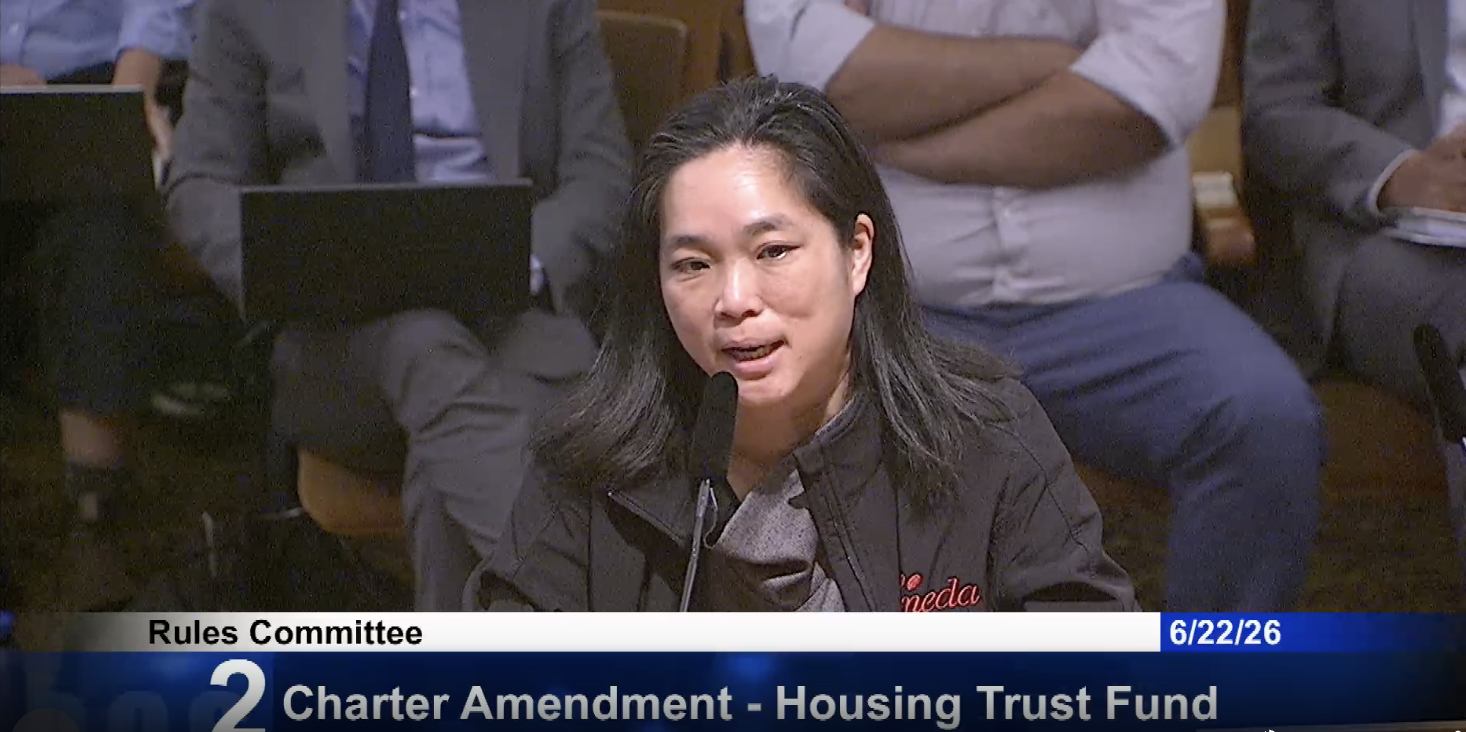
The most striking testimony came from members of the SRO Families United Collaborative, many speaking through interpreters. Yu Ma described living in a small SRO with her 7-year-old son who suffers allergies from poor air circulation, having waited over 10 years for affordable housing. Multiple family members from Chinatown described overcrowded conditions with mice, roaches, shared bathrooms, and long waits for cooking facilities.
Supervisor Melgar shared her own story during closing remarks: "My family came to San Francisco when I was 12. We lived in a little studio apartment off of Mission Street. My sisters and I all slept in the walk in closet."
Developers Say Pipeline Is Stalling
Affordable housing developers and nonprofits lined up to underscore the urgency. Jessica Rubia, policy director at the Mission Economic Development Agency, told the committee that MEDA has three projects on hold totaling more than 400 units and capacity to acquire four preservation sites — projects the $125 million commitment could unlock, housing close to 500 families.
Jennifer Dolan, CEO of TNDC, emphasized the importance of predictable funding for running a development business, noting five projects waiting for funding and favorable federal tax credit timing.
Bill Barnes of the Nonprofit Housing Association explained the structural logic: "You cannot borrow against unreliable funding," making the set-aside structure essential for capital stack financing.
Quentin Mecke, executive director of the Council of Community Housing Organizations, expressed strong support but noted the overall need is in the billions, urging the committee to treat the measure as "a floor, not a ceiling" — a phrase echoed by multiple speakers throughout the hearing.
Zachary Friel of Somcan put the gap in starker terms: the city needs $2 billion per year to meet its Regional Housing Needs Allocation goals, and the expanded fund would supply only 6.25% of that.
A Habitat for Humanity representative supported the measure but warned that expanding down payment assistance without increasing the supply of affordable ownership homes could drive prices higher.
Decisions: The committee voted 3-0 to amend and 3-0 to continue the charter amendment as amended to the June 29 Rules Committee meeting. (For: Chair Shamann Walton, Vice Chair Stephen Sherrill, Supervisor Rafael Mandelman; Against: 0; Absent: 0.)
What's next: The measure returns to Rules Committee on June 29 and must clear the full Board of Supervisors to reach the November 2026 ballot.
SF Moves Toward California's First Public Bank
The committee forwarded a charter amendment establishing the governance framework for a Municipal Finance Corporation and eventual public bank — a measure that must advance before the state enabling law, AB 857 (the California Public Banking Act), sunsets in 2028.
The basics: The MFC would be a non-depository precursor entity that issues loans in partnership with credit unions and community development financial institutions, targeting a market gap in loans between $50,000 and $1 million — a range private banks find unprofitable to service. Conversion to a full deposit-taking public bank would follow.
Charlie Shammas, legislative aide in Supervisor Chen's office, and a LAFCO presenter outlined the proposal, which emerged from a 14-month Reinvestment Working Group process including regulatory consultations with the FDIC and CDFPI.
The LAFCO presenter explained the core market failure: "It costs them just as much to issue a loan for $10 million as it does for $100,000. A loan officer has to sit down, do paperwork that consumes time and money."
The charter amendment establishes governance with staggered appointments from the Treasurer, Comptroller, City Attorney, Mayor, and Board of Supervisors. The entity would be a separate nonprofit requiring approximately $4 million in pre-opening funding and $26 million in initial capitalization, with profitability projected by year three.
Sherrill Presses on Risk
Vice Chair Sherrill asked pointed questions about financial viability, including: "What happens if the public bank fails?"
The LAFCO presenter responded directly: "It is a separate nonprofit, so if it should fail, it would have no impact on the city financially."
Supervisor Mahmoud spoke strongly in favor, framing it as a matter of economic justice: "I firmly believe that when there is an inefficiency in the market of the capitalist system, we have really not just an option, but a responsibility to ensure that the market is operating efficiently for those who are most vulnerable."
Broad Coalition, One Dissent
About 15 public commenters spoke in support, spanning affordable housing organizations, climate groups, and small business advocates. Reina Theo of Poder noted the city had supported a public bank before AB 857 became law. Joseph Clifton of the SF Public Bank Coalition pointed to the Mayor's Climate Action Plan, which specifically calls for a green bank. Hala Ahmed, also of the Public Bank Coalition, addressed insolvency concerns by noting that financial insolvency is preempted by laws requiring collateralization and FDIC insurance. Susan Green of the SF Climate Emergency Coalition cited upcoming Air District zero-emission appliance rules that will require low-cost financing a public bank could provide.
Griffin Lee of Connected SF was the sole opponent, arguing the city should focus on construction costs and permitting reform instead.
Decisions: The committee voted 3-0 to forward the charter amendment to the full board with recommendation. (For: Chair Walton, Vice Chair Sherrill, Supervisor Mandelman; Against: 0; Absent: 0.)
What's next: The measure heads to the full Board of Supervisors for consideration ahead of the November 2026 ballot.
Mandelman's Charter Cleanup Targets Decades of Governance Clutter
Supervisor Rafael Mandelman presented the Board of Supervisors' contribution to charter reform — a comprehensive amendment drawing from three sources: departmental recommendations for operational relief, the Commission Streamlining Task Force's evaluation of boards and commissions, and a stakeholder working group.
Why it matters: Many of the city's charter-mandated structures haven't been meaningfully revisited in decades, creating operational friction and outdated requirements across dozens of departments.
Where things stand: Key changes include eliminating the Streets and Sanitation Commission and Public Works Commission; moving the PUC Citizens Advisory Commission and Parks and Recreation Open Space Advisory Committee from the charter to administrative code (where the Board can more easily update them); modernizing MTA charter-mandated service standards from on-time performance to weight assessments; updating obsolete provisions such as replacing a mandated "book binder" position at the law library with a "technical services manager"; and expanding PUC's exclusive charge over water, power, and sewer infrastructure.
"What I'm proposing today is the board's contribution, what I hope will be the board's contribution to that conversation," Supervisor Mandelman said, referencing the broader charter reform effort.
Late amendments restored the mayor-board split for Homeless Oversight Commission appointments, updated MTA climate goals to align with the citywide Climate Action Plan, and corrected typos. Griffin Lee of Connected SF spoke in support, calling it a good step to eliminate City Hall bloat.
Decisions: The committee voted 3-0 to amend and 3-0 to continue the measure to June 29. (For: Chair Walton, Vice Chair Sherrill, Supervisor Mandelman; Against: 0; Absent: 0.)
What's next: Returns to Rules Committee on June 29 for final action before heading to the full board.
Minor Items
- Behested payment waiver for homeless services (File 260687): The committee unanimously forwarded a resolution authorizing the Department of Homelessness and Supportive Housing to solicit private philanthropic donations — the sixth such waiver. Director Emily Cohen noted previous waivers helped leverage resources from foundations including Crankstart, the Housing Accelerator Fund, and the Schwab Foundation. No public comment. Passed 3-0 to the full board as a committee report.