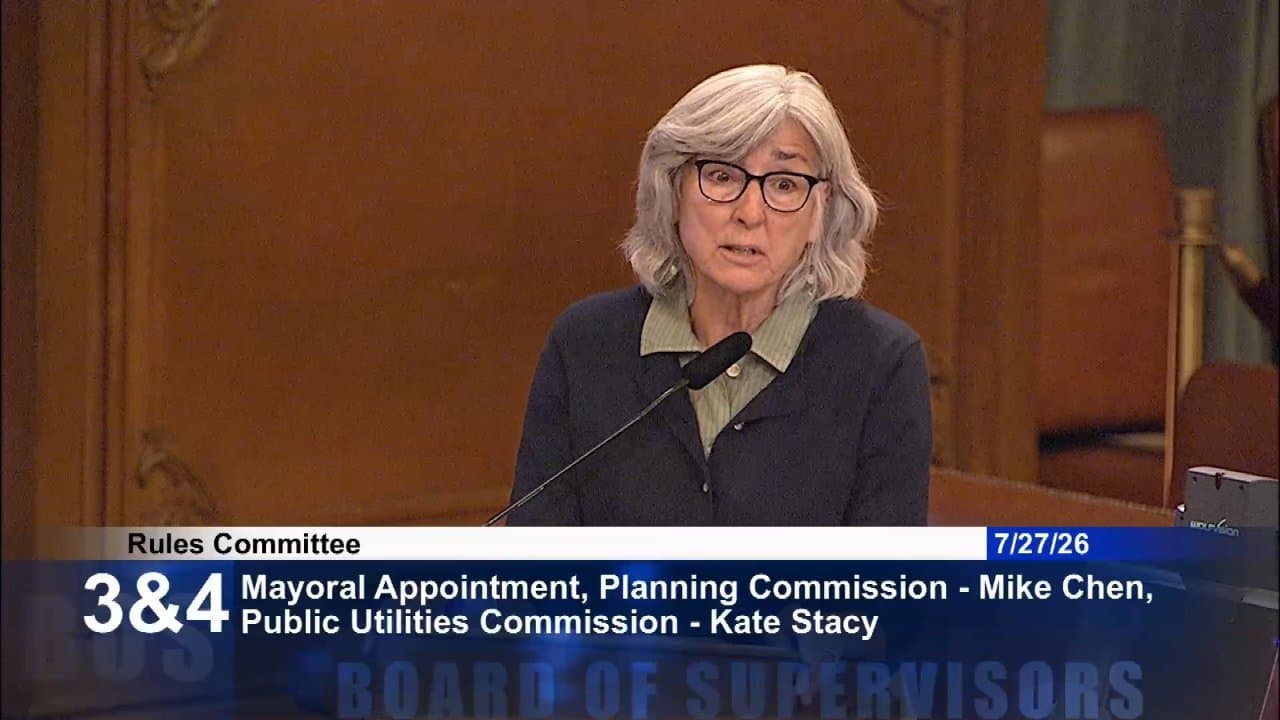
Rules Committee - Jul 27, 2026 - Regular Meeting
Rules Committee • San FranciscoJuly 27, 2026
Locunity is a independent informational service and is not an official government page for this commission.We use AI-assisted analysis and human editorial review to publish information.
Three New Planning Commissioners Advance as YIMBY Delay Bid Falls Short
San Francisco's Rules Committee shaped the future of two powerful commissions Monday, unanimously advancing three Planning Commission nominees and a PUC reappointment to the full Board of Supervisors — but not before a pointed clash over how the city should vet the people who will oversee its housing boom. The sharpest exchange came when YIMBY groups asked for more time to evaluate one nominee's housing record, and Chair Shamann Walton called the approach "borderline unethical."
Board President Mandelman's two Planning Commission picks — veteran commissioner Joel Koppel and UC Berkeley planning professor Elizabeth McDonald — advance 3-0 despite YIMBY push to delay McDonald
SF YIMBY's request for a continuance on McDonald rejected; Chair Walton calls vetting nominees by predicted votes "borderline unethical"
Housing advocate Mike Chen wins broad coalition support from YIMBY, Sierra Club, United Democratic Club for Planning Commission seat
PUC Commissioner Kate Stacy reappointed as agency confronts climate-driven flooding, GM vacancy, and ratepayer affordability pressures
Vice Chair Sherrill warns the city must "get ahead of the streetscape crisis" as housing density accelerates
Mandelman's Planning Picks: Labor Veteran and Urban Design Scholar
Why it matters: The Planning Commission is the frontline body implementing San Francisco's family zoning plan and state housing mandates. These two appointments — chosen by Board President Rafael Mandelman — will help determine how fast and how well the city absorbs a generational shift in land use.
Where things stand: Mandelman presented his nominees as complements, not ideological allies. "My first priority was not finding people who necessarily are going to agree with me on every land use issue, but finding people who I thought would add to the multiplicity of perspectives on the Planning Commission, and above all, were well qualified," he said.
The Labor Builder Returns
Joel Koppel, the government affairs director for the SF Electrical Contractors Association and IBEW Local 6, previously served on the Planning Commission from 2016 to 2024, including two years as president. He grew up in Parkmerced, attended Lowell High School and USF, and now lives in the Sunset.
"I literally built this city with my hands and still have the scars to prove it," Koppel told the committee.
On the family zoning plan, Koppel said he would have supported it and expressed enthusiasm for the changes it could bring to his own neighborhood. "I actually live near Golden Gate Park and the polo fields. And believe it or not, I have to walk a far distance to get to anywhere that I would go patronize. And so I'm looking forward to more housing that's going to bring more people and encourage more ground floor retail businesses," he said.
Koppel drew support from organized labor and the development community. Mark Gleason, representing Teamsters Joint Council 7, praised his leadership for working people. Mark Babson, president of Emerald Fund, called Koppel a product of San Francisco and noted that the IBEW union pension fund is an equity partner on 100/150 Van Ness. Jeremiah Cadigan, vice president of SF Firefighters Local 798, said Koppel understands how buildings perform in emergencies while supporting green standards without compromising fire safety.
The Professor Who Redesigned Octavia Boulevard
Elizabeth McDonald, professor emerita in UC Berkeley's Department of City and Regional Planning, brings five published books and decades of practice-oriented research on walkable streets and the urban public realm. Her San Francisco portfolio includes work on the Market Octavia Neighborhood Plan, the Octavia Boulevard design, and the Better Streets Plan.
"I would be a voice for good planning that follows best practices. I support eliminating cumbersome bureaucracy and streamlining planning and permitting processes while also allowing community voices to be appropriately heard," McDonald said.
She described her Octavia Boulevard work as an example of challenging entrenched engineering standards: "We had to work with traffic engineers to talk about really basic things like lane width standards and how it would be appropriate perhaps to have different lane width standards in the center of that street than on the side of the street."
Vice Chair Stephen Sherrill pressed both nominees on a practical scenario: a family zoning project that meets objective standards but still triggers discretionary review — say, for a demolition. Koppel said every item deserves a hearing and consideration of all factual information. McDonald said she would generally view such projects favorably but might comment on design quality. When Sherrill pushed back that design comments could increase costs, McDonald was direct: "Frankly, I don't think that good design has to be more expensive. I actually believe that rather strongly."
Peter Albert, a former SF Planning Department staffer and professor, spoke in support of McDonald, praising her curriculum's focus on equity and sustainability.
The YIMBY Objection — and the Pushback
The most charged moment came during public comment on McDonald. Representatives from SF YIMBY and Northern Neighbors — including Mo Zhu, Jonathan Bünemann, and Jules Landry-Simard — requested a continuance. They said they could not find sufficient public record on McDonald's housing supply positions, despite finding her testimony encouraging. Peter Belden, political chair of the Sierra Club, said the organization could not support or oppose either nominee due to insufficient time to engage.
The committee declined to delay.
Vice Chair Sherrill made a forceful case for McDonald's appointment, arguing her streetscape and transit expertise would be essential as the city absorbs new density. "We need to do the thing that we failed to do with the housing crisis, which is get ahead of it. We need to get ahead of the streetscape crisis that, by the way, is already here," he said.
Chair Walton went further, directly rebuking the vetting approach. "Picking commissioners and picking people to serve should be about their values, their morals, their experience, and their expertise. It should not be about how we think or how we know they're going to vote. In fact, I think that's borderline unethical," he said.
Decisions: Both nominations passed 3-0 (For: Sherrill, Mandelman, Walton; Against: none) and advance to the full Board of Supervisors as committee reports with positive recommendations.
What's next: The full Board of Supervisors will vote on both appointments at a future meeting.
Mike Chen: The Renter-Advocate With a Big Coalition
Why it matters: Mayor Lurie's nominee, Mike Chen, 36, brings a renter's perspective and an explicit housing-supply focus to the Planning Commission — along with the broadest public support coalition of any nominee heard at this meeting.
Where things stand: Chen, a District 2 renter with nearly two years on the SFMTA Board of Directors and a professional background in data and technology, framed the housing crisis as the root cause of the city's broader challenges. "The housing crisis is something that really weighs on all of us. It's the reason why it's really hard to have late night entertainment and dining. It's the reason why it's really hard to have a vibrant art scene in the city, because it's hard to be an artist," he said.
His testimony drew enthusiastic support from across the political spectrum. Mozou of SF YIMBY called him a longtime advocate for improving housing supply. Peter Belden of the Sierra Club said his organization sent a letter to supervisors praising Chen's thoughtfulness. Bob Akisfangyari of the United Democratic Club described him as a thoughtful problem-solver. Jonathan Bunnemann of Northern Neighbors credited Chen as a leader and mentor in the housing movement. Ali Zhang, a District 8 resident, spoke about concerns as a young person about long-term affordability. Elijah Ball, a District 3 resident with a planning background, noted he wouldn't be able to afford to move to San Francisco today. Dane Willette, SF YIMBY volunteer lead from Cole Valley, praised Chen's genuine interest in listening to people's transit and neighborhood concerns.
Maxine Anderson, a District 5 resident, used her comment time to raise concerns about planned data centers' water consumption and environmental justice impacts on minority communities, urging both Planning and PUC nominees to consider these issues.
Vice Chair Sherrill and Board President Mandelman both praised Chen's temperament and problem-solving approach.
Decisions: Approved 2-0 (For: Sherrill, Mandelman; Walton absent). Advances to the full Board of Supervisors as a committee report. Chen's term would end June 30, 2030.
PUC Reappointment: Stacy Stays On as Storms Intensify
Why it matters: The Public Utilities Commission faces a leadership vacuum — it's searching for a new general manager — while confronting aging infrastructure, climate-driven flooding, and ratepayer affordability pressures. Kate Stacy, a four-year PUC commissioner and 30-year city government veteran, provides institutional continuity at a critical moment.
Where things stand: Stacy outlined six priorities: leadership continuity during the GM search, watershed protection (citing the Dos Rios State Park restoration), water supply resilience through alternative sources and reduced Tuolumne River dependence, wastewater system upgrades including the Southeast Treatment Plant, clean energy portfolio development, and ratepayer affordability. "Everything we do at the PUC is supported by our ratepayers and we need to remain vigilant about affordability and efficiency," she said.
Flooding and the Five-Year Storm Problem
Vice Chair Sherrill zeroed in on flooding, raising specific concerns about the Marina district and asking whether the PUC's combined sewer system — designed to handle a five-year storm — is still adequate. "Right now, the PUC aims to have the sewage system address a five year storm comfortably. But we're seeing five year storms happen more often than five years. Does the PUC need to reevaluate its threshold?" he asked.
Stacy acknowledged the challenge: "I think climate change is affecting everything the PUC does. I'm sorry, I can't recall immediately whether we are looking at more than a five year storm. But I think we are seeing much bigger storms, more intense weather patterns that we absolutely are going to have to address one way or another."
The GM Search Question
Chair Walton pressed Stacy on whether the PUC's general manager search would truly be national in scope, noting a pattern at other city agencies. "They both ended up landing on internal candidates, which by all means, I am definitely not saying I have any issues with those candidates. But it seems like we've been ending up having good internal candidates," he said, referencing recent Port and RPD director searches.
Decisions: Reappointment approved 2-0 (For: Sherrill, Mandelman; Walton absent). Stacy's new term runs through Aug. 1, 2030.
What's next: The full Board of Supervisors will vote on the reappointment. The PUC general manager search remains ongoing.