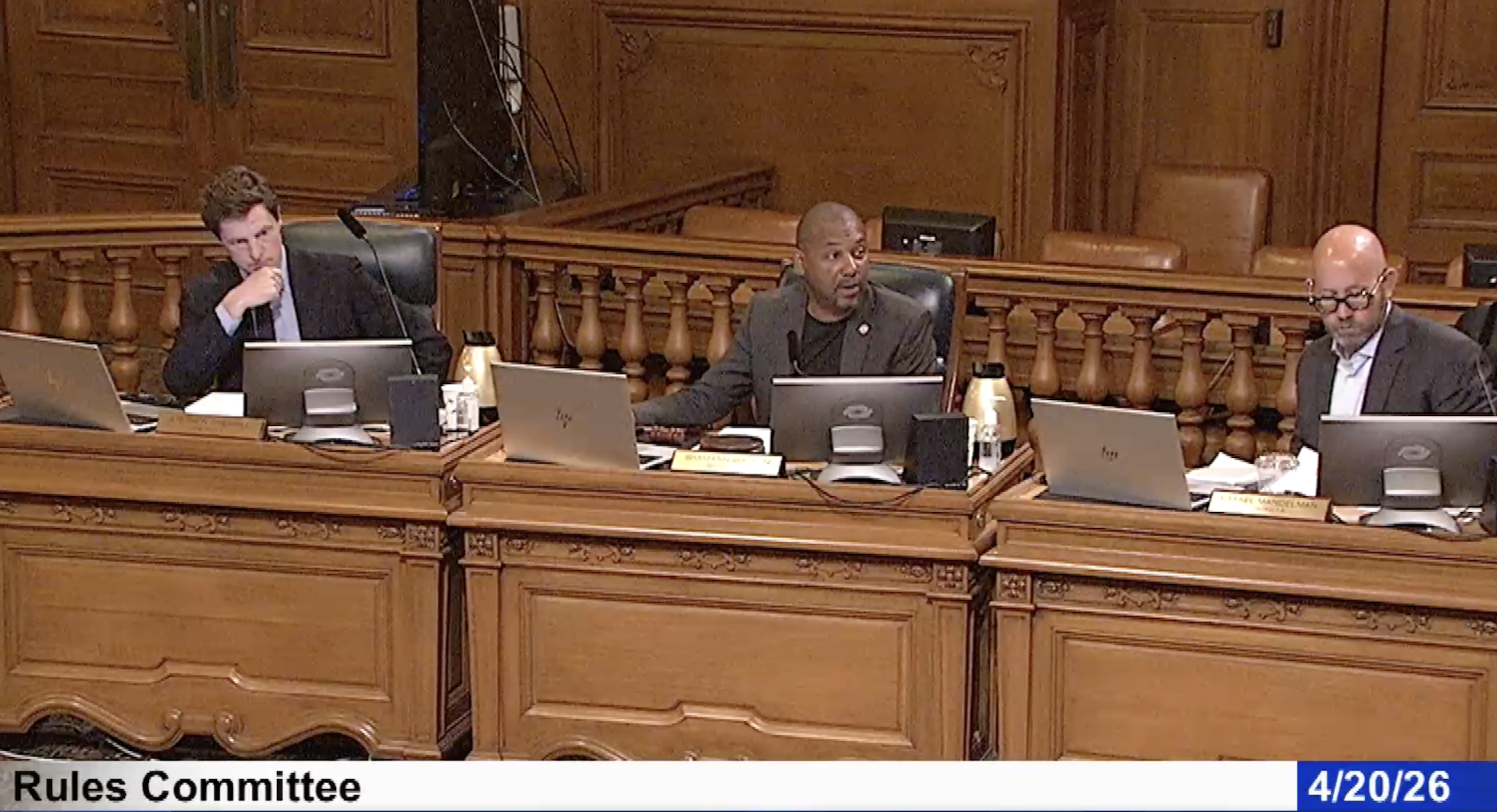
Rules Committee - Apr 20, 2026 - Regular Meeting

Rules Committee - Apr 20, 2026 - Regular Meeting

Rules CommitteeSan FranciscoApril 20, 2026

Sources:

Locunity is a independent informational service and is not an official government page for this commission.We use AI-assisted analysis and human editorial review to publish information.

Pacific Islander Cultural District, Two Entertainment Zones Advance in Busy Rules Committee Session

The San Francisco Rules Committee moved a slate of cultural preservation, neighborhood economic development and board appointment items forward in a brisk April 20 session, teeing up three ordinances and two Treasure Island development board reappointments for the full Board of Supervisors. Along the way, a soda tax veteran made the case for doubling the city's sugary drink levy to help close the budget deficit.


Treasure Island Board Gets Two Reappointments; Richardson Teases Housing News

The Rules Committee unanimously advanced the reappointments of Timothy Reyff and Linda Fadeke Richardson to the Treasure Island Development Authority (TIDA) Board of Directors, while continuing a third nomination — that of Jeanette Howard — after she did not appear before the committee.

Why it matters: Treasure Island is San Francisco's largest active development project and a linchpin of the city's strategy to meet regional housing production targets. Board continuity matters as the island transitions from phase one residential construction to a far larger second phase.

Where things stand: Reyff described his first term as a learning process. He noted that phase one residential construction is largely complete, several parks have opened, and Bay FC has broken ground on its stadium.

Richardson gave the most extensive testimony of the meeting. She detailed her creation of TIDA's Transportation Infrastructure Committee and work securing San Francisco County Transportation Authority funding. She also highlighted a workforce development pipeline for at-risk youth and adults from Bayview and across the city.

"We are the only one that take at-risk youth and adult from the Bayview, from all over San Francisco and resident of Treasure Island. We train them and all of them go to training and they are able to be part of that development on Treasure Island," said Richardson.

Richardson framed the island as the city's best tool for scaling up housing production:

"This is the only place in San Francisco at the moment that we can help you and Mayor Lurie to scale up and build more housing that we need to meet the regional allocation. In fact, in a couple of months we are going to be coming out here to make major announcement."

Decisions: Both reappointments were amended to "approve" and forwarded to the full board on 3-0 votes (Walton, Mandelman, Sherrill all voting yes). Howard's nomination was continued to the call of the chair, also 3-0.

What's next: The two approved reappointments head to the full Board of Supervisors. Richardson's teased housing announcement bears watching — any significant scaling of Treasure Island's residential buildout could reshape the city's housing production math.


Soda Tax Veteran Wins Advisory Seat, Calls for Doubling the Levy

Dr. John Maa, a general surgeon at Chinese Hospital and former American Heart Association president, was appointed to Seat 3 on the Sugary Drink Distributor Tax Advisory Committee over Rada Baleb, a registered dental hygienist with HealthRight360 and the UCSF Food is Medicine Coalition.

The basics: San Francisco's soda tax, established through Prop V in 2016, is a general tax on distributors of sugar-sweetened beverages. A "special tax" — which Maa advocates — would earmark revenue for specific uses and require a higher vote threshold for passage, but would also provide a dedicated funding stream.

Why it matters: Maa is not a passive appointee. He previously served on the committee from 2019 to 2021 and championed both the 2014 Prop E (which narrowly failed) and the 2016 Prop V campaigns. He arrived with a specific policy agenda: double the tax rate and convert it to a special tax.

"There is an urgency given our city's budget deficit and one of the solutions is to fulfill Senator Wiener's vision to double the tax and to make it a special tax," said Maa.

Maa also highlighted the global ripple effects of the Bay Area's soda tax movement:

"There were only 20 nations that taxed sugary drinks in 2016, but the world followed and there are now nearly 120 nations that tax sugary drinks as of 2026."

He cited a 2024-2025 Santa Cruz soda tax victory published in JAMA as a model for building scientific evidence.

The other side: Baleb offered a community-based public health perspective.

"I also lead a food pharmacy program through the UCSF Food is Medicine Coalition serving patients with chronic conditions. In this work I integrate nutrition into oral health care, connecting diet, especially sugary drink consumption to both chronic disease and dental outcomes," she said.

Her pitch emphasized frontline nutrition education.

Vice Chair Stephen Sherrill, Supervisor, District 2, praised Maa directly:

"I just wanna say that I appreciate your doggedness in pursuing what you believe is right for the health of San Franciscans and frankly, Americans both on the issue of sugary drinks."

Chair Shamann Walton, Supervisor, District 10, acknowledged the difficulty of the choice:

"It's not always easy to make a decision between two qualified people."

He encouraged Baleb to continue seeking opportunities to serve.

Decisions: Dr. Maa was appointed 3-0 (Walton, Mandelman, Sherrill). The appointment goes to the full board.


Pacific Islander Cultural District Headed to Full Board

The committee unanimously advanced an ordinance establishing the Pacific Islander Cultural District in the Visitation Valley and Sunnydale neighborhoods — the city's first formal recognition of Pacific Islander cultural heritage through the cultural district framework.

Why it matters: Cultural districts are San Francisco's primary policy tool for stabilizing communities facing displacement. This one triggers a requirement for the Mayor's Office of Housing and Community Development to submit reports describing the district's cultural attributes and propose preservation strategies.

"Cultural districts are proven to stabilize communities during periods of rapid change. And we know that neighborhoods like Visitation Valley and Sunnydale have faced exactly that. Economic pressures, displacement, long standing inequities," said Chair Shamann Walton, Supervisor, District 10, who presented the item.

The ordinance had already passed unanimously through the Historic Preservation Commission and the Planning Department. Supervisor Rafael Mandelman, Supervisor, District 8, asked to be added as a co-sponsor.

Decisions: Forwarded to the full Board of Supervisors as a committee report, 3-0.


Glen Park, Upper Fillmore Get Entertainment Zones for Outdoor Events

Two companion ordinances creating entertainment zones — one in Glen Park and one on Upper Fillmore — cleared the committee unanimously, both headed to the full board for April 21 consideration.

The basics: Entertainment zones allow restaurants and bars within designated corridors to sell alcoholic beverages to-go for outdoor consumption during community events and activations. San Francisco created the framework during the pandemic; these would be the city's fourth and fifth such zones.

Supervisor Rafael Mandelman, Supervisor, District 8, presented the Glen Park ordinance, explaining it was requested by the Glen Park Merchants Association in collaboration with the Glen Park Association. He noted it would be the third entertainment zone in District 8, following Cole Valley and Castro.

"During COVID San Francisco, like many cities, adapted to the health concerns surrounding closed indoor gatherings by allowing more commercial activity outdoors. And although we initially did this out of necessity, turned out this could allow pretty cool outdoor gatherings that could be particularly helpful to our businesses," said Mandelman.

Shane Ryan, co-owner, Glen Park Station Bar, testified in support, describing how Civic Joy Foundation-funded night markets had already demonstrated the revenue and community benefits of regular outdoor events. He highlighted Glen Park's proximity to BART and Muni as making the neighborhood accessible citywide.

Vice Chair Stephen Sherrill, Supervisor, District 2, presented the Upper Fillmore ordinance, thanking Fillmore Merchants Association leaders Tim Omi and Patty Mangan.

"It's really because of you that we've had so much success bringing Fillmore Street back post pandemic. And I'm excited to see this move forward with my colleagues' support at the full board," said Sherrill.

Decisions: Both ordinances forwarded as committee reports, 3-0. The full board is expected to take them up on April 21, 2026.


Minor Items

  • Behavioral Health Commission appointments continued to the call of the chair (3-0) as the committee needs additional conversations with candidates before filling seats on the commission that guides the city's behavioral health strategy.