
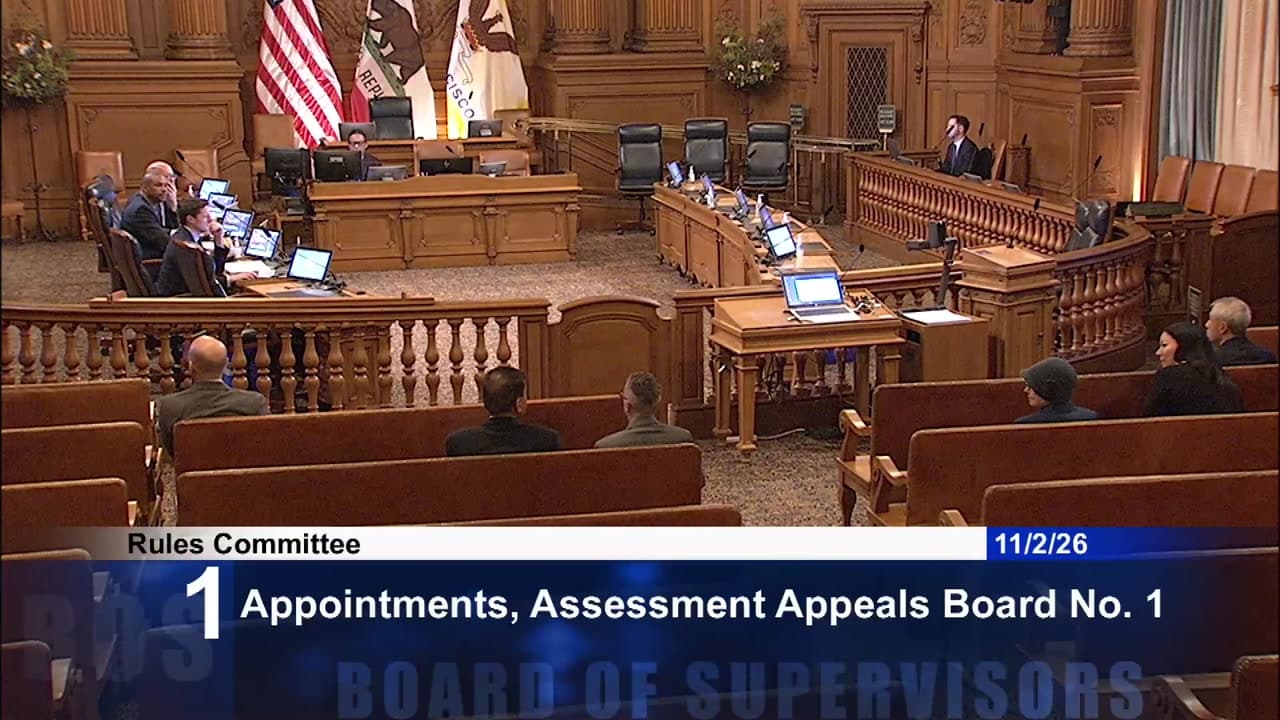
Supervisors Question $1.2M Red-Light Camera Cost, Accept SFMTA Surveillance Report
Rules Committee • San FranciscoNovember 2, 2026
Locunity is an independent informational service and is not an official government page for this commission. All information is sourced from public footage and an analysis of official agendas with the aid of responsible, fact-checked AI. to report an error or omission.
San Francisco's red-light cameras issued 10,385 citations in 2025, and the city still loses money on them. That came out Nov. 2, 2026, as the Board of Supervisors' Rules Committee voted 3-0 to accept the San Francisco Municipal Transportation Agency's 2026 surveillance technology report. The committee also unanimously advanced six appointees to the city's property tax appeals panels and its youth funding oversight committee.
- SFMTA surveillance report accepted 3-0 after supervisors pressed on red-light camera costs
- Red-light cameras cost about $1.2M a year, while citation revenue goes to the court and state
- Five Assessment Appeals Board nominees forwarded, three of them with residency waivers
- Former foster youth Rebecca Castanon advances to the Children, Youth and Their Families oversight committee
Red-Light Cameras: Safer Streets, Thin Returns
The basics: Under Administrative Code Section 19B.6, SFMTA must adopt a use policy for every surveillance technology it operates and report to the Board of Supervisors every other year. This cycle covered six technologies. One was red-light and no-right-turn cameras, which got their policy last year. The other five were on the regular reporting cycle.
Where things stand: Jill Arnaud, SFMTA Principal Business Analyst, reported 10,385 red-light and no-right-turn citations in 2025, with no complaints and no policy violations. "We are not requesting any changes to the policy," said Arnaud. Four of the five regular-cycle technologies had nothing to report.
The exception was automated speed enforcement. "We did get several comments about privacy and data sharing," Arnaud said. The agency told the committee its existing safeguards address those concerns.
The money question: Vice Chair Stephen Sherrill, Supervisor, District 2, turned the discussion from privacy to budget. "Do these really cost us money, the red light cameras, and we're not making money on that?" he asked.
Monica Giese, SFMTA Red Light Camera Program Manager, said the program is not built to make money. Citations run about $489, but the agency does not keep that revenue. "Those are collected by the Superior Court and kept by the State of California," said Giese.
SFMTA gets the traffic school fees instead. "In lieu of that, they give us the whole amount of traffic school fees, but it's less than what our program costs to operate per year," Giese said. She put that operating cost at about $1.2M a year on average and noted that installing new cameras is also costly.
Why it matters: The revenue split puts the full cost of a city-run enforcement program on the city, while the fine money flows to the court and the state. Any proposal to expand camera enforcement will have to account for that gap.
Rules Committee Chair Shamann Walton, Supervisor, District 10, said he supports safer streets but was blunt about the price tag. "This is an expensive program," said Walton.
The other side: The only public comment on the report came from John Ellis, member of the Supportive Housing Providers Network Resident Advisory Board, who spoke as an individual. He said supportive housing residents care about safety, data analysis and accountability, and he asked about data control. "Has there been any thought to bring some of the AI technology to within the city so that we're not exporting the data outside the city's control?" he asked. No answer to his question was recorded.
Decisions and stakeholder impacts: The committee accepted the report and forwarded the resolution to the full board (For: 3 — Sherrill, Mandelman, Walton; Against: 0; Absent: 0). The vote keeps SFMTA's surveillance oversight cycle on schedule, with no policy changes. The cost discussion gives budget hawks and privacy advocates a reason to keep watching. Drivers and pedestrians see no immediate change.
What's next: The resolution is expected on the Board of Supervisors' Nov. 10 agenda.
Property Tax Appeals Boards Get Five Nominees
Why it matters: Assessment Appeals Boards hear disputes between property owners and the city over assessed values. The appraisers, lawyers and real estate professionals who sit on them shape how those tax appeals are decided.
Where things stand: The hearing for Assessment Appeals Board No. 1 listed five seats. The committee forwarded four nominees:
- Karina Mitchell, a commercial appraiser with about three years on the board, for Seat 1
- Stephen Wasserman, who has 30-plus years in commercial real estate and is seeking a third stint, for Seat 3
- Elizabeth Zareh, a transactional real estate attorney with nearly 10 years of prior service, for Seat 5
- Richard Lee, who described a broad real estate career, for Seat 7
Zareh did not attend. Tanya Giacone, Senior Administrative Analyst for the Assessment Appeals Board, spoke on her behalf during public comment.
The Seat 1 and Seat 5 nominations both carry residency waivers. A residency waiver lets a nominee serve without meeting the seat's residency requirement.
For Assessment Appeals Board No. 2, attorney Claire Irvin Lee sought reappointment to Seat 8, also with a residency waiver. She has served two years. She said she brings a legal focus and empathy for appellants who come before the board without representation.
Decisions and stakeholder impacts: Both motions passed (For: 3 — Sherrill, Mandelman, Walton; Against: 0; Absent: 0). No one spoke against any nominee. The slate leans on returning members and industry experience, which favors continuity for property owners and their representatives. Irvin Lee's focus on unrepresented appellants speaks to smaller taxpayers who appeal on their own.
What's next: The nominations go to the full board, expected Nov. 10. One Board No. 1 seat listed in the hearing was not filled at this meeting.
Lived Experience Joins Youth Funding Panel
Where things stand: The committee forwarded Rebecca Castanon, 19, for Seat 7 on the Children, Youth and Their Families Oversight and Advisory Committee. The hearing covered four seats, but only Castanon's was taken up.
Castanon told supervisors she entered foster care at 15. She takes part in the Department of Children, Youth and Their Families' Youth Empowerment Program, where young people prepare listening sessions that help shape DCYF funding for the next budget cycle. She also chairs the HYPE Center's Youth Advisory Board. Walton praised her willingness to serve.
Why it matters: The committee advises on how DCYF understands youth needs and directs funding. Castanon would bring direct foster-care experience to that work.
Decisions and stakeholder impacts: No one offered public comment, and the motion passed (For: 3 — Sherrill, Mandelman, Walton; Against: 0; Absent: 0).
Looking Ahead
All four actions are expected before the full Board of Supervisors on Nov. 10, unless otherwise noted. Residents with views on red-light camera costs, speed camera data practices or the appointments can weigh in then.