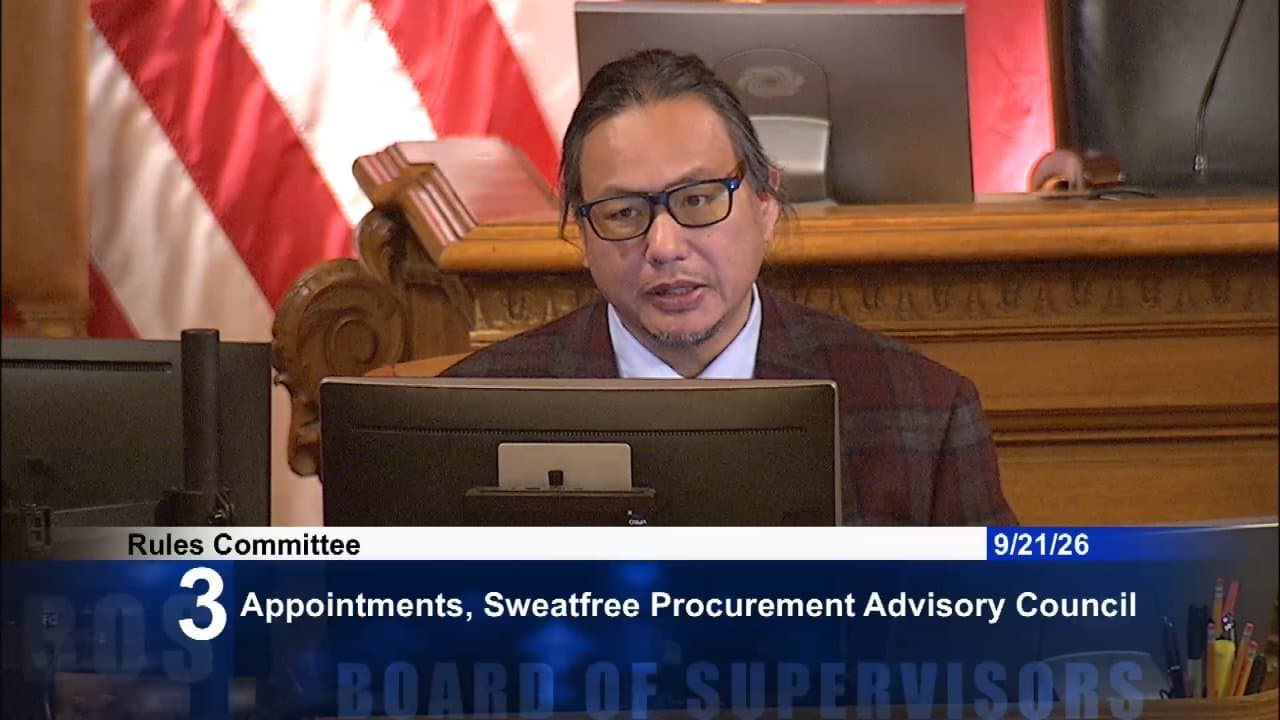
Rules Committee - Sep 21, 2026 - Regular Meeting
Rules Committee • San FranciscoSeptember 21, 2026
Locunity is an independent informational service and is not an official government page for this commission. All information is sourced from public footage and an analysis of official agendas with the aid of responsible, fact-checked AI. to report an error or omission.
SF Creates Food Security Office to Coordinate $200M Amid Federal Threats
The Rules Committee unanimously advanced a landmark ordinance formalizing how San Francisco coordinates $200 million in food programs across nine city departments — a direct response to HR 1's assault on the federal safety net. The committee also confirmed a new County Veterans Service Officer and filled seats on three advisory bodies in a brisk but substantive session.
- New Office of Food Security Coordination advances unanimously, centralizing oversight of $200M in food funding across 9+ departments with no new staff
- Iraq War veteran Gerardo Carr confirmed as County Veterans Service Officer, with a mandate to expand outreach to homeless, women, and LGBTQ+ veterans
- Sweat-free procurement veterans reappointed, eyeing expansion of anti-sweatshop standards beyond garments to all city purchases
- Four seats remain vacant on the children's advisory committee after only one applicant appeared
A Safety Net Gets a Spine: Food Security Coordination Ordinance
The meeting's most consequential action — consuming roughly half the session — was an ordinance creating an Office of Food Security Coordination within the Human Services Agency. The measure responds to three converging pressures: federal threats to food assistance under HR 1, two decades of community requests for better coordination, and the loss of the Food Security Task Force after Prop E sunsetted it.
The basics: The ordinance amends the Administrative Code to elevate HSA's existing Citywide Food Access Team, led by Cindy Lin, into a formal office — no new positions required. It replaces the biannual food security report (previously produced by the Department of Public Health) with a five-year assessment cycle, including a three-year interim report and annual budget updates. A new Food Security Council with 15 seats — five city departments, five community-based organizations, and three community members — will replace the sunsetted task force. Co-sponsors include Supervisors Rafael Mandelman, Mildred Melgar, Fielder, Connie Chan, and Alan Wong.
Why it matters: HSA directs nearly three-quarters of the city's $200 million in food funding. Yet community organizations serving the same populations have been forced to navigate duplicative grant applications and misaligned reporting requirements across multiple departments.
"Fundamentally, HR 1 has posed the biggest risk to our social safety net in decades. Our food systems and healthcare access are under attack through HR 1, and it's more important than ever that we have coordinated response," said Susie Smith, Deputy Director of Policy Planning and Public Affairs, Human Services Agency.
Smith described the practical dysfunction the ordinance aims to fix: two departments funding the same community organization to do the same work, with separate RFP timelines and separate reporting metrics. The new office would align those processes without absorbing other departments' funding.
DPH Deputy Director of Community Health Asa King acknowledged the administrative burden of the current system, noting DPH's heavy reliance on HSA data to produce the biannual report — a dynamic that made the transfer of reporting responsibility logical.
Where things stand: Vice Chair Stephen Sherrill pressed the case for why legislation was necessary when the work was already happening informally. "Can you, in a perhaps overly simplistic or overly blunt way, tell me why we need legislation to formalize this if it's already being done?" he asked.
Smith responded that formal designation carries weight when compelling interdepartmental collaboration, and the code needed to be amended to change the report cadence and shift responsibility from DPH to HSA. Sherrill conceded the point: "I think it's too bad that we need legislation to break down bureaucratic walls, but I get it. And I think the challenge we face necessitates the move."
Supervisor Alan Wong shared a personal window into the problem, recalling his difficulty during COVID finding the right point of contact for getting food to district residents. He added his name as co-sponsor during the hearing.
Chair Shamann Walton issued a pointed warning that coordination must not become a pretext for cuts. "I want to make sure that everybody stays on top of making sure that the pot stays the same, if not grows, because obviously the need continues to grow," he said. Smith acknowledged that if CalFresh caseloads decline due to federal changes, the city may need to increase community-directed food support programming.
The other side: The ordinance drew no opposition. Marshawn Tapman, Associate Director of Policy and Advocacy, San Francisco Marin Food Bank, offered the sole public comment — and it was enthusiastic. "Almost 2 years ago to this month, I stood here and asked you, Supervisor Walton, could we pause and table efforts for the Office of Food Coordination so more work can be done in collaboration and among community," he recalled, praising the robust engagement process that followed with the Shape Up Coalition, FACTS, the Soda Tax Advisory Committee, the SF African American Faith-Based Coalition, the Latino Task Force, and the AAPI Council.
Decisions: The ordinance passed 3-0 (For: Walton, Sherrill, Wong; Against: none; Absent: none).
What's next: The ordinance is expected on the Board of Supervisors agenda Sept. 29. The Food Security Council's first meeting is anticipated in October, with over 50 community members having applied for seats.
Iraq War Veteran Confirmed as County Veterans Service Officer
The committee confirmed Gerardo Carr as San Francisco's County Veterans Service Officer, a position within the Department of Disability and Aging Services that serves as the primary gateway for veterans seeking federal, state, and local benefits.
Carr served in the U.S. Army and Army National Guard from 1999 to 2014, including deployments during Operation Iraqi Freedom and Operation New Dawn. He holds bachelor's and master's degrees and described a personal understanding of the bureaucratic maze veterans face navigating the VA system.
"My goal is to expand outreach to underserved veterans, including homeless veterans, women veterans, and LGBTQ+ veterans. I intend to strengthen my partnership with community organizations, service providers, and government agencies to improve coordination, streamline referrals," Carr told the committee.
Supervisor Alan Wong underscored why the appointment matters: "It's really important to the veterans community to have somebody that is well qualified and knows what they're doing to be helping assist veterans with disability claims, to be able to navigate our complex city, federal, and state bureaucracies."
Decisions: The resolution passed 2-0 (For: Wong, Walton; Against: none; Absent: Sherrill) and advances to the full board.
Sweat-Free Procurement Group Reappoints Three, Eyes Expansion
Three longtime members of the Sweat-Free Procurement Advisory Group won reappointment, bringing stability to a body now preparing its most ambitious move: expanding anti-sweatshop oversight beyond garments to all city-purchased commodities.
Julie Fisher, a union member and former Macy's employee with over 40 years in San Francisco, reaffirmed her commitment to workers' rights and living wages (Seat 4). Coyote Marin, who has served as vice chair and acting chair for eight years, delivered a sobering assessment of factory conditions: "Never once have they found a factory that is just abiding by all labor laws on their own. And these are the local labor laws of the country. We have additional requirements in our contract, but even those get violated."
Jason Orringer, a member since the ordinance's inception and founding Sweat-Free Coalition member, framed the next chapter: "When this law was passed, it was intended to use the sweat-free scope in the broadly recognizable garment industry, which is maybe 1% of what the city buys. But to get the system down and then to think about the other items that the city purchases and make sure that they are not produced in sweatshops too."
Decisions: All three reappointed — Fisher to Seat 4, Marin to Seat 2, Orringer to Seat 1 — on a 2-0 vote (For: Wong, Walton; Against: none; Absent: Sherrill). Two seats remain open.
Minor Items
-
Jennifer Hand reappointed to DCYF Oversight and Advisory Committee (Seat 9). A District 6 social worker and mother of a child with a rare disability who coordinates care across 30 providers, Hand was the only applicant for five available parent seats. Passed 3-0. Four seats remain vacant — Chair Walton urged the public to apply.
-
Architect Nicholas Suk appointed to Fire Code Technical Advisory Committee (Seat 6). A licensed California architect and 24-year Tenderloin resident, Suk chairs the Hamilton HOA's architecture committee and brings 30 years of fire and building code experience. Passed 2-0 (Sherrill and Walton; Wong not recorded in roll call).
-
Board of Supervisors President Rafael Mandelman excused from the meeting. Passed 2-0.