
Ross Council Splits Over Sign Ban as Kuhn Fills Vacant Seat
Town Council • RossSeptember 23, 2026
Locunity is an independent informational service and is not an official government page for this commission. All information is sourced from public footage and an analysis of official agendas with the aid of responsible, fact-checked AI. to report an error or omission.
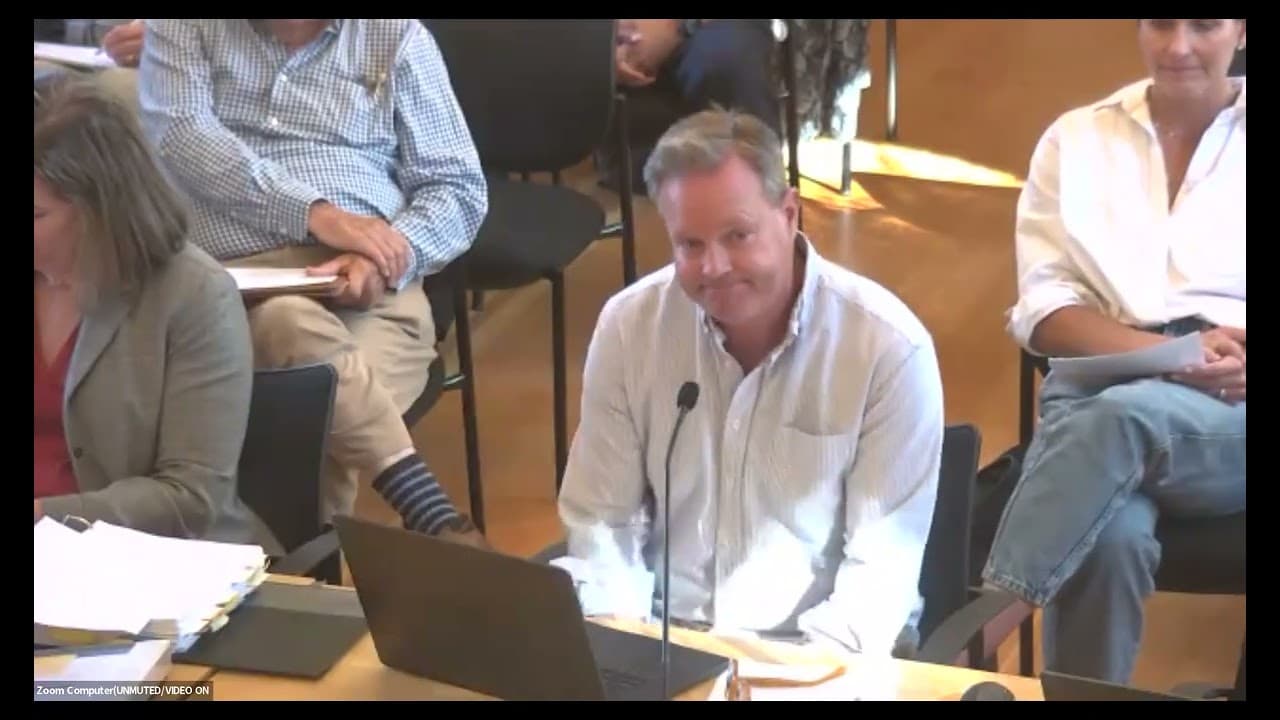
Campaign signs pulled from Ross roadsides during a council election drew the longest debate of the Sept. 23 special meeting, and the council left it unresolved with no ordinance change and no vote. Before that fight, the council voted 4-0 to appoint Jeff Kuhn to the vacant seat, which restores a fifth vote to a body that often split 2-2. Kuhn could become the deciding voice if the sign rules come back for a vote.
- Sign ordinance sent to committee after council split on repealing the right-of-way ban
- Jeff Kuhn appointed 4-0 to finish Bill Kircher's term, despite a "backroom deal" allegation
- Gensler cleared to build an independent fire station program, with Tiburon added for comparison
- Bond vote targeted for May 4, 2027, but no firm date yet for a cost estimate
The Sign Fight Moves Behind Committee Doors
Why it matters: Town staff removed campaign signs during a contested council race. That raised questions about free speech, private property rights and whether the rules were enforced evenly, all while voters were still deciding the race.
Where things stand: The item concerns Ross Municipal Code Section 18.40.115, and no staff report was included in the packet. Town Manager Christa Johnson opened by disputing claims made to the media. She said Ross is not the only Marin town that bans temporary signs in the public right-of-way. "Only San Anselmo and Novato allow it with restrictions," she said.
Johnson also rejected several other claims:
- She said the rule is not new. It dates to 1961 and was last updated in 2021.
- She said it has been enforced in the past.
- She denied that staff trespassed or targeted two candidates.
Staff explained that they identify the right-of-way from experience rather than from maps.
Councilmember Mathew Salter pressed on the legal basis for the removals. "Where in the ordinance does it say that the town can remove signs without notice?" he asked. The town's legal counsel answered that notice is required only for signs on private property. "There's no equivalent provision for notice when we're talking about signs in the public right-of-way," counsel said. Salter argued that the ordinance text does not distinguish public from private property and that the town did no due diligence before removing signs.
Mayor Julie McMillan distanced herself from the removals. "I did not order the removal of any sign," she said.
The other side: Two public commenters criticized the enforcement:
- Paul Rustler, council candidate, said staff removed campaign signs, including signs on his own property. He compared the enforcement with how signs were handled during the 2024 Measure E campaign and asked who directed the removals.
- Dennis Miller, public commenter, said Section 18.40.115 mixes public and private property and needs a rewrite. He argued that the rule's long history does not justify past practice and that barring speech on public property raises First Amendment problems.
Mayor Pro Tem Elizabeth Robbins said the enforcement looked selective. "It looks like the town is interfering in a contested election," she said. Robbins and Salter both favored repealing the right-of-way prohibition while keeping limits on signs that block passage.
McMillan pushed back, citing community character and concerns about junky signs. "I am opposed to changing the right-of-way concept," she said. Counsel explained what repeal would mean in practice: "If we remove the concept of the public right-of-way, people are going to be able to have signs up in our public right-of-way for 60 days," any time of year.
Decisions and stakeholder impacts: No vote was taken. Councilmember Teri Dowling proposed that the Governance Committee, made up of Dowling and Robbins, meet with counsel. Councilmember Jeffrey Kuhn also favored a committee approach. Johnson urged restraint: "I recommend against the council giving direction to come back with an ordinance," she said, at least not without a staff report and legal input. Counsel said he would not draft anything until all five members give direction.
Until the council acts, candidates and residents remain under the current right-of-way prohibition. Robbins and Salter favor repeal and McMillan opposes it. Kuhn, the newest member, has not taken a position on repeal, which means his eventual stance could decide the outcome.
What's next: The Governance Committee will meet with legal counsel to review Section 18.40.115. No date was set.
Kuhn Seated 4-0 Amid Process Objection
Why it matters: The appointment ends the frequent 2-2 deadlocks and avoids a special election. The council's 60-day window to act would have closed Nov. 10, 2026.
The basics: Councilmember Bill Kircher resigned effective Sept. 11, 2026. Under Government Code Section 36512, the council can either appoint a replacement or call a special election. On Sept. 10, the council directed staff to solicit applications.
Where things stand: Four residents applied, and all met the age, residency and voter requirements. Michael Rosenbaum could not be reached, so the council interviewed three. Each candidate was asked about the Citizens Advisory Committee's (CAC) civic center proposal and the biggest issue facing Ross.
- Stephen Sutro, a member of the Ross Advisory Design Review Group, emphasized his architecture and project management background. "I'm supportive of a fire station in Ross as long as it's financially prudent," he said.
- Megan Zoback cited her business background and her perspective as a parent of school-age children. On the CAC plan, she said: "Support the direction, stress test the numbers, protect the trust."
- Jeff Kuhn pointed to his role in creating the CAC and to his corporate board experience.
No members of the public commented on the appointment.
McMillan backed Kuhn. "Jeff would be an outstanding candidate given his unique ability to bring very polarized stakeholders together," she said. Dowling also favored him.
The other side: Salter preferred Sutro or Zoback and argued that voters should choose. He also accused colleagues of prearranging the outcome. "It is clear there has been a backroom deal to appoint Jeff," Salter said. Robbins said she was uncomfortable appointing someone, but she named Kuhn as her choice. She said she thinks the town needs "to appoint a 5th person because I don't think that a split 2-2 serves the town well."
Decisions and stakeholder impacts: Dowling moved to appoint Kuhn to the remaining two years of the term, and Robbins seconded. The roll call passed with For: 4 (McMillan, Robbins, Dowling, Salter) and Against: 0. Salter voted yes despite his objection to the process. Kuhn was sworn in immediately.
His arrival gives the CAC's founder a vote on the civic center plan that his committee shaped.
Gensler Gets Green Light on Fire Station Sizing
Why it matters: The size of the fire station, and whether fire, police and paramedic functions share space, will drive the cost of a civic center on a constrained site. That cost will shape any future bond measure.
Where things stand: David Kelley, project manager and interim public works director, said Gensler is updating the facilities master plan amendment, refining the 2023 plan with a focus on the fire station. He said no additional funding was requested that night.
Gensler's project manager, Letha, described the work already completed: laser scans, as-built drawings, program validation and a preliminary site evaluation. The next steps are:
- A tour of Fire Station 20 on Oct. 2
- An interview with Chief Mahoney
- A review of code and operational requirements
- A program recommendation, followed by test fits
Gensler confirmed that its program assumes Ross remains in the Ross Valley Fire Department.
Staff cited an earlier study by Mary McGrath. It estimated about 7,600 square feet for a satellite station and about 10,100 square feet for a standalone station.
The other side: Salter objected to relying on the McGrath report. "We have many examples of recent stations that are much smaller and much more economically done," he said. He asked Gensler to review Tiburon's planned Station 10. Gensler said that addition "will not hold up the project."
Salter also asked that Gensler engage Chief Weber of the paramedic authority, because the town's paramedic lease was based on a standalone paramedic structure. McMillan said there was agreement on that request.
Decisions and stakeholder impacts: The council gave informal direction rather than voting on a motion. Salter, Robbins, Kuhn and McMillan supported Gensler's independent approach. Staff advised against giving broader direction because Amendment No. 2 to the Gensler agreement was not yet before the council.
The bond clock: A public commenter asked about taking the project to voters through a bond. Johnson said Gensler's scope includes a cost estimate. No completion date is firm, but staff hope to have it by year-end. McMillan said the council wants to meet the 2027 general obligation bond election, hopefully by May 4, 2027.
What's next: Staff will return Oct. 8 with Amendment No. 2. A CAC meeting will follow later.
Minor Items
- Closed session: The council recessed to a closed session item whose subject was not disclosed. Robbins recused herself, citing her residence within 500 feet of the property in question.
Looking ahead: The Oct. 8 meeting will be Kuhn's first chance to weigh in on the Gensler contract amendment. The sign ordinance will return only after the Governance Committee finishes its review with counsel.