
Rohnert Park Lets Developers Delay Impact Fees in 5-0 Vote
City Council • Rohnert ParkSeptember 22, 2026
Locunity is an independent informational service and is not an official government page for this commission. All information is sourced from public footage and an analysis of official agendas with the aid of responsible, fact-checked AI. to report an error or omission.
Rohnert Park is betting that timing can do what money can't. On Sept. 22, 2026, the City Council unanimously adopted Resolution 2026-081, which lets builders pay city impact fees when a project is finished rather than before construction begins. Public comment showed the other side of the city's financial picture: a resident pushed back on Measure K, and a union representative warned that city workers are leaving.
- Development Fee Deferral Program adopted 5-0, shifting fee payment from permit issuance to occupancy
- No interest on residential deferrals under state law; non-residential projects pay about 2.56%
- City manager stresses fees are deferred, not waived, and occupancy is withheld until payment
- Resident challenges Measure K's extra $5.5M a year as SEIU 1021 cites three more staff departures
Pay Later, Build Sooner: Council Backs Fee Deferral
The basics: Under California's Mitigation Fee Act, cities charge development impact fees to cover the public costs that new projects create. Rohnert Park currently collects these fees before it issues a building permit. The new program lets developers defer general plan maintenance, public facilities and affordable housing fees until construction ends, which typically takes two to three years.
Why it matters: Staff said high upfront fees raise developers' loan costs because builders must finance those fees for the full construction period. With redevelopment agencies gone, staff called deferral one of the few incentive tools cities still have. Vice Mayor Jackie Elward linked the program to statewide conditions: "The state has declared a state of emergency for housing," said Vice Mayor Jackie Elward.
Where things stand: Senior Analyst Kevin King explained that the rules differ by project type. State law, Government Code Section 66007, bars interest on residential deferrals, though the city may charge a late penalty.
"We actually cannot charge interest on any deferral program we have for residential projects," said King.
Non-residential deferrals carry interest at a pooled five-year rate, which is set when the deferral begins. King put the current rate at "roughly, that's 2.56% that we would be pooling for going forward."
The program has several guardrails:
- Staff may deny a deferral if the fees are needed to build necessary infrastructure.
- Agreements over $100,000 go to the council for approval by resolution.
- Smaller agreements go to the city manager.
- All agreements are recorded against the property title.
The other side: No member of the public spoke on the item, and no councilmember opposed it. The skeptic's question is predictable: is the city fronting money to developers? Staff addressed it directly.
"This is not a loan to the developer at all," said King.
City Manager Marcela Piedra drew the same line between deferral and forgiveness. "This is not waiving, this is not eliminating any city fees that are owed. This is just deferring them," said Piedra. The city's leverage is the certificate of occupancy, which the city will withhold until the fees are paid.
The city attorney said deferral arrangements already happen informally. The resolution, the attorney said, makes them predictable and speeds approvals: "this is a more organized program to address it."
Conflict check: Before discussion began, Councilmember Gerard Giudice asked whether he had a conflict of interest. The SoMo Retail Center was named in the discussion, but the item applies citywide rather than to that project. "No, you do not have a conflict," the city attorney told him.
Decisions and stakeholder impacts: Councilmember Gerard Giudice moved the resolution and Vice Mayor Elward seconded it. It passed 5-0 by voice vote, and all five councilmembers were present.
- Housing developers gain the most. They can defer fees with no interest, which lowers financing costs on residential projects.
- Commercial builders also get deferral, but they pay interest at roughly 2.56%.
- The city gives up immediate cash flow but keeps its veto when fees are needed for infrastructure. It also keeps the occupancy hold as its enforcement tool.
- Affordable housing funding will arrive later, because affordable housing fees are among the fees that can be deferred.
What's next: Any deferral agreement over $100,000 will return to the council as its own resolution. That gives residents a public checkpoint on the largest deals.
Measure K and Labor Pressure Collide
Why it matters: Two of the three public commenters showed the competing pressures on Rohnert Park's general fund. One questioned whether residents should pay more. The other warned that the city's workforce is shrinking. Council members did not respond during the meeting.
Where things stand: Thomas Engdahl, a public commenter who said he recently moved to the city, questioned the sales tax increase tied to Measure K. He asked what measurable results residents get from current taxes. He noted that the new revenue would go into the general fund rather than to designated purposes.
"What specifically will another $5.5 million do for the city?" asked Engdahl. He added: "Why is there another tax increase when the economy is absolutely making it almost impossible for people to afford living in California?"
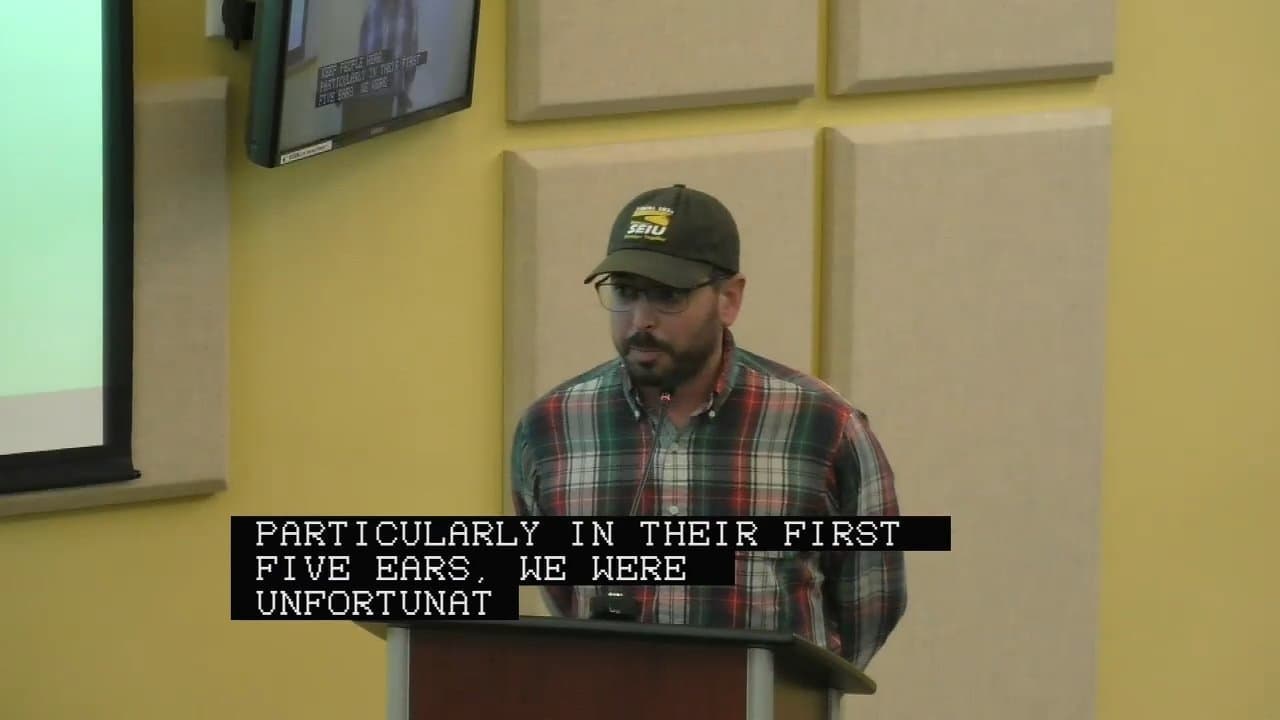
The other side: Kevin Arnold, Field Representative for SEIU 1021, said members are canvassing in support of locally controlled revenue. He said they will keep attending meetings throughout the bargaining cycle.
Arnold made several requests and points:
- He asked the city for flexibility to bargain unit by unit.
- He named health care and cost of living as top priorities.
- He thanked Matt Snodgrass of the POA for work on retention and affordability.
"We were unfortunate to see another 3 people leave the city of Rohnert Park in just the last pay period," said Arnold.
Decisions and stakeholder impacts: No action was taken. The comments frame a clear tradeoff. Taxpayers want specifics on how new revenue would be spent. City employees argue that without more local revenue, the city faces retention losses and severe decisions next year. A third speaker made wide-ranging remarks that were largely unrelated to city business.
What's next: SEIU 1021 says it will keep showing up as bargaining continues. Residents with questions about Measure K spending can raise them during public comment at future meetings.
Minor Items
- Consent calendar approved by voice vote; no tally was stated. Giudice praised two items: an Adrian Drive active transportation project with speed reductions (8J), for which SCTCA will handle federal reporting, and well rehabilitation (8L). He noted that "Rohnert Park produces about 40% of its own water."
- Proclamation: Mayor Emily Sanborn declared October 2026 National Disability Employment Awareness Month, honoring United Cerebral Palsy of the North Bay. Jeremy Hogan of the organization highlighted its Flipside thrift store, eco pods and day programs in the city.
- SCTCA report: Giudice said the authority kept staff recommendations for a bike-pedestrian overcrossing and a roundabout. It also funded a three-year Redwood Bikeshare extension and began Highway 37 resiliency work.
- New public safety leadership: Mayor Sanborn noted that "it's technically Chief Navarro's first day" as Director of Public Safety.
- Community calendar: Announcements included Founders Day events and Recology's reuse bazaar.
Looking Ahead
No councilmember requested new future agenda items. Watch for two things at upcoming meetings: the first fee deferral agreements large enough to require a council vote, and continued labor pressure as bargaining moves forward.