
City Council - Apr 30, 2026 - Workshop
City Council • Rio VistaApril 30, 2026
Locunity is a independent informational service and is not an official government page for this commission.We use AI-assisted analysis and human editorial review to publish information.
Rio Vista Faces Millions in Public Safety Needs as Revenue Outlook Darkens
Rio Vista's City Council got a sobering look at the gap between what its fire, police and public works departments need and what the city can afford, as a budget workshop revealed urgent capital requests colliding with declining cannabis revenue and a looming sheriff's contract increase. A real-time emergency — a multi-vehicle bridge accident that left a resident waiting 38 minutes for an ambulance — drove the stakes home.
Fire chief's top ask: replacing a 27-year-old ladder truck at roughly $1.8M, with used prices soaring and new builds taking nearly five years
All city ambulances were tied up during a bridge accident mid-meeting, illustrating the staffing and apparatus gaps Council is being asked to close
Police seek 8 additional Flock license plate cameras and explore purchasing adjacent property for a new station to replace a termite-infested modular building
Public Works proposes $420K in park improvements, $360K in water infrastructure and $270K to pave Rainier Court — the street project residents have demanded since it was cut from Measure K
City manager warns cannabis revenue is dropping "potentially pretty significant" and a new sheriff's contract will bring unavoidable increases, squeezing the general fund
Council directs staff to compile a comprehensive fund-by-fund budget spreadsheet for the May 20 follow-up workshop, where the hard trade-offs begin
A Bridge Accident Makes the Budget Case in Real Time
The fire chief arrived late to the workshop — and brought with him the most compelling argument of the evening. A significant multi-vehicle traffic accident on the bridge had required two ambulances and a helicopter, leaving a separate medical aid call without transport for 38 minutes.
Why it matters: The incident was a live demonstration of what the department's three biggest budget requests are designed to prevent: a city stretched too thin on command staff, apparatus and coverage.
Where things stand: The department reported 2,678 calls in 2025, roughly eight per day, and is fully staffed with firefighter paramedics for the first time in recent memory. But the chief's three priorities carry significant price tags:
1. Replacing the 1998 ladder truck (Truck 55): The apparatus has logged more than $100,000 in maintenance, including a $42,000 cracked-frame repair. New ladder trucks run approximately $1.8M to $1.9M with 56-month build times, though demo or stock units could cut delivery to 12–18 months with potential $100,000 cash discounts. The used market offers no relief — "There was a 2020 ladder truck that probably last year was in the seven to eight hundred thousand dollar range. And they're having it listed, starting bid at 1.2 million," said the fire chief. The truck lacks modern safety features including airbags, crumple zones and current braking systems. Engine 56, a 2007 unit, could potentially be refurbished at roughly a third the cost of new.
2. Reinstating the battalion chief position: Currently, only one captain can act in the chief's absence. The battalion chief would provide chief-officer coverage after hours, on weekends, holidays and during major incidents — exactly the kind of event that unfolded during the meeting.
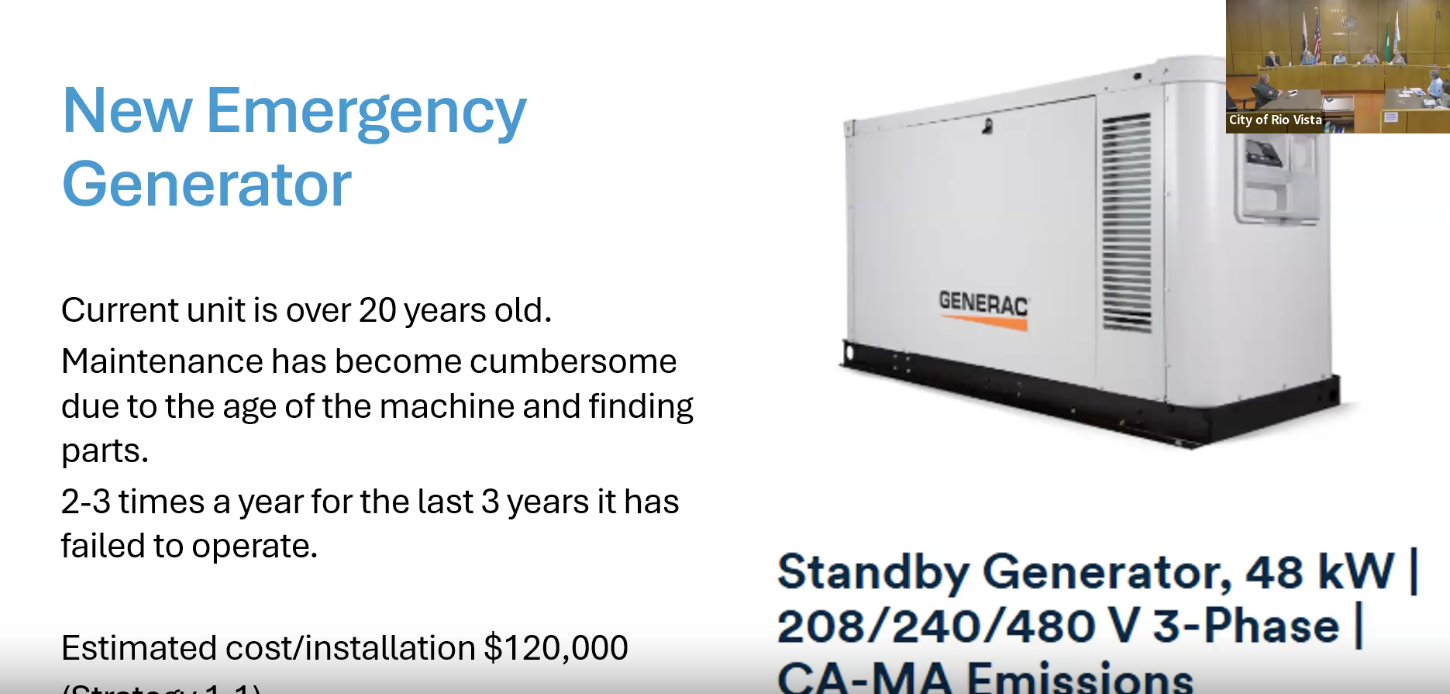
3. A new diesel generator ($120,000): The current 22-year-old unit is failing, with an 18- to 24-month lead time for replacement. An OES loaner generator may bridge the gap at no cost.
The other side: Councilmember Lisa Duke made the staffing argument personal. "When you said the ambulance took 38 minutes — in my small street, I've lived there 11 years. There's 12 houses and eight people have died on my street since I've lived there," she said, adding that she felt the city was "rolling the dice and just waiting for something to happen" by not funding the battalion chief.
Councilmember Sarah Donnelly pressed on a second fire station, asking about the timeline given ongoing development negotiations with Brand Ranch. The city manager noted utilities won't reach the planned station site until Phase 2 of that development, creating a gap that could stretch years.
Councilmember Walt Stanish proposed a creative interim solution: purchase the property adjacent to the current police station, relocate the city's Delta Breeze facility there, and temporarily house fire operations at the current Delta Breeze location near the airport. "It would make sense to me that if we did purchase that property next to the current police station that we could temporarily move Delta Breeze there, temporary move the fire department where Delta Breeze is until everything is settled with that second station," he said.
Vice Mayor Rick Dolk, drawing on fleet management experience, raised practical concerns about modern emissions systems on fire apparatus, noting the challenges DEF fluid requirements pose for vehicles that idle frequently.
What's next: The fire chief identified the ladder truck as his top priority if forced to choose one item, citing both safety and the 20-year planning horizon as the city grows with three-story development. Current fire apparatus loans will be paid off in 2028, potentially freeing up funds. The city manager encouraged exploring federal low-interest loans through USDA for apparatus purchases.
Police Station Crumbling; Department Seeks Cameras, Vehicles and Shields
The acting police chief — filling in on short notice during the regular chief's leave — presented a department working out of a deteriorating 2002 modular building and requesting targeted technology and equipment upgrades.
Why it matters: The police facility, now over two decades old, is infested with termites (requiring $70,000 in remediation) and rodents — a building the city has talked about replacing for roughly a decade without action.
Where things stand: The department operates 15 vehicles out of a 23-vehicle fleet, with 8 decommissioned units awaiting disposal. Four active patrol vehicles are six to eight years old with high mileage. The budget requests include:
1–2 new patrol vehicles
3 additional mobile data computers ($2,100–$5,000 each, depending on recycled components)
A Level 3 ballistic rifle protection shield ($8,300), reflecting the shift from handgun to rifle threats
8 additional Flock automated license plate recognition cameras ($19,200 annual recurring cost) covering key entry and exit points including McCormick Road, Providence Place, Kenright Road, Liberty Island Road, River Road, Airport Road, Second Street and Beach Drive. The current five cameras have proven effective for solving crimes.
On the facility, the city manager reported that an appraisal has been completed on an adjacent property and the city's consultant, Interwest, is evaluating renovation costs versus new construction. The property owner was described as very motivated. Councilmember Duke asked about using one of two available buildings for a temporary fire station, but the fire chief indicated it would not significantly improve response times. The city manager cautioned that the second building is essentially an empty shell requiring significant improvements.
Vice Mayor Dolk pushed for urgency: "The facility — I think we all agree it's inadequate at this point, but do we have kind of a plan as far as a time frame? It seems like we've been looking kind of the last, I don't know, decade, but haven't done much about it."
What's next: The Interwest evaluation will inform whether the city pursues renovation of the adjacent property or new construction — a decision that could shape the next decade of public safety infrastructure.
Public Works Lays Out Parks, Paving, Water Projects
The Public Works director opened the workshop with a comprehensive review of completed projects from the past year and proposed capital improvements spanning parks, streets, water and storm drains across multiple restricted funding sources.
Why it matters: With the park fund holding roughly $630,000 and RMRA street funds covering only one paving project, Council must decide how aggressively to spend down restricted reserves while maintaining capacity for future needs like the 17-acre Liberty park.
Where things stand: Completed projects included a Brownfield Army Base cleanup grant, EV charging installation, camera deployment, speed tables, Main Street bollards Phase 2, Front Street sidewalk extension, LED retrofits and community center improvements.
Proposed Park Fund 54 projects total roughly $420,000: a baseball field ($75,000), boat launch floodwall improvements ($30,000), pickleball courts ($200,000 with location to be determined due to noise concerns), a shade structure at Liberty playground ($30,000), Airport Road tree project Phase 2 ($50,000), Sierra Park horseshoe pit ($5,000) and a dog park ($30,000).
Water fund items include Well 17 design ($300,000) and State Revolving Loan Fund application engineering ($60,000). Storm drain CCTV Phase 1 is budgeted at $200,000. A wood chipper would cost approximately $27,000, supplemented by grant funds. And RMRA street funds of $290,000 would cover Rainier Court paving ($270,000) — the project residents have demanded since it was cut from the original Measure K list.
The Public Works director emphasized the importance of water infrastructure: "The next two pieces there, as far as the water fund, aren't a whole lot of money, but it's critical for us to keep moving down the road — to get this well designed so we can get into this state revolving fund."
The other side: Mayor Edwin Okamura questioned whether the city should deplete the park fund, noting it "was at a million just a short period" ago and asking what reserve level is appropriate. The Public Works director noted the fund currently holds about $630,000 after accounting for the shade structure project.
Vice Mayor Dolk flagged potential trouble with pickleball courts, citing Martinez's experience of tearing out recently built courts due to noise complaints. Councilmember Donnelly praised the department's output but zeroed in on Rainier Court, asking whether heavy trash vehicles making U-turns at the end of the cul-de-sac would simply destroy the new pavement again.
Councilmember Stanish raised a broader fiscal concern, asking how a potential elimination of the gas tax — being discussed by gubernatorial candidates — would affect Public Works funding.
A Rio Vista Little League representative made the only public comment of the evening, advocating for the secondary baseball field. She noted the league has just 105 registered players, the lowest in seven years since the league was revived after a six-year shutdown. Practice time and field assignments for different divisions are inadequate, she said, and the incoming Brand Ranch development will bring more families. She suggested the city provide the base, backstop and field while the league would collaborate on the rest.
Decisions: The Measure K street project received bids with the low bid just over $2M against a $3M budget, providing some fiscal cushion. Mayor Okamura directed staff to prepare a comprehensive spreadsheet showing all fund balances and the impact of each proposed project.
The Budget Bottom Line: Revenue Down, Costs Up
Woven through each department's presentation was the city manager's consistent fiscal caution — a warning that FY 2026/27 will be tighter than recent years.
Why it matters: The city faces a structural tension between urgent one-time capital needs (fire truck, police station, water wells) and recurring costs (battalion chief salary, sheriff's contract) that the general fund may not support.
The city manager was direct: "Things aren't going to look as rosy this year. We're looking at some drops in cannabis-based business revenue, potentially pretty significant, as well as a new contract with the sheriff's department that undoubtedly will have a large increase."
The municipal improvement fund holds just over $4.8M — reduced by $2.5M to account for a Measure K interfund transfer — and could fund capital purchases like fire apparatus or a police station. But recurring staffing costs like the battalion chief position require sustainable general fund revenue.
"I would love to have full staffing in every department. It's needed. I'm not denying that it's needed. It's whether we can pay them," the city manager said.
Councilmember Stanish pushed back on delay as a strategy: "If we would have bought a new engine two years ago, we'd be saving a whole lot of money and it might be getting closer to being delivered. The longer we put them off, the more it's going to cost us in the end."
What's next: Staff will compile all departmental requests into a comprehensive budget spreadsheet organized by fund, showing resulting fund-balance impacts. Council will reconvene for a follow-up budget workshop on May 20 at 5 p.m., where prioritization — and cuts — will begin.
Minor Items
Roll call and pledge of allegiance convened the special workshop session with all five councilmembers present: Mayor Edwin Okamura, Vice Mayor Rick Dolk, Councilmember Sarah Donnelly, Councilmember Lisa Duke and Councilmember Walt Stanish.
No speakers appeared during the general public comment period.
No ex parte communications were disclosed.