
Rio Vista Hires Retired Fremont Chief as Interim Fire Chief
City Council • Rio VistaOctober 6, 2026
Locunity is an independent informational service and is not an official government page for this commission. All information is sourced from public footage and an analysis of official agendas with the aid of responsible, fact-checked AI. to report an error or omission.
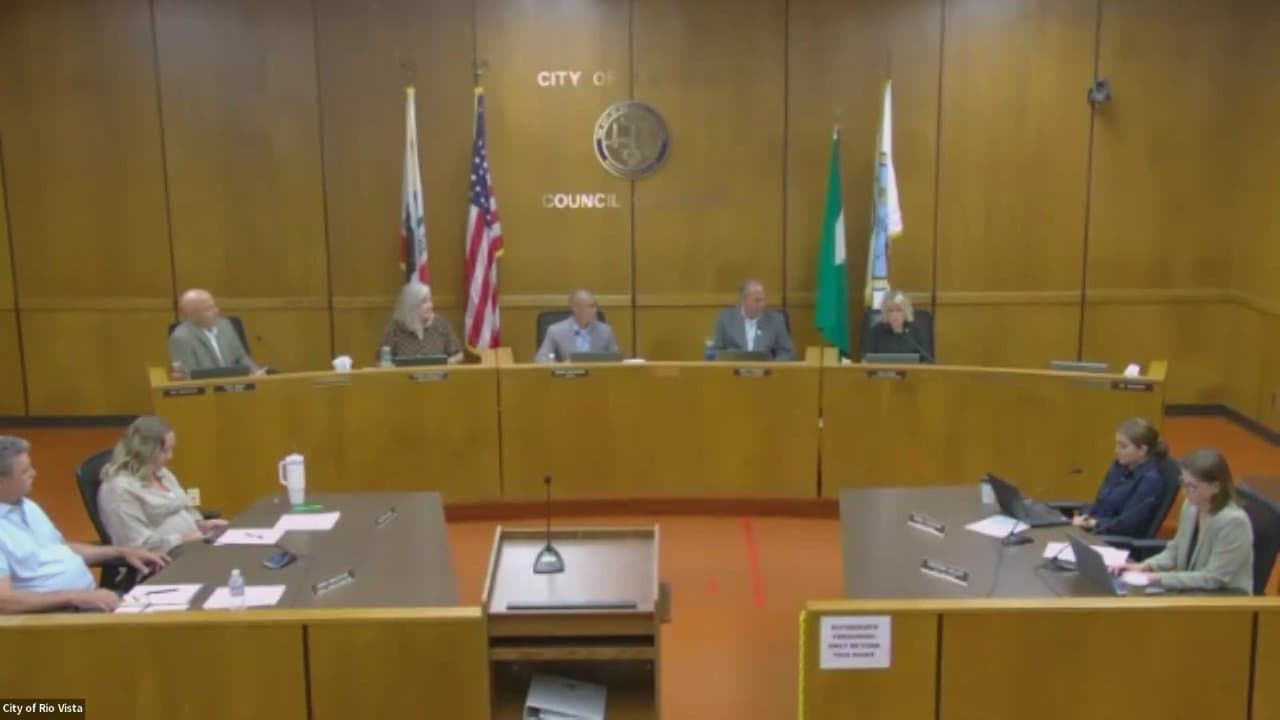
Rio Vista's fire department has a temporary leader again. The City Council voted 5-0 to hire Douglas McKelvey as interim fire chief at $83.30 an hour, with no benefits. The same meeting produced the night's only split vote, a 4-1 adoption of garbage can rules. Council also awarded a federally funded airport upgrade and referred a $100,000 private recreation pledge to the Parks and Recreation Commission.
- Interim fire chief approved 5-0: McKelvey will be paid $83.30 an hour, with no benefits and a 960-hour cap.
- $440,000 airport contract awarded 5-0: Covers the parking lot and ADA restrooms, with 95% FAA funding.
- Trash can placement ordinance adopted 4-1: Councilmember Walt Stanish dissented, warning against fines.
- Youth sports foundation pledges $100,000 toward volleyball, pickleball and a ninja course.
Retired Fremont Chief Steps In
Why it matters: Rio Vista's fire chief resigned effective Sept. 14. Without a replacement, the department's leadership gap would be covered by existing personnel working overtime. Staff called this agreement the most cost-effective option.
Where things stand: McKelvey rose to fire division chief at the Fremont Fire Department, a 136-member agency with 11 engine companies and two truck companies.
- He served more than 11 years as a battalion chief.
- He is a state fire training instructor.
- He ran a 17-recruit academy and holds a business administration degree.
City Manager Kristina Miller described the interim job as largely administrative, plus response to major incidents.
The basics: McKelvey is hired as a CalPERS retired annuitant. That arrangement caps his work at 960 hours per fiscal year and required council to adopt the agreement by resolution.
The terms:
- He serves until a permanent chief is appointed or March 15, 2027, whichever comes first.
- Pay is $83.30 an hour, Step E of the fire chief salary schedule, with no benefits.
- At that rate, the 960-hour cap limits pay to $79,968 in a fiscal year.
Vetting the pick: Vice Mayor Rick Dolk asked how many applicants the city considered. "I think there was about 5 that we looked at in total, maybe 6," said City Manager Miller. The candidates came through a recruiting firm and an internal review.
Councilmember Lisa Duke asked whether McKelvey had already used any of his 960 hours this fiscal year. "He has not used any hours," Miller said.
The other side: Councilmember Walt Stanish asked council to strike a contract sentence committing the city to send the interim chief to training events.
"I don't see the purpose in sending an interim fire chief to a training event, especially since he's not going to be here," said Councilmember Stanish.
Miller said the training was not required. She noted the chief may still need training on new apparatus, such as LifeVac, or briefings from OES, the state Office of Emergency Services. Mayor Edwin Okamura backed keeping some flexibility. "For instance, there may be a state of emergency because of the potential El Niño effect or something," he said.
"So again, we can say may as opposed to shall so that we're not obligated to do that," said Miller, offering the compromise.
Decisions and stakeholder impacts: Council reached consensus on the "may" language. Councilmember Sarah Donnelly moved approval and Councilmember Duke seconded. The amended agreement passed (For: 5 — Okamura, Dolk, Donnelly, Duke, Stanish; Against: 0; Absent: 0).
Firefighters get a seasoned leader and some relief from overtime. Taxpayers get a capped, benefit-free contract.
What's next: The city still needs a permanent chief. The interim deal also lands as Measure O, which funds most of the city's fire staffing, heads to voters in November (see Looking Ahead).
Federal Dollars Rebuild Airport Lot, Restrooms
Why it matters: The airport project will cost local taxpayers little, because the FAA covers 95% of it. The money also cannot be redirected to city streets.
Where things stand: Council accepted FAA airport grant funding on Sept. 15, 2026. The project includes:
- Removing dilapidated asphalt and laying new asphalt, curb, sidewalk and striping.
- Fully renovating the terminal restrooms to ADA standards.
Bids opened Aug. 26, 2026. Seven responsive bids came in, from $393,000 to $619,111.04. PRIDE Industries One, Inc. was the low bidder. A $7,000 additive alternate for restroom improvements brings the award to $400,000, plus a 10% construction contingency of $40,000.
The contractor's references from Roseville City School District and Placer County were satisfactory. Work is expected in November and December 2026.
The basics: The project is exempt from the California Environmental Quality Act (CEQA) under Section 15301, an exemption for existing facilities. The city's 5% local match comes from a $10,000 California Aid to Airports Program credit plus the airport fund.
The other side: Councilmember Stanish asked a question residents often raise: why is the airport getting paved when city streets need work?
"Greg, can you explain how doing the airport runway is different than our streets?" he asked.
The staff presenter explained the difference:
- The street project was paid for with Measure K and general fund dollars.
- Airport work runs on FAA and Caltrans grants that are limited to public-access improvements and must be used or lost.
"It can't be used for city streets or anything else," the staff presenter said.
Decisions and stakeholder impacts: Councilmember Stanish moved approval and Councilmember Donnelly seconded. The contract passed (For: 5; Against: 0; Absent: 0). Airport users and travelers with disabilities benefit most.
What's next: Staff said a runway project costing between $7M and $8M is in the works. "We hope to get funded by 2032," the presenter said.
Trash Can Rules Draw Lone Dissent
Why it matters: This was the only split vote of the night. The debate centered on how far City Hall should reach into residents' daily routines.
Where things stand: Ordinance 007-2026 amends Rio Vista Municipal Code Sections 8.12.030 and 8.12.040, which govern waste collection. The changes set rules on where residents may place collection containers. The ordinance was on the consent calendar for its second reading. Councilmember Stanish pulled it for discussion. No public commenters spoke.
The other side: Stanish argued the council was getting "in the weeds" with ordinances. He recalled bringing in a neighbor's cans in another city. He said communication works better than penalties, and suggested residents who want stricter rules could live in a gated community.
"I don't think we want to go as far as fining people because their garbage can's been out an extra few hours," said Councilmember Stanish. "So I don't think our city really needs this personally."
No other member spoke to the item.
Decisions and stakeholder impacts: The ordinance passed (For: 4 — Okamura, Dolk, Donnelly, Duke; Against: 1 — Stanish; Absent: 0). Residents now face formal rules on placing their trash containers. Stanish's dissent flags fines as the likely flashpoint once the rules are enforced.
$100K Pledge Could Seed Waterfront Rec Hub
Why it matters: A private donor and existing city money could combine into a larger recreation complex. Council members warned, however, that the full cost could run far higher.
Where things stand: During public comment, Ryan Mahoney, chairman of the privately funded Rio Vista Youth Sports Foundation, proposed adding to the city's planned pickleball courts. His pitch included a beach volleyball court, a rec park area and potentially a ninja course.
"As an organization, we're willing to commit $100,000 to support the construction of this in cooperation with the city," Mahoney said.
A council member noted the city's budget already sets aside about $200,000 for pickleball. Mayor Okamura praised growing momentum for public-private partnerships.
The other side: Councilmember Donnelly called the pledge generous but cautioned about the price tag. "I know that projects like this cost up in the millions, right?" she said.
She asked for a ballpark cost and other funding sources. She also saw economic development potential in pickleball tournaments near downtown. Recalling slow "pennies for playgrounds" fundraising, she said "our children were like in middle school by the time we raised enough money for 1 set of playground equipment."
Vice Mayor Dolk said he supports the idea but asked whether the waterfront specific plan would need changes. "I reviewed the concept and I think it would be consistent with the waterfront-specific plan," said City Manager Miller.
What's next: By consensus and without a vote, council referred the proposal to the Parks and Recreation Commission.
Minor Items
- Consent calendar passes 5-0: It includes Ordinance 008-2026, citywide rules for bikes, e-bikes and motorized scooters. It also includes a MetLife employee dental contract effective Jan. 1, 2027, and the Sept. 15, 2026, minutes.
- Fee waiver report accepted 5-0: Chris Armbrust of Rio Vision said the facility fee waiver list seemed incomplete. Mayor Okamura said an updated list had been released.
- 930 Airport Road talks: Council gave staff direction in closed session on the property's price and terms. Mayor Okamura recused himself, citing no conflict but wanting to avoid any appearance of impropriety.
- October proclamations: Council recognized Breast Cancer Awareness Month and Domestic Violence Awareness Month. SafeQuest Solano reported over 1,300 crisis line calls last year.
- Youth commissioner seats vacant: Several commissions need youth members. Councilmember Duke pledged to recruit from the high school's 25-member Rotary Interact Club.
Looking Ahead
Measure O appears on the November ballot. It extends a three-quarter-cent sales tax rather than creating a new one, and generates almost $1.4M a year. City Manager Miller said 92% of the funds support fire personnel, 7% law enforcement and 1% public works personnel. The measure supports two-engine fire staffing with paramedic-level service.
Little Egbert multi-benefit project: Proponents of the roughly 3,150-acre project at the Yolo Bypass terminus, just upstream of Rio Vista, made two changes:
- They amended the plan to reduce flooding through Watson Hollow Slough.
- They dropped proposed Mellen Levee improvements, citing negligible benefit. The city will evaluate that claim.
The project's environmental impact report is expected in spring 2027, when formal comments open.
Brand Ranch needs two Planning Commission hearings before it reaches council, with a special meeting anticipated in November. Separately, a land swap with the school district for a much-needed new municipal well is close. The district's talks with California Forever have stalled.