
City Council - Aug 04, 2026 - Meeting

City Council - Aug 04, 2026 - Meeting

City CouncilRio VistaAugust 4, 2026

Sources:

Locunity is a independent informational service and is not an official government page for this commission.We use AI-assisted analysis and human editorial review to publish information.

Rio Vista Moves to Ban Data Centers, Eyes Downtown Entertainment Zone

The Rio Vista City Council took its most aggressive land-use stance in years, directing staff to draft both an emergency moratorium and a permanent ban on data centers — before a single developer has even applied. In a wide-ranging three-and-a-half-hour meeting, the council also approved a $3.8 million sheriff's contract, launched a pilot entertainment zone for downtown, and received a sobering water system report showing the city 21.8% over its state conservation target.

  • Council unanimously moves toward banning data centers, citing water scarcity, energy demands, and incompatibility with the Delta city's character

  • $3.8M law enforcement contract approved for year one of a three-year deal with the Solano County Sheriff's Office, with graduated overhead rates

  • Downtown entertainment zone pilot advances, with staff directed to draft an ordinance allowing open alcohol consumption during events from the waterfront to 4th Street

  • City exceeds state water conservation targets by 21.8%, as critical Well 17 remains about a year from coming online

  • California Forever watch: a potential state budget trailer bill could fast-track a shipbuilding and foundry project near Rio Vista


No Data Centers in the Delta

Rio Vista joined a growing wave of California cities moving to block data center development — and it did so before a single application landed on the city manager's desk.

The basics: Planning Consultant Jana Wismer of Interwest presented four regulatory options: a complete prohibition, a temporary moratorium via urgency ordinance, regulated permitting through conditional use permits, or no action. She flagged that existing zoning language in the city's industrial districts is ambiguous enough that a developer could argue a data center qualifies as a use similar to manufacturing or R&D.

Why it matters: Data centers consume enormous quantities of water and electricity — two resources Rio Vista can't spare. The city already exceeds its state water conservation objective by nearly 22%, relies entirely on groundwater, and residents have experienced unreliable electricity in the core area. A data center would compound every pressure point.

City Manager Kristina Miller made clear at the outset that this was a preemptive effort.

"I did want to make it absolutely clear before we even get started that we have absolutely no application for a data center in Rio Vista. We are simply trying to get ahead of any potential application," she said.

Where things stand: Public comment ran overwhelmingly against data centers. Joan Savaris read a statement opposing them on environmental grounds. Tina Arnold urged the council to act quickly, saying many communities regret allowing them. Lila Mazo advocated for outright prohibition, citing water restrictions and incompatibility with the city's brand. Mr. Burton and Ms. Smith, retirees who chose Rio Vista for its small-town character, described press accounts of jet-plane-level noise running 24 hours a day. Sonia Rochelle called on Rio Vista to be a model for other small cities balancing development and environmental stewardship.

The other side: Mr. Elliott was the lone dissenter, arguing from personal data center experience that modern facilities use recycled water and technology has changed significantly. He supported option three — regulate rather than prohibit — warning the city shouldn't miss economic opportunities. Public commenter Chris Armbrust, a technologist, offered a historical cautionary tale: the town of Alviso rejected the Southern Pacific Railroad terminal and subsequently declined. He urged the city to work responsibly with emerging industry rather than refuse it outright.

On the dais, Mayor Edwin Okamura stood apart from his colleagues.

"I'm actually for the idea of having a moratorium so that we can do the necessary research," he said, adding later: "I just feel like we're shooting ourselves in the foot when technologies are ever evolving and changing."

He supported blocking data centers that would strain water or electricity but opposed a permanent ban.

The rest of the council pushed further. Councilmember Sarah Donnelly was blunt:

"I've heard also from my very good friend that in three years, data centers will be obsolete. And so we could end up with a building that has used a lot of our resources, that has harmed our health. And then it's an empty shell of a building."

Vice Mayor Rick Dolk compared the approach to how cities handled cannabis legalization:

"A lot of cities were doing moratoriums. They weren't saying we're for cannabis, we're against it. They're just saying we'd rather watch other cities make mistakes."

Councilmember Walt Stanish disclosed that his own experience with a proposed data center near property he owns in Utah prompted him to bring the issue to the council.

Decisions: The council reached unanimous consensus to direct staff to bring an urgency moratorium ordinance at the next meeting and simultaneously begin drafting a permanent prohibition ordinance that would go through the planning commission process. Councilmember Lisa Duke confirmed the two-step approach:

"The first step would be to get the urgency ordinance for the temporary moratorium so that if we did get an application, they can't move forward at all. And then we would move toward the total prohibition."

What's next: The urgency moratorium ordinance is expected at the next council meeting. The city manager noted a new state law extending public hearing notice requirements to 20 days may affect the timeline for the permanent prohibition ordinance.


Drinks on Main Street: Entertainment Zone Pilot Takes Shape

The council directed staff to draft an ordinance for a 12-month pilot entertainment zone that would allow open alcohol consumption during community events in downtown Rio Vista — a first for the city and a direct implementation of the state's SB 969.

The basics: SB 969, signed in 2025, authorizes cities to designate zones where alcohol purchased from participating licensed businesses can be consumed outdoors. Planning Consultant Jana Wismer presented four options: a permanent zone, monthly events, weekly events, or a pilot program. The proposed boundaries cover Front Street from the promenade to the boat launch, Main Street from the river to 4th Street, and connecting side streets.

Why it matters: Downtown Rio Vista has struggled with foot traffic and economic vitality. An entertainment zone could transform community events into walkable, open-air experiences that drive spending at local businesses — particularly those without outdoor patios.

Tammy Mitchell, president of the Rio Vista Downtown Association, framed the zone as an economic development tool. She advocated for the broader boundaries, a 12-month evaluation period, and inclusion of beer, wine, and spirits. Sienna Frazier, owner of the Flamingo Lounge, said the zone would benefit businesses like hers that lack outdoor seating and committed to working with the city on safety.

Chris Armbrust, speaking for RioVision, raised concerns about how the zone would interact with existing fundraising events where nonprofits sell alcohol, and asked whether property owners in the zone had been surveyed. Mr. Elliott asked practical questions about service pets, cannabis use in public, and security staffing.

Councilmember Walt Stanish drew on seven years of managing alcohol at the Bass Festival:

"In the seven years that I did it, we had one incident, and I was the cause of that incident because I stopped serving a patron because he had too much to drink."

He supported the broader 4th Street boundary and suggested businesses could make donations to nonprofits during events to address fundraising concerns.

Vice Mayor Rick Dolk initially proposed limiting the zone to 2nd Street out of concern for families.

"The older folks would really enjoy coming downtown. And then I'm just worried about creating an environment where families with children don't want to come downtown anymore," he said.

He ultimately agreed with the broader consensus.

Councilmember Sarah Donnelly emphasized measurement, calling for data on attendance, business sales, police calls, community feedback, and Delta Breeze bus ridership during events.

The Police Chief raised a practical concern: the city is covered 24/7 by only two officers, and larger zones require more coverage. City Manager Kristina Miller noted that existing overtime in the law enforcement contract is limited and frequent events could become cost-prohibitive — but added that the entertainment zone aligns directly with the city's strategic plan, specifically Item 4.11 to evaluate a food and entertainment arts district.

What's next: Staff will work with the state Department of Alcoholic Beverage Control to draft an event-based pilot ordinance with boundaries up to 4th Street and a 12-month evaluation period, processed through the Development Review Committee.


$3.8M Sheriff's Deal: Take-Home Cars, Uncertain Out-Years

The council unanimously approved a three-year law enforcement services agreement with the Solano County Sheriff's Office at $3,825,102 for year one — a 9% increase — but not without pointed questions about costs the city can't yet see.

Why it matters: This is Rio Vista's largest single expenditure. The contract maintains current staffing — one lieutenant acting as police chief, two sergeants, and nine deputies — but introduces graduated indirect cost rates that will rise from 3.1% in year one to 5% in year two and 7.5% in year three, compared to the county's standard 10% rate.

A major new provision allows all deputies to take home city vehicles within a 35-mile radius, adding an estimated 72,800 miles and $14,560 in annual fuel costs. The contract also includes 2,588 hours of overtime at $103 per hour; additional overtime is billed separately. The adopted budget projected a 7% increase; a $70,462 mid-year budget adjustment will be needed.

Councilmember Walt Stanish voiced the sharpest concern:

"This is my biggest rub — approving a contract where we don't know what years two and three are going to bring. We don't do that with any other contract that we do with any other vendor in the city."

He also flagged that the city has not been receiving a lieutenant as contracted and suggested using outside consultants for future negotiations.

Councilmember Sarah Donnelly offered a counterweight, noting that reduced liability insurance costs — $139,000 in savings — partially offset the increases since the city moved from its own police department to the sheriff's contract. Vice Mayor Rick Dolk agreed, saying service quality improved significantly after the switch.

Public commenter Chris Armbrust calculated the contract at roughly $350 per resident per year and asked whether comparisons to other cities' policing costs had been examined.

Mayor Edwin Okamura acknowledged the cost but noted advantages of guaranteed backfill staffing and suggested that future growth from the Brand Ranch development might eventually justify exploring an independent police department again.

Decisions: Approved 5-0 (For: Okamura, Dolk, Donnelly, Duke, Stanish; Against: none; Absent: none).


City 21.8% Over State Water Target

Public Works Director Greg Malcolm delivered a comprehensive presentation on the city's water system, revealing that Rio Vista residents average 78 gallons per person per day — well above the state's 2030 target of 42 gallons per day — and that the city exceeded its state conservation objective by 21.8% in fiscal year 2024-25.

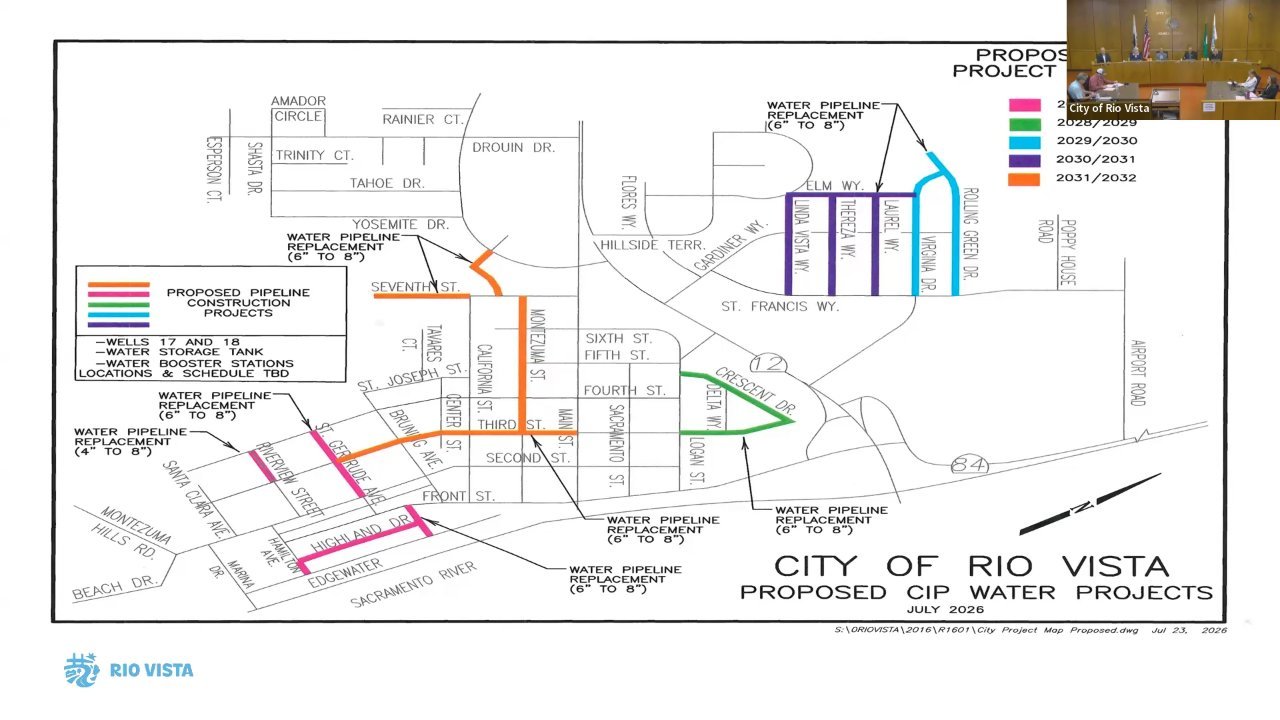
Why it matters: Rio Vista relies entirely on groundwater from the Solano subbasin through five active wells. The city has two 2-million-gallon storage tanks and plans a third at the city courtyard. Infrastructure upgrades covering over 50% of the core town were completed between 2010 and 2022 but stopped due to lack of rate increases. Proposed capital improvement water projects could resume in fiscal year 2027-28.

The presentation's most consequential detail: Well 17, described as critical because it can pump directly to the Amador tank serving downtown — eliminating the 2.5-mile pumping distance from Well 10 — could be operational in about a year, with details coming at the next council meeting.

The city's arsenic removal treatment facility, built in 2014, can treat up to 1,500 gallons per minute. Staff is working with the Solano County Water Agency on rebate programs to drive conservation.

Councilmember Lisa Duke pressed on specific gaps, noting that a section of 3rd Street between Maine and Logan isn't included in the paving or water line projects.

"I had quite a few people that live in that area asking," she said.

The public works director confirmed older lines remain in parts of the system.

What's next: The full presentation will be posted on the city website. Well 17 details will come before the council at a future meeting.


Minor Items

  • Special assessments and liens for unpaid utility charges and administrative citations approved unanimously through a public hearing. A second motion authorized the finance department to correct clerical errors. (5-0, both motions)

  • Consent calendar approved unanimously: July 21 council meeting minutes and June 2026 monthly departmental report.

  • California Forever update: No direct meetings with the developer, but the city manager reported a potential state budget trailer bill could streamline a shipbuilding and foundry project. GoBiz director Dede Myers indicated Rio Vista will be included in future discussions. Councilmember Donnelly noted California Forever is also engaging school districts in Rio Vista and Fairfield-Suisun.

  • Measure K road project — the largest in city history — completed streets near schools before the first day of classes. Airport Road will be closed from Church to St. Francis from Aug. 20-27 for slurry sealing, coinciding with Hog August Bites weekend.

  • Public Safety Commission reported two movable speed monitors installed in Trilogy in early July, with data now being analyzed. Chair John Parrinello said emergency preparedness programs are expanding from Trilogy to the Liberty development and other neighborhoods.

  • Planning Commission reported its first lot split application under the city's new general plan, on Main Street.

  • Measure K Oversight Committee lacks a quorum after its chair resigned; a special meeting will be scheduled.

  • Election filing is open for two council seats held by Vice Mayor Dolk and Councilmember Duke.

  • Front Street speeding was flagged by both a public commenter and council members; navigation apps are routing commuter traffic through the residential street near a school. The council requested patrol or traffic calming measures.

  • Public commenter Chris Armbrust praised the city manager and code enforcement for cleaning up the long-neglected Portuguese Hall property on 7th Street, noting abandoned vehicles were removed after a Thursday deadline.

  • Delta Breeze evening shuttle pilot was mentioned in the city manager's report as an upcoming transportation initiative.

Rio Vista Moves to Ban Data Centers, Eyes Downtown Entertainment Zone | City Council | Locunity