
Rio Vista Shelves Speed Cushions for Traffic Study, Passes Turf Watering Ban
City Council • Rio VistaNovember 18, 2026
Locunity is an independent informational service and is not an official government page for this commission. All information is sourced from public footage and an analysis of official agendas with the aid of responsible, fact-checked AI. to report an error or omission.
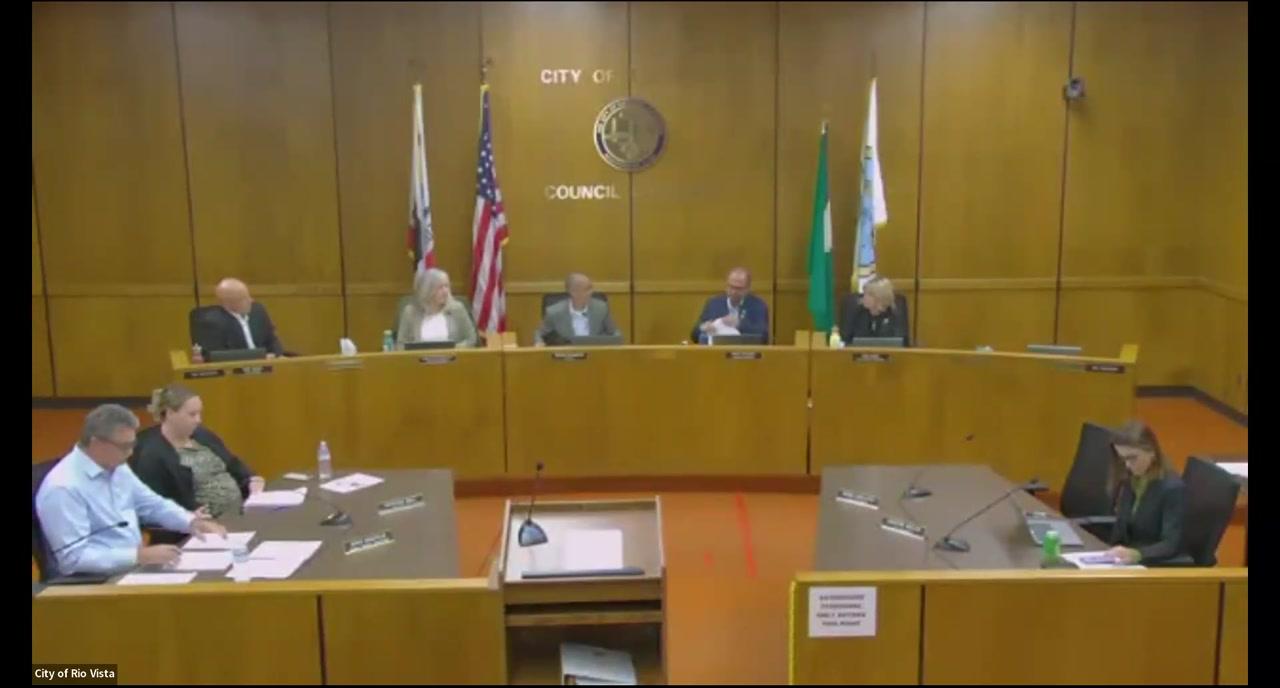
Rio Vista's City Council spent more time on two short stretches of South Front Street than on anything else, then chose not to spend $25,000 on speed cushions there until a citywide traffic study is complete. The council also voted 5-0 on a state-mandated ordinance barring drinking water for ornamental turf and split 4-1 on an Airport Advisory Commission appointment that drew pointed questions about how applicants are screened.
- $25,000 South Front Street speed cushion plan pulled with no vote; council will wait for a traffic study
- Nonfunctional turf ordinance passes 5-0, positioning Rio Vista for the state's Jan. 1, 2027, AB 1572 deadline
- Dale Ann Springer appointed to Airport Advisory Commission, 4-1, with Councilmember Lisa Duke opposed
- Seven applicants, few interviews: Councilmember Walt Stanish and public commenters questioned the appointment process
- Enforcement emerges as a recurring theme in the traffic debate, with a police chief recruitment underway
Speed Cushions Stall on South Front Street
Why it matters: Residents near South Front Street will wait longer for traffic relief. The council signaled it wants a citywide strategy and more enforcement rather than fixes made one street at a time.
Where things stand: Staff asked the council to fund speed cushions at two locations on South Front Street. The agenda put the cost at $25,000. Staff said drivers are speeding through residential areas and school zones, partly because traffic is now avoiding the speed tables on 2nd Street. Staff also noted the area lacks speed limit signs and said stop signs should not be used to control speed.
"Due to existing road geometry and multiple driveway locations on Front Street, Staff recommended the use of small speed cushions for this location," said staff presenter Greg, a city Director.
The other side: Councilmember Sarah Donnelly, who lives in the area, argued that cars parked along the street already push drivers toward the middle. That would let drivers straddle the cushions. She suggested a one-way option and crosswalks on North Front Street, and she urged colleagues to wait for the Planning Commission's traffic study. "We're sort of chasing speed bumps for the next person who asks for them," Donnelly said.
Two public commenters pushed in different directions. One favored short, round speed bumps over wide tables, described fast traffic at 5th and Main, and said they would support traffic cameras at intersections. Bill Mortimer, a public commenter, said enforcement is the missing piece and that drivers will get around speed bumps if no one writes tickets.
Decisions and stakeholder impacts: Colleagues quickly fell in line behind waiting. "So I'd wait for the traffic study personally," said Councilmember Walt Stanish. Vice Mayor Rick Dolk said he was open to speed bumps but added, "I'm willing to kind of sit back and see what the traffic study says."
Mayor Edwin Okamura left the door open to acting on South Front later. "It's not mutually exclusive either that we don't have something to mitigate it on South Street versus North, but the study hopefully would vet that out," he said. The Mayor confirmed the item was pulled and no action was taken.
The outcome favors a slower, data-driven approach over neighborhood-by-neighborhood requests. That is a trade-off for South Front residents and families in the school zone, who keep the current conditions for now. Donnelly said she had raised school bus concerns with the school superintendent. Okamura noted that hiring a new police chief could bring more traffic enforcement.
What's next: The proposal waits on the Planning Commission traffic study. No date for that study was given.
Turf Ordinance Clears Council Unanimously
The basics: AB 1572 is a state law that phases in a ban on using potable water, meaning drinking-quality water, to irrigate "nonfunctional" turf. That is decorative grass on commercial, industrial, institutional, HOA and similar properties. The property deadlines run from 2027 to 2031.
Why it matters: The city must update its local rules by Jan. 1, 2027. Missing that deadline risks penalties and the loss of turf-replacement funding. Staff reported no financial impact and said the ordinance is exempt from CEQA, the California Environmental Quality Act.
Where things stand: Staff framed the ordinance as a compliance task. Under state rules, "public water suppliers must revise their ordinance, regulations, or policies by January 1st, 2027, and communicate these changes to customers," said Greg, the staff presenter.
Council questions centered on what counts as "functional" turf. Staff said the promenade, parks, park-like areas and golf courses all qualify. Members also asked about HOA entrances such as those at Trilogy and noted how little water the city itself would save. "It almost seems like the definition of ornamental lawn is kind of loose," said Vice Mayor Rick Dolk.
Mr. Elliott, a public commenter, asked whether a golf course would have to stop watering its out-of-bounds roughs. The Mayor replied that golf courses are treated as parks and are exempt.
Decisions and stakeholder impacts: Donnelly moved the ordinance and Stanish seconded. It passed 5-0 (For: Okamura, Dolk, Donnelly, Duke, Stanish; Against: 0; Absent: 0). The agenda described the item as an introduction and first reading, while the motion as spoken referred to adoption.
Commercial, industrial, institutional and HOA property owners will need to plan for phased limits on decorative grass. Residential customers are not covered for now, though Donnelly flagged that this could change. "I know this doesn't apply to those residential customers, but I'm thinking probably in the future it will," she said.
What's next: The agenda anticipated final adoption at a following meeting. Watch for a second reading to confirm the ordinance's status.
Airport Pick Passes 4-1 Amid Process Questions
Why it matters: Appointments to advisory commissions shape who advises the council. The debate exposed frustration over how the Mayor screens applicants and whether they hear back.
Where things stand: Councilmember Walt Stanish pulled the item from consent, noting that seven people applied over two rounds. "I just want to know if all the applicants were interviewed for this position," he asked.
Mayor Edwin Okamura replied that he had talked with several applicants and screened the applications as he would in a hiring process. Stanish said it would have been encouraging for applicants to hear back. The Mayor then pointed to past practice: "Council members in the past have turned down applicants merely because they had a wrong date on it or items like that," he said.
The other side: Tom Nowak, a public commenter, asked why all seven applicants were not interviewed. A second commenter objected to the Mayor's remark about form errors, saying it was not in good spirit.
Decisions and stakeholder impacts: Okamura moved the appointment and Stanish seconded it, despite his earlier questions. Dale Ann Springer will fill the remainder of a term ending Jan. 1, 2029. The vote was For: 4 (Okamura, Dolk, Donnelly, Stanish), Against: 1 (Duke), Absent: 0.
The seat is filled, but the episode could put pressure on how future commission vacancies are handled and how applicants are notified.
Minor Items
- Consent calendar approved 5-0, covering October minutes, financial reports, Shade Sail project completion and three State Revolving Fund reimbursement resolutions.
- Conflict of Interest Code updated 5-0 to make the economic development manager a designated financial disclosure filer.
- Sidewalk notices reset: After resident John Lampa said repair notices listed prices without describing the scope of work and some went to wrong addresses, staff conceded, "I think we kind of got ahead of ourselves. We're backtracking a little bit."
- K-rails as fencing: Councilmember Lisa Duke called them "not an approved form of fencing"; the City Manager said a new code enforcement officer will help address the issue.
- Storm prep and California Forever: The City Manager warned of a Super El Niño and urged households to be self-sufficient for 72 hours. The city also restated its concerns about the Suisun Expansion Plan draft EIR to Gabe Metcalf.
Looking Ahead
The proposed Brand Ranch project was set for its first Planning Commission hearing the night after this meeting. The project includes up to 1,073 single-family homes, parcels for up to 52 multifamily dwellings, parks, a required firehouse and a school district agreement. A City Council hearing will follow and requires 20 days' public notice.
The Mayor also asked staff for a status report on the sidewalk program in about a quarter. City recruitments continue for an economic development manager and a police chief, and the city has a contract in place to recruit a fire chief.