
Richmond Charts $20M Keller Beach Sewer Fix, Extends Data Center Pause
City Council • RichmondOctober 20, 2026
Locunity is an independent informational service and is not an official government page for this commission. All information is sourced from public footage and an analysis of official agendas with the aid of responsible, fact-checked AI. to report an error or omission.
Richmond's City Council spent more of its Oct. 20, 2026 meeting on a failing sewer line under Keller Beach than on any other issue. It voted 7-0 to pursue a quick interim diversion and a longer-term fix to the shoreline pipe. The council also unanimously extended its data center moratorium to 2028, heard that $99.7 million in Chevron settlement money remains unspent and signaled that disabled residents should not pay for blue curb parking.
Keller Beach sewer: 7-0 for an ~$800,000 interim diversion plus a Group B pipe fix, with a roughly $20 million total price tag
Data center moratorium extended to Sept. 15, 2028, 7-0, after environmental justice groups urged a permanent ban
$99.7 million Chevron settlement balance untouched, as police union and youth advocates stake competing claims
No fee for blue curb parking: a majority of the council opposed charging disabled applicants
Keller Beach Sewer: Fast Patch, Bigger Fix
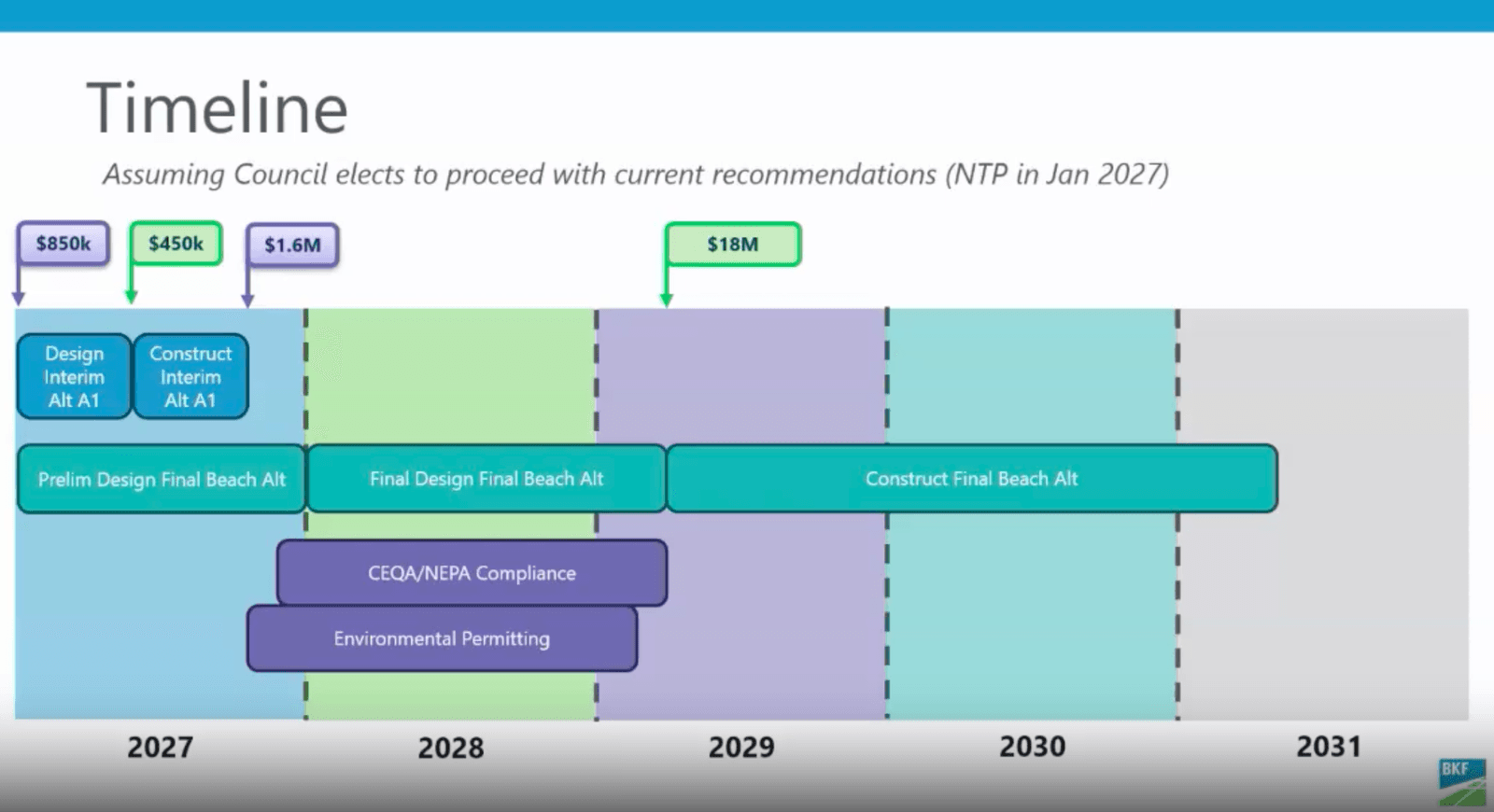
Why it matters: The pipe along the Keller Beach shoreline is failing, and a sewer connection moratorium in Point Richmond is set to expire in February 2027. The full fix is estimated at roughly $20 million over four to five years. A $1.7 million EPA grant, pending acceptance, covers design only.
Where things stand: Staff and consultant BKF presented seven alternatives in three groups. Group A diverts flow; its interim option, A1, would cost about $800,000 and divert about 17% of flow. Group B rehabilitates or replaces the pipe on the beach, with B1 estimated at $17.4 million. Group C relocates the line to streets and would require five to six pump stations. The scoring found no silver bullet, but Group B ranked best. BKF recommended pursuing A1 and a Group B final design at the same time.
Councilmember Cesar Zepeda leaned toward full replacement built for sea-level rise. He tied the project to the city's 2018 Baykeeper settlement, which he said "does ask that we repair or replace 2 miles of pipe annually."
The other side: Councilmember Soheila Bana challenged the scoring, which weighted construction at 15% and operations and maintenance at 25%. "I'm still surprised of 15% and 25% without actually weighing the cost," she said. Bana and public commenter Claudia Citroën asked why septic tanks were not studied. Staff said septic tanks fell outside council direction and that a holding-tank policy returns in November.
Councilmember Sue Wilson pressed on who pays. "I think what you're telling me is we have an obligation to put them on sewer lines," she said of the 290 connections. Staff confirmed that sewer service is a city obligation funded by the wastewater enterprise fund. A special assessment district, staff added, would require a vote of property owners.
Neighbors want speed: Point Richmond residents largely backed the consultant's plan. Philip Rosenthal, speaking with the blessing of the Point Richmond Neighborhood Council's land use committee, rejected septic tanks and urged quick action on a gravity solution. Brenda Greenwood supported Options B1 and B2 and immediate action on A1, saying she hoped to end the moratorium. Eric Greenwood, a licensed civil engineer, said Alternative C has more problems than reported. Caller Don Mill questioned the scheduling delays, citing a $75,000 contractor bid for a simple rerouting.
Decisions and stakeholder impacts: The council voted to receive the report and direct staff to move ahead with A1 while developing the Group B final solution, leaning toward B2 (For: 7, Against: 0, Absent: 0). No money was appropriated. Wastewater ratepayers carry the long-term exposure, and Point Richmond property owners remain under the connection moratorium until the line is fixed.
What's next: Staff will return with design work and a financial plan in early 2027. The holding-tank policy comes back in November.
Data Center Pause Stretches to 2028
Why it matters: No data center applications are pending, but Richmond's zoning code has no rules for them, and Pittsburgh, Hayward and Gilroy have already approved projects. The extension gives the city time to study the issue and write rules.
Where things stand: Planning Manager Avery Stark said the 45-day moratorium under Ordinance 13-26-NS would expire Oct. 30. The new urgency ordinance restates that pause and extends it by 22 months and 15 days under Government Code 65858. That law allows cities to adopt temporary zoning freezes but requires a four-fifths vote. The ordinance includes findings that it is exempt from CEQA, the state's environmental review law. Staff has issued a request for proposals (RFP) for consultants.
The coalition: Speakers from United Native Americans, Communities for a Better Environment (CBE) and Reclaim Our Power pushed past a pause toward a ban. Quanah Parker-Brightman of United Native Americans cited tribal bans, water consumption and PFAS, the so-called "forever chemicals." Wilder Zeiser of CBE urged a full extension without weakening and a community process that considers a citywide ban, citing the city's pollution burden. Shawna Lazaro, CBE's co-legal director, called the moratorium legally defensible and pointed to proposed PG&E rate increases tied to data center load. Colin Andrew Logan of Reclaim Our Power backed a permanent ban. Tarnell Abbott warned of job displacement and ratepayer subsidies.
The other side: Public commenter Mark Wasberg opposed the moratorium and said opponents lacked specifics. His demeaning remarks about Native Americans prompted a hostile exchange.
Council questions: Bana asked about OpenAI's leased Richmond property; staff said it is a robotics laboratory, not a data center. Councilmember Jamelia Brown asked for evidence from both sides. "I want to have the facts that I can compare and contrast so I can make an informed decision," she said. Councilmember Claudia Jimenez pushed for robust outreach: "We want to hear the residents and center them more than anybody else."
Decisions and stakeholder impacts: On a motion by Zepeda, seconded by Brown, the ordinance passed (For: 7, Against: 0, Absent: 0), clearing the four-fifths threshold. Environmental justice groups won time. Developers face a pause of nearly two years in a region where neighboring cities are saying yes.
What's next: Watch for consultant selection through the RFP and for community engagement on permanent rules.
Chevron Money: Whose Fund Is It?
Why it matters: How the council classifies the settlement determines what it can spend the money on. That question now runs into a police staffing ballot measure claiming Chevron money would fund new officers.
Where things stand: Director of Finance Emily Combs reviewed three audited years: surpluses of $13.1 million and $8.65 million, followed by a deficit of about $820,000. Reserves stood at 25%, 26% and 24%, against a 21% target. "Across all three years, general fund reserves remained above the council-adopted target," Combs said. The settlement totals $550 million over 10 years. The city has received $100 million to date, sent $3 million to Kids First and earned about $2.7 million in interest, for an estimated balance of $99.7 million.
The competing claims: Ben Theriault, president of the Richmond Police Officers Association, argued that the settlement is general fund revenue that can pay for personnel and training. Youth from APEN pressed for a say in how the money is spent. Hassan Alazani, 15, asked for teen jobs, internships and activities. Catherine Lee cited Chevron-linked cancer risk.
On the dais: Mayor Eduardo Martinez sided with the general fund framing. "It's not separate money," he said. Bana countered that a September 2024 council resolution restricts commitments of the funds. Wilson warned against using one-time revenue for permanent positions.
Decisions and stakeholder impacts: This was an informational item, and the council took no vote. The balance remains unallocated, leaving police, youth and environmental advocates competing for the same pool.
What's next: The Dahlberg Advisors community engagement contract and plan return Nov. 10.
Blue Curb Parking Stays Free
Why it matters: The program would standardize how residents request on-street accessible parking. Staff estimate it would take 56 to 221 staff hours a year, plus capital costs of up to $200,000 per space. A sidewalk program need of roughly $5 million a year also remains unfunded.
Where things stand: Public Works and consultant Fehr & Peers outlined the application process, a two-phase review, full-block siting, two-year renewals and removal procedures. From 2019 to 2024, the city received about 21 applications a year and approved about 60%. Sarah Kanter, a wheelchair user, urged more spaces, coverage in commercial areas and approval even where curb cuts are missing.
The fee fight: A majority opposed charging applicants. "I don't think we should have an application fee," said Vice Mayor Doria Robinson, who also questioned the full-block siting approach and whether engineers should judge walking distance. Staff said applicants describe their own needs and engineers do not determine disability. "I do not have a desire to charge disabled folks for accessibility," Brown said. Bana stood alone in favoring a fee paired with an honor-system waiver. The interim city manager noted the risk that shared spaces could be abused and said a fee would not buy applicants ownership of a space.
Decisions and stakeholder impacts: The council voted to receive the draft and direct staff, with a sense of the council against any fee (For: 7, Against: 0, Absent: 0). Disabled residents likely avoid fees, but staffing and capital funding remain unresolved.
License plate reader study: The council approved a $20,000 contract amendment with Police Strategies, LLC, 7-0, after Wilson said "the scope of work is a little bit thin" and required a one-page research design first.
Consent calendar: Passed 7-0. The appointment of Crescent Diamond to the Community Police Review Commission (V6B) was pulled.
Housing Authority: Commissioners approved contract amendments with Bayhawk Inc. and Net Electric, 8-0.
Agenda shuffle: Items Y7 and Y8 were withdrawn and Y2 was moved to Nov. 17. Don Gosney and Claudia Citroën criticized the handling.
Point Richmond pushback: Two residents opposed the Downtown Point Richmond Connectivity Project, citing about 65 lost parking spaces and evacuation risk.
Looking ahead: Applications for permanent city manager close Nov. 1. Public input forums are set for Oct. 28 from 2 to 3 p.m. in person and Oct. 29 at 10 a.m. on Zoom. The Dahlberg settlement engagement plan returns Nov. 10, and Y2 comes back Nov. 17.