City Council - Apr 29, 2026 - Meeting
City Council • RichmondApril 29, 2026
Locunity is a independent informational service and is not an official government page for this commission.We use AI-assisted analysis and human editorial review to publish information.
Council Hires Consultant to Shape $550M Chevron Payout as Transit and Earthquake Warnings Loom
Richmond's City Council waded through a marathon session that put a generational question at center stage: how to spend half a billion dollars from Chevron while the region's transit lifelines teeter on the edge of collapse and scientists warn a major earthquake could hit before the money runs out. The April 29 meeting produced three consequential votes, a sobering seismology briefing, and a late-night punt on street vendor rules — all underscoring a city navigating enormous opportunity and enormous risk at the same time.
Council approves consultant to lead community process for $550M Chevron settlement spending — but two members dissent over pace and philosophy
Pullman neighborhood moves one step closer to its first park after 20 years of advocacy
$300K port-funded study greenlighted for relocating WWII Victory ship to Ford Point; skeptics cite $16–20M funding gap
UC Berkeley scientists warn of 32% chance of a major Hayward Fault earthquake by 2044; ad hoc committee formed
BART director tells council: without a ballot measure, trains stop running at 9 PM starting January 2027
Sidewalk vendor ordinance overhaul delayed to May 5 as council runs out of time
$550M, but How Much Is It Really Worth?
The basics
Richmond's 10-year, $550 million Chevron settlement — branded internally as "limited-term revenues" — is the largest financial windfall in the city's history. Before a dollar is committed, council approved hiring Dalberg Advisors to run a seven-month community engagement process to build an expenditure framework and investment strategy.
Why it matters
The headline number is misleading. City Manager Shasa Curl told council that after applying a discount rate, the present value of the $550 million is closer to $380–466 million — a point she said would be explored further at the May 5 budget session. Three labor memoranda of understanding remain unfinished, and Curl recommended waiting until those negotiations close and the engagement wraps before making spending commitments.
Where things stand
Out of 1,170 vendors notified through the RFP, only 11 proposals came in. A cross-departmental evaluation panel ranked Dalberg Advisors first based on qualifications and interviews. Finance Department staff member Avinesh Nadan presented the procurement process.
Emma Ishii of the Asia Pacific Environmental Network — part of the coalition behind the Polluters Pay campaign that produced the settlement — urged the council to pick a consultant that shares the city's just transition values and reaches the most-impacted communities.
Councilmember Sue Wilson pushed for the engagement to explicitly address "the concept of a just transition" in a post-Chevron world.
Curl signaled she favors a conservative investment approach:
"Assuming like a 4% rate on return on $100 million — we're going into year two — that could give the council $4 million next budget cycle to appropriate."
The other side
Councilmember Jamelia Brown voted no, pressing for action over more process.
"I want to move away from studying the problem to actually addressing it, because we are a city where many residents — you can go out right now and ask them what are the top three, five priorities? They'll tell you," she said.
Mayor Eduardo Martinez also voted no, arguing the settlement funds belong in the holistic budget picture.
"This money is general fund money. It's not special fund money. And when we start looking at the budget as separate issues, we tend to have a budget that's skewed and not holistic," he said.
Decisions
The motion passed 5-2 (For: Bana, Jimenez, Wilson, Robinson, Zepeda; Against: Brown, Martinez).
What's next
Dalberg's scope is advisory only — facilitating engagement, documenting community priorities, and presenting a proposed expenditure framework. The May 5 budget session will begin detailed discussion of discount rates and investment strategy. No settlement funds will be committed until MOUs are finalized and the engagement process concludes.
A Park for Pullman: First Step After Two Decades
Why it matters
The Pullman neighborhood has roughly 9,000 residents — 25% of them under 18 — and no park. The area is hemmed in by Carlson Boulevard, Cutting Boulevard, and other high-speed corridors that rank among Richmond's most dangerous roads.
Where things stand
Vice Mayor Doria Robinson introduced the item, asking staff to explore acquiring two vacant parcels at 6 South 27th Street and Florida Avenue. She emphasized she was not requesting acquisition or construction funds — just a staff analysis of the pathway.
"For over 20 years — wanting a park for the kids that live in this neighborhood because there is no park," Robinson said, adding that the neighborhood "is bound by three very dangerous roads."
Naomi Williams, president of the Pullman Neighborhood Council, has championed the cause for more than two decades. She told council that the south side of Richmond has been neglected in city park investments. Five community speakers supported the item.
Councilmember Sue Wilson asked staff to simultaneously examine park-deficient areas citywide per the existing parks master plan. Councilmember Claudia Jimenez co-sponsored the item.
Decisions
The vote was 7-0 unanimous. Staff must return with recommendations within 90 days.
Can a WWII Ship Save Itself? Council Bets $300K on a Study
The basics
The SS Red Oak Victory — the last surviving ship built at Richmond's Kaiser Shipyard during World War II — sits at an isolated berth in Basin 5 of Shipyard Number Three. It generates roughly $150,000 in annual revenue. A move to Ford Point, near the Rosie the Riveter National Historical Park and the Richmond ferry terminal, could boost that figure to approximately $1 million, according to the ship's crew. But building a new wharf would cost an estimated $16–20 million.
Why it matters
Port Director Charles Girard presented the proposal: a $299,797 contract with Liftech Consultants for existing-conditions assessment, cost analysis, permitting pathway, and preliminary 15% design, funded entirely from the Port Enterprise Fund — not the general fund.
National Park Service (NPS) Acting Superintendent Elaine Jackson Rotondo said NPS has an interpretive preference for keeping the ship at its historic location but clarified the agency cannot direct physical management decisions and is statutorily prohibited from spending appropriated funds on the ship.
Twelve public speakers — mostly crew volunteers — passionately advocated for the study. Public commenter Claudia Citroen offered the sharpest dissent, calling the feasibility study deceptive for excluding the full relocation price tag.
The other side
Councilmember Sue Wilson cast the lone no vote, citing no identified funding source for the construction itself.
"I don't have a lot of confidence that I think we're going to end up spending $300,000 to reach a conclusion that I'm sort of reaching tonight — is that people love this ship, but nobody's coming forward to pay for it," she said.
Councilmember Claudia Jimenez supported the study but urged Congressman John Garamendi's office to commit significant federal funding. Councilmember Soheila Bana echoed support, emphasizing the ship's tourism and educational potential.
Decisions
The motion passed 6-1 (For: Martinez, Bana, Jimenez, Robinson, Zepeda, Brown; Against: Wilson). The contract runs through June 30, 2027.
32% Chance of the Big One: Scientists Sound Alarm on Hayward Fault
Why it matters
Richmond sits squarely in the impact zone of the Hayward Fault, and UC Berkeley scientists told the council the numbers are sobering: a 32% probability of a magnitude 6.7 or greater earthquake before 2044, with potential shaking intensity of MMI 8–9 and very high liquefaction risk across parts of the city.
Where things stand
Councilmember Soheila Bana organized the session, bringing together the Berkeley Seismology Lab, the UC Berkeley Center for Smart Infrastructure, Community Emergency Response Team (CERT) volunteers, and the West Contra Costa Fire Safe Council.
Suresh Raman from the Berkeley Seismology Lab laid out the probabilistic seismic hazard data. Professor Kenichi Soga of the Berkeley Center for Smart Infrastructure demonstrated computational simulations showing how a major quake would trigger cascading infrastructure failures — buildings, pipelines, and roads failing in sequence — and modeled recovery timelines.
CERT volunteer David Swanson stressed the practical gaps: most Richmond neighborhoods lack incident command posts, ham radio communication networks, and supply caches. Cell phones and internet will fail after a major quake, he warned. Rocky Saunders of the West Contra Costa Fire Safe Council advocated for a "neighbor to neighbor" philosophy of mutual aid.
What's next
Mayor Eduardo Martinez appointed an ad hoc committee — Bana, Councilmember Jamelia Brown, and one additional member — to develop policy and budget recommendations for neighborhood-level emergency preparedness, including expanded CERT training and supply caches.
BART's Fiscal Cliff Reaches Richmond's Doorstep
Why it matters
BART Board Director Barnali Ghosh delivered a stark warning: BART's pre-pandemic operating model depended on fares for 71% of costs — far more than peer transit agencies. Remote work has permanently depressed ridership, creating a $376 million annual deficit beginning in fiscal year 2027.
Where things stand
BART is backing a proposed five-county, 0.5% sales tax measure (1% in San Francisco) on the November 2026 ballot that would generate $310 million annually. Without it, BART plans to close at 9 PM daily starting January 2027, reduce to three-line service, and eventually shutter up to 15 stations. Ghosh went further:
"If at any point it is determined that BART can't safely or legally operate without available resources, we will need to stop passenger service."
Vice Mayor Doria Robinson connected BART's potential failure to the foundation of the city's housing policy:
"For the last 10 to 20 years we've been focused on transit-oriented development. And in that transit-oriented development, you actually do not allow for enough parking... If we lose our transit systems, our whole philosophy around development falls apart."
Public commenter Sarah Kanter, a wheelchair user, highlighted chronic elevator failures at BART stations, urging investment in accessibility once new funding is secured.
Separately during open forum, Ryan Lau of AC Transit warned of a $200 million deficit over four years, with potential 16% service reductions and 300 job losses by June 2027 without new sustainable revenue — underscoring that the transit crisis extends well beyond BART.
Sidewalk Vendors Wait Again as Clock Runs Out
Staff presented proposed amendments to Chapter 7.42, the sidewalk vendor ordinance, addressing waiver provisions for equipment size, ability-to-pay provisions for fines, compliance with SB 635 (which protects vendor personal information from immigration authorities), and a new definition of "solicitation."
Councilmember Cesar Zepeda moved to accept the first reading with a solicitation definition amendment, but Councilmember Claudia Jimenez raised concerns about rushing the item. City Manager Shasa Curl suggested continuing to May 5 so members could submit questions in advance.
Estefany Sanchez of Super Churros — a family business that has served Richmond for 27 years — asked to be grandfathered into her original vending location, telling council the business has donated to schools, police, firefighters, and hospitals.
The item was continued to May 5.
Minor Items
Consent calendar passed unanimously (7-0), including establishment of a sister city commission for Sebastia, Palestine. Multiple speakers from Richmond for Palestine and Richmond Jews for Palestine thanked council during open forum.
E-bike share contract amendment (O4C) pulled from consent at the request of Claudia Citroen and continued to the next meeting.
RPOA President Benterio used open forum to argue police understaffing delays justice for domestic violence, homicide, and sexual assault victims, challenging council members opposing staffing recommendations to explain their positions publicly.
Public commenter Saad Afzal, a former Tesla Autopilot engineer, proposed an AI safety pilot using smart glasses on the Carlson and McDonald corridors to collect data for federal Safe Streets for All grant applications.
Public commenter Cordell Hendler requested a Salesian College Prep Service Day proclamation and urged investing Chevron settlement money in street repairs and police hiring.
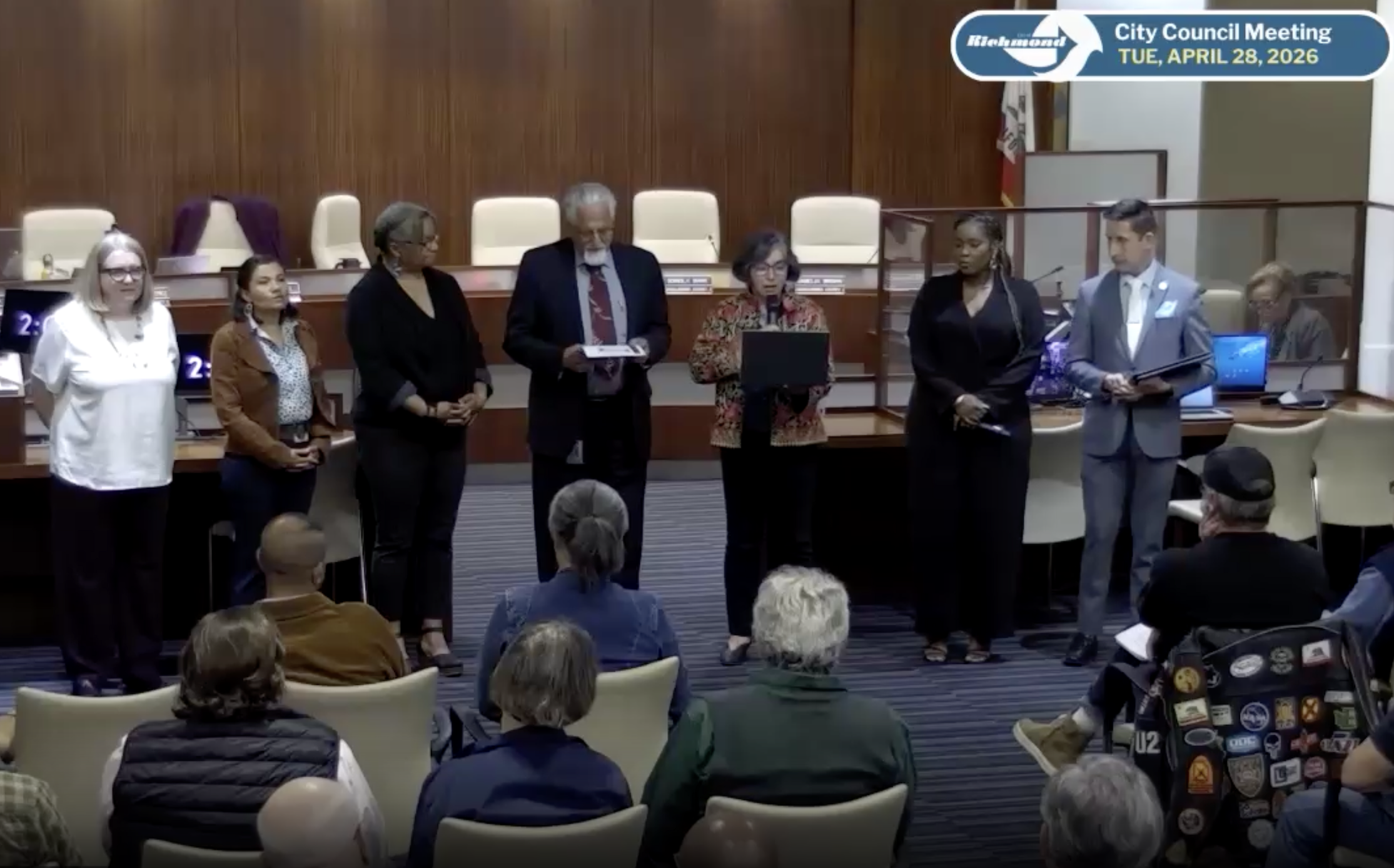
May 2026 proclaimed AAPI Heritage Month, with a May 2 community celebration at the Richmond Auditorium featuring 20+ partner organizations and free food from Eritrean, Afghan, and Nepali communities. Susan Kim of the SAGE Center spoke about visibility and solidarity for AAPI communities.