
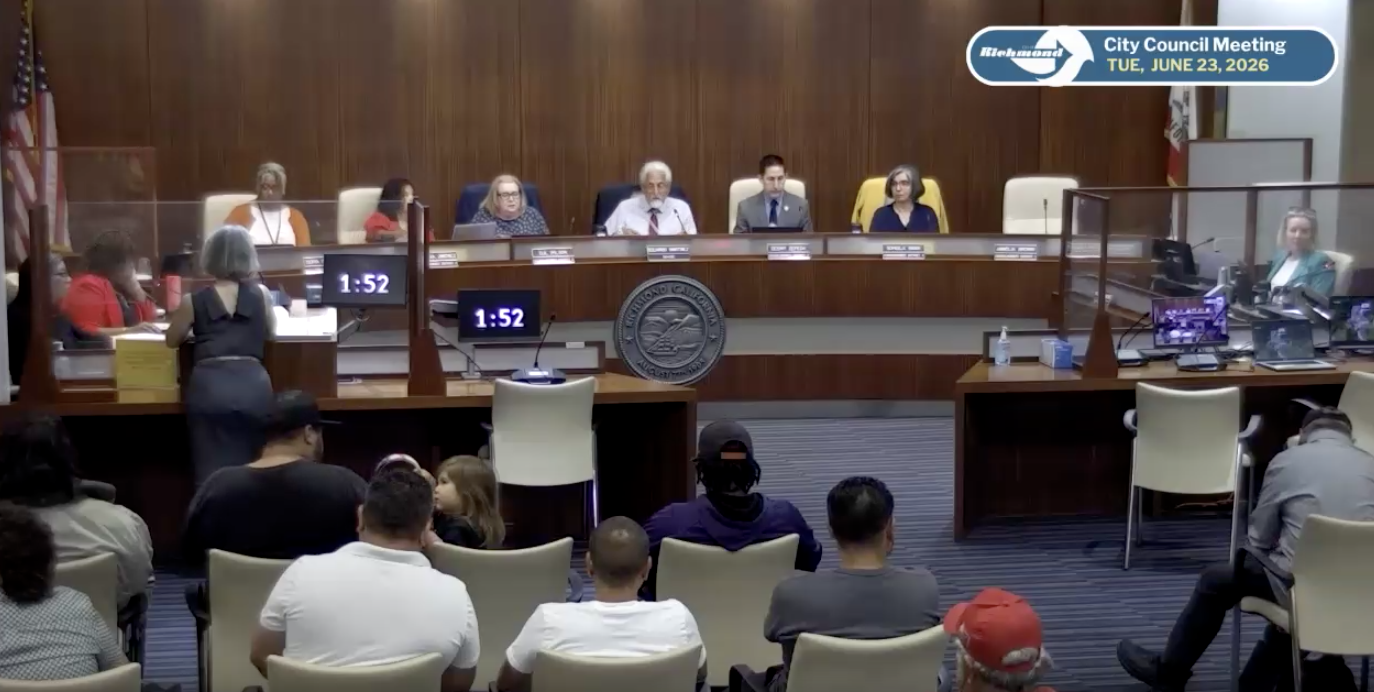
City Council - Jun 23, 2026 - Meeting
City Council • RichmondJune 23, 2026
Locunity is a independent informational service and is not an official government page for this commission.We use AI-assisted analysis and human editorial review to publish information.
Richmond Adopts $324.7M Budget, Greenlights $120M Fire Station Bond for November Ballot
The Richmond City Council locked in its financial direction for the coming year, unanimously adopting a balanced $324.7 million general fund budget with no layoffs, then pivoting to a potentially transformative decision: advancing a $120 million general obligation bond to rebuild the city's deteriorating fire stations toward the November 2026 ballot. A parade of SOS Richmond employees and supporters underscored the human stakes behind the numbers, pleading for funding stability for unhoused services even as the city prepares to reissue a competitive procurement process this summer.
- $324.7M balanced budget adopted unanimously — no layoffs, 142 positions added since 2021, $328M in active grants funding parks, housing, and library construction
- $120M fire station GO bond advances toward November 2026 ballot after voter survey shows 69% durable support, clearing the two-thirds threshold
- SOS Richmond employees and board members rally for stable funding as the city plans a competitive RFP for unhoused services this summer
- Council directs staff to create a transparent events policy after discovering nonprofits must know a council member to get auditorium fees waived
- Landscape assessments approved with 3% increases for both Marina Bay and Hilltop districts; Councilmember Zepeda dissents on both
Richmond's $324.7M Budget: No Layoffs, Big Bets on Infrastructure
Why it matters: Richmond's ninth and final budget session produced a structurally balanced spending plan that sustains all city services, preserves nearly $60 million in cumulative unhoused services funding since 2021, and positions the city to leverage $328 million in active grants for capital projects — all without a single layoff.
Where things stand: The general fund holds at $324.7 million in revenues against $276.2 million in expenditures, with $48.5 million in limited-term revenue preserved as directed expenditure appropriations. Personnel costs now consume nearly 70% of general fund spending, driven by 142 positions added to position control since FY 2021 — a net increase of 99 full-time equivalents.
"We're very proud of the work that we're doing. We're proud that we are submitting a balanced budget to the City Council without the need for any layoffs," said City Manager Shasa Curl. She pushed back on vacancy rate concerns, explaining that the current rate "is a byproduct of the positions that have been added to the position control. If we were still looking at the positions that were adopted back in position control for fiscal year 2021, we would not have a situation with staffing or a vacancy rate."
The five-year capital improvement plan includes major projects already underway: a $34.9 million library renovation opening in April 2027, the Shields Reed park (grand opening July 11), construction at Borman Park and Wendell Park, 48 units of permanent supportive housing through the Home Key project, 142 affordable units at Nevin Plaza, and 101-109 new affordable units at the Nistrom Development. Staff identified $2.676 million in CIP shortfall adjustments for the Richmond Wellness Trail, Bay Trail at Point Molate, and change orders at Shields Reed and Wendell Park — covered by deferring vehicle replacements and reallocating from other capital projects.
State threats on the horizon: City Manager Curl warned about multiple state legislative threats to local revenue, including ACA 13 (requiring supermajority votes for ballot initiatives), a Howard Jarvis Taxpayers Association initiative that would restrict local taxing authority, and AB 736, which would cap charter city transfer taxes. Under that bill, she noted, "no new charter city transfer taxes above a 1.5% could be adopted after January 2027."
Decisions: The budget passed 6-0 (For: Councilmembers Bana, Jimenez, Wilson, Zepeda; Vice Mayor Robinson; Mayor Martinez. Absent: Councilmember Brown, who is recovering from surgery).
SOS Richmond Workers Make the Case for Funding Stability
Why it matters: A large contingent of SOS Safe Organized Spaces employees, board members, and community supporters turned out during both open forum and budget discussion to urge the council to secure ongoing funding for unhoused services — putting real faces and stories behind a line item that has been subject to annual uncertainty.
Where things stand: O'Neill Fernandez, an SOS employee, reported the organization had exceeded every contracted target: "We were supposed to do annually showers, 1,800. We did over 2,000. We were supposed to annually pick up 48 tons cleanup events, we did 55." But he noted funding wasn't received until mid-November last year, forcing the organization to operate at half staff for months.
Menard Washington, also with SOS, testified that the organization gave him his job back after incarceration, demonstrating its commitment to second chances. Daniel Barth of SOS Richmond offered a sobering statistic: five of nine SOS employees who died during employment were African Americans in their 50s and 60s, illustrating the mortality risk in the populations they serve.
Board members Karina Espino and Loris Maddox called for SOS to become a permanent budget line item rather than subject to annual procurement cycles.
The other side: City Manager Curl insisted that competitive procurement is required for contracts exceeding half a million dollars, rejecting sole-source arrangements regardless of organizational track record. "I would never recommend in excess of a half a million dollars for any procurement," she said, noting that other organizations should have the opportunity to compete. Director of Community Development Lena Velasco confirmed the RFP would be reissued this summer with potential multi-year contract options, contingent on annual budget adoption.
Vice Mayor Doria Robinson championed multi-year grants and transparent RFP cycles, drawing a sharp line on the principle: "That's why I moved the unhoused services to an RFP so it would be an open process so anyone could apply, so you wouldn't have to know somebody to get access to city funds. I think that's where corruption starts."
Councilmember Sue Wilson called for stable contracting practices that don't stress small organizations. The reimagining public safety allocation of $1.32 million remains in the budget, and the summer RFP will determine which organizations receive contracts going forward.
$120M Fire Station Bond Clears Key Hurdle for November Ballot
Why it matters: Richmond's fire stations are in dangerous disrepair — too small for modern equipment, lacking quarters for female firefighters — and a $120 million GO bond could fund the most significant investment in fire infrastructure in the city's modern history, while laying the foundation for eventual advanced life support (ALS) paramedic services.
Where things stand: Consultants from SCI Consulting and Evitarus Research presented results from a survey of 800 likely Richmond voters. Both a $120 million GO bond for fire station reconstruction and a $67-per-year parcel tax for paramedic services polled at roughly 65-66% initial support. But the paths diverged after voters heard positive and negative arguments: the bond retained 69% support — above the critical two-thirds threshold — while the parcel tax dropped to 64%, below the line.
"We have fewer voters that are definitely committed to supporting a measure and more people who are undecided are leaning towards supporting the measure, which suggests that voters would like additional information about the benefits," said Sha'Carri Byerly of Evitarus Research, framing the undecided voters as persuadable rather than opposed.
Affordability concerns were the strongest negative factor, with 40% of respondents finding tax increases a compelling reason to vote no. The Chevron settlement argument — that the city should use Chevron money instead — resonated negatively at 70%. Key voter priorities included improving 911 response times (83% high importance), 24/7 paramedic services (85%), and structural resiliency of fire stations (71%).
Based on these findings, consultants recommended proceeding with the GO bond for November 2026 and deferring the parcel tax to a subsequent election cycle.
The ALS question: The bond would fund physical infrastructure, but staffing advanced paramedic services requires separate ongoing funding. Chief Osario of the Richmond Fire Department explained the dilemma: "This is like going out to buy a home. It's going to be the most significant investment you're going to make. You don't do that without knowing how much you can afford." Without dedicated revenue, the city would need to hire firefighter-paramedics through attrition rather than single-role paramedics, with cost implications still unclear pending labor negotiations.
Vice Mayor Robinson expressed concerns about the ALS squad model's potential impact on mandatory overtime, while noting, "We absolutely have to address the poor state of our fire stations. The things that I saw when I actually toured with the now chief were horrendous."
Councilmember Wilson raised a pointed concern about sequencing: "My fear would be that people are good with giving us this money to do the physical space. We fix up the physical space, we stand up the ALS program, and then when we go back a second time and say, now help us pay for the ALS program, they're like, eh, not on this one."
Decisions: The council approved Phase 2 ballot readiness 6-0, with an Aug. 7 filing deadline requiring council action by late July. City Manager Curl committed to bringing an updated position control list incorporating ALS positions after MOU negotiations conclude. The council confirmed the bond measure path rather than the parcel tax.
Council Pushes for Transparent Events Policy
Why it matters: A policy gap that lets some community organizations access free city facilities while others pay thousands — depending on whether they know a council member — drew pointed criticism from multiple council members who called it an equity and corruption risk.
Where things stand: Diego Garcia, founder of Richmond Soul, told the council he paid over $4,000 for a community awards ceremony serving 2,000 attendees because he didn't know that nonprofits could get auditorium fees waived through a council member's agenda item. Deputy City Manager LaShonda White explained the fee waiver process and noted the auditorium is exempt from the standard fee waiver policy.
"I'm afraid we are creating a system where people who have relationships with council members are going to be advantaged in terms of having low cost or free," said Councilmember Wilson.
Vice Mayor Robinson was blunter, warning the current ad hoc system risks abuse. The ECIA mini-grant program that provided up to $5,000 for community events is ending as ECIA funding sunsets.
What's next: Staff committed to developing a draft comprehensive events sponsorship and fee waiver policy over the summer recess and bringing it to council for adoption. Mayor Martinez requested the policy include Mother's Day and Valentine's Day events and ensure equitable access for all community organizations, including the Yemeni soccer club.
Refinery Transparency Bill Gets Council Backing
The council approved a letter supporting SB 1259, a bill from Sen. Katherine Blakespear requiring transparency around refinery asset retirement planning — a significant environmental justice concern given that Richmond hosts Chevron's Bay Area refinery. Councilmember Claudia Jimenez moved the item, which was pulled from the consent calendar after public commenter Claudia Citron alleged Brown Act violations in its placement. The city attorney confirmed no procedural violations occurred. Passed 6-0 (Brown absent).
Rental Housing Fee Set at $261
The council set the FY 2026-27 residential rental housing fee at $261 per controlled unit and $149 per partially covered unit, funding the rent board's operations. Rent Program Executive Director Fred Tran confirmed rent board meetings are Brown Act compliant and publicly noticed. City Manager Curl warned of anticipated $3.5 million increases in risk pool costs and urged continued monitoring to ensure the general fund subsidy does not exceed the $524,912 cap. Passed 6-0 (Brown absent).
Minor Items
- Automated transit network feasibility study accepted 5-1 (Councilmember Zepeda voting no, Councilmember Brown absent); remaining grant funds redirected to solar lighting along bus routes. The project, originally approved in 2012, closes out a long-delayed commitment. Mayor Martinez attempted to continue the item for more discussion, but his motion failed for lack of a second.
- Marina Bay landscape and lighting assessment approved with a 3% increase — residents assessed approximately $780,780 and the city contributing $1.026 million. Councilmember Zepeda abstained. Resident Lynn Theriault raised concerns about staffing levels; staff clarified that four seasonal positions are split into two six-month rotations as historically practiced. Passed 5-0-1 (Brown absent).
- Hilltop landscape maintenance district assessment approved with a 3% increase across three zones, totaling approximately $2 million. Consultant John Bliss acknowledged a Chevron quit claim was incorrectly listed as an ongoing assessment rather than a one-time item, promising a correction. Councilmember Zepeda, who has advocated for the Hilltop district for eight years, voted no. Passed 5-1 (Brown absent).
- SB 707 Internet disruption policy adopted 6-0, establishing procedures for when technology failures prevent public participation during meetings, including mandatory one-hour recesses. Required by state law before July 1, 2026. Public commenter Claudia Citron demonstrated the nearly one-minute delay between the live meeting and the online stream.
- Remaining consent calendar items approved 6-0 (Brown absent).
- Closed session on a liability claim (Manuel G. Agent v. City of Richmond) and labor negotiations with six employee organizations produced no reportable actions.
- Public commenter Kimberly Graves demanded dash cameras in police vehicles after being pulled over without video evidence, calling the encounter racist. Cassie Levy reported dangerous conditions from illegal occupants at a HUD-owned property, including a gun incident.