City Council - Jul 28, 2026 - Meeting

City Council - Jul 28, 2026 - Meeting

City CouncilRichmondJuly 28, 2026

Sources:

Locunity is a independent informational service and is not an official government page for this commission.We use AI-assisted analysis and human editorial review to publish information.

Council Puts Fire Station Bond on November Ballot Despite Softening Polls

Richmond's City Council pushed a fire station general obligation bond to November 2026 voters even as new polling shows support well short of the two-thirds threshold — and received a stark warning from AC Transit that bus service cuts and hundreds of layoffs could follow if a separate regional tax measure also fails at the ballot.

  • Fire station bond headed to November ballot with only 54% initial voter support, 12 points below the required two-thirds
  • Environmental coalition rallies behind anti-coal resolution as Trump pledges $75M for Oakland coal terminal
  • AC Transit reveals $200M four-year deficit; Richmond bus routes face frequency cuts and shortened hours without new regional sales tax
  • Mayor blocks councilmember from rules committee, sparking governance standoff that kills the item
  • Healthy checkout ordinance advances with free county enforcement for 33 retailers
  • CicLAvia street closure pilot deferred after staff warns $145K+ cost would divert sole transportation planner from traffic safety

The Uphill Road to Two-Thirds

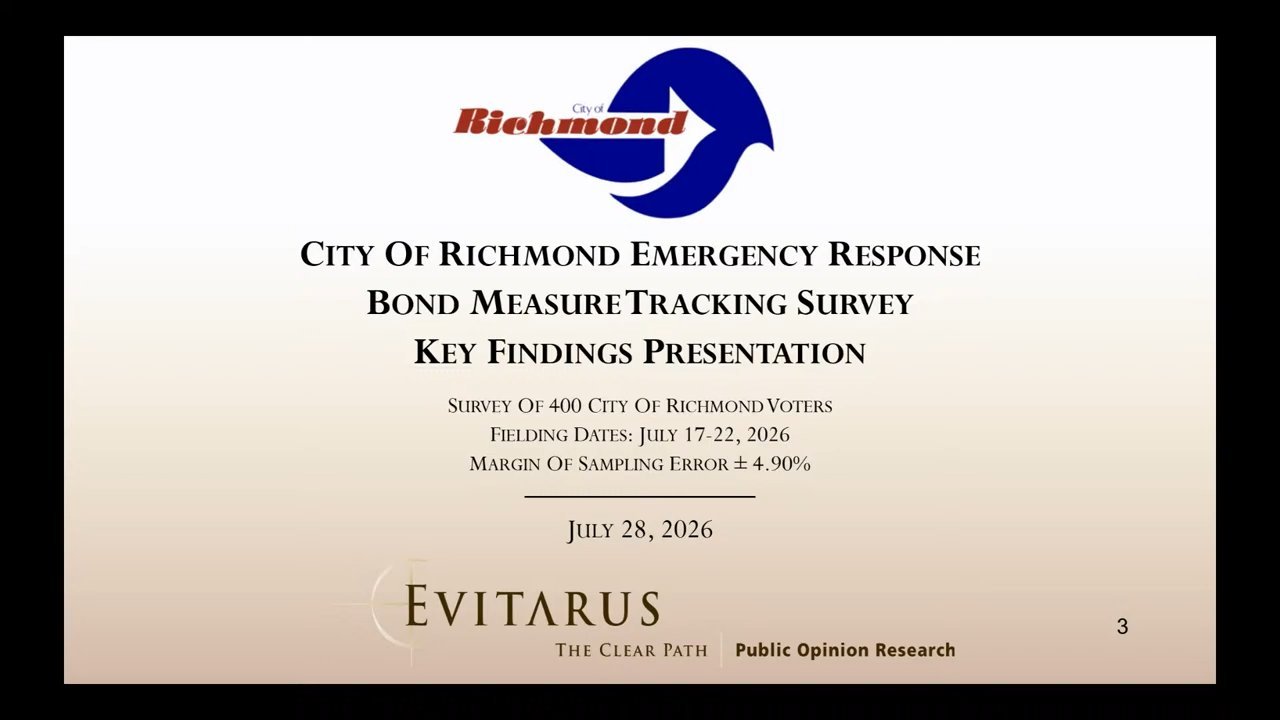
The council unanimously adopted an ordinance and resolution placing a general obligation bond for fire station improvements on the Nov. 3, 2026 ballot — but the real fight is just beginning. Fresh polling from Clifford Moss shows the measure faces a steep climb.

The basics: GO bonds require a two-thirds supermajority (66.7%) to pass. The bond would fund seismic upgrades and renovations to aging fire stations, with an estimated cost to homeowners of $144 per year ($12 per month) on a home assessed at $650,000.

Why it matters: July polling (N=400, July 17–22) found just 54% initial support — down roughly 10 points from May. Support rose to 63% after positive messaging but fell back to 54% after negative messaging focused on affordability and the $550 million Chevron settlement funds. That settlement, staff noted, has a present value of only $407–$480 million against more than $1 billion in unfunded capital needs plus $408 million in pension and OPEB liabilities.

Where things stand: Polling consultant Tom Clifford of Clifford Moss told the council that the softening is part of a statewide pattern. "The softening in support is something that we're actually seeing in communities across California. Richmond is not unique," he said. But he also delivered a blunt warning: "In my 17 years doing this, I have seen it be difficult to get back to the next election after you lose."

Firefighters made the case personal. IAFF Local 188 President Marcus Famui described conditions inside 85-year-old stations: "We have mold problems, we have leaks. These are causing additional risk to a job that is already a hazard to our health, something that could be prevented." Firefighter Kelly Griffin, a west county resident, added: "When it rains, we place buckets throughout our stations because the roofs leak gallons of water every single night."

The other side: Councilmember Soheila Bana raised accessibility concerns, noting that 46% of Richmond's residents are immigrants. "English is a second language. It should be very clear to the point to get their yes," she said, and asked what happens if the bond fails. City Manager Shasa Curl said the alternative would be to ask the council to appropriate Chevron settlement funds for station upgrades — a Plan B that would compete directly with other unfunded needs. Public commenter Philip Rosenthal supported the bond but criticized the polling methodology as more promotional than scientific.

Decisions: The motion passed 6-0 (Councilmembers Brown, Bana, Jimenez, Wilson, Zepeda and Mayor Martinez voting yes; Vice Mayor Robinson absent). Councilmember Sue Wilson expressed full conviction: "I'm 100% convinced that the city needs to fully fund and then begin and then complete the renovation on the fire stations."

What's next: The measure goes before Richmond voters on Nov. 3, 2026, consolidated with the statewide election. Campaign outreach will need to close a 12-point gap, with the Chevron settlement affordability argument resonating strongly — 81% of polled voters cited it as a reason to vote no.


Richmond Stands Against Coal as Trump Backs Oakland Terminal

The council adopted a consent-calendar resolution opposing new coal and petcoke export facilities and urging stronger regulation by the Bay Area Air Quality Management District — a move that drew a procession of environmental advocates to the microphone.

Why it matters: The Trump administration recently announced $75 million under the Defense Production Act to support the Oakland coal terminal, giving new urgency to a fight Richmond has led since passing the nation's first coal ban ordinance.

Where things stand: Six speakers from environmental and public health organizations testified in support. Sierra Club Managing Attorney Aaron Isherwood framed the federal action in stark terms: "Last month the Trump administration announced that it was using the Defense Production Act to address a so-called national emergency, namely the need to fulfill the coal industry's wish list." Caitlin Alcontin of Communities for a Better Environment cited Richmond's already elevated asthma rates and particulate matter burden. Jack Lucero Fleck of the No Coal East Bay Coalition urged other cities to follow Richmond's example.

The consent calendar also included a resolution supporting SB954, a state bill that would tighten the broad CEQA advanced manufacturing exemption adopted the prior year. Former Oakland Councilmember Dan Kalb, working with over 100 organizational endorsers including Clean Water Action, Sierra Club California, California Nurses Association, State Building and Construction Trades Council, and UAW Local 2320, listed the coalition's breadth. Alcontin explained the current exemption allows facilities emitting toxic substances like arsenic and hexavalent chromium to bypass environmental review and public input.

Decisions: Consent calendar passed 6-0 (Vice Mayor Robinson absent). The coal resolution was sponsored by Councilmember Wilson; the SB954 resolution by Councilmember Cesar Zepeda.


AC Transit's $200M Cliff Could Reshape Richmond Bus Service

AC Transit officials told the council that without new revenue, the agency faces a $200 million deficit over four years — roughly $50 million annually starting fiscal year 2027 — that could force 16% service cuts and 300 layoffs.

The basics: Federal pandemic relief has expired. Sales tax revenue has flattened. Costs have surged — fuel up 28%, bus parts up 14%, bus purchases up 35%. A $55 million state loan covers the current year but must be repaid.

Why it matters: Three of four AC Transit riders are people of color and nearly two-thirds are low income. In West Contra Costa County, contingency plans would reduce most routes to 40-minute intervals with shortened hours (7 a.m.–7 p.m.), while Line 70 would end at Richmond BART on weekends instead of continuing to Del Norte BART. Only Lines 70 and 76 on Cutting Boulevard would maintain 15-minute weekday service.

Where things stand: The agency's hopes rest on the Connect Bay Area measure, a half-cent regional sales tax (one cent in San Francisco) going to voters in five Bay Area counties in November. If it passes, AC Transit would receive approximately $52 million annually. AC Transit Board Director Apreece Sandu, Executive Director of External Affairs Claudia Burgos, and Transportation Planner Carissa Lee presented the fiscal picture.

Public commenter Hope Dixon, a transit-dependent Richmond resident, urged support for the measure but acknowledged the tension: "Residents face competing financial pressures," she said, citing SNAP cuts and layoffs.

What's next: The November ballot measure is the pivotal variable. Richmond voters will face two consequential measures simultaneously — the fire station bond and the regional transit tax — in a climate where affordability concerns are top of mind.


Rules Committee Dies After Mayor Blocks Bana

A seemingly procedural item — formalizing a two-member ad hoc committee to update council rules — exposed deep governance rifts before the August recess.

Why it matters: The committee would rewrite the operating rules governing how the council itself functions. Who sits on it determines whose perspective shapes those rules.

Where things stand: Mayor Eduardo Martinez sought to appoint himself and Vice Mayor Doria Robinson to the committee, as previously authorized on the May 19 consent calendar. Councilmember Bana requested inclusion, arguing that diverse perspectives were essential for a body rewriting its own procedures. "As a council member who has often found myself in the minority, I have at times felt that my perspectives were overlooked and that interactions have been unnecessarily adversarial," she said.

The mayor refused. "I want someone who not only knows how to write rules, but knows how to follow them. And that is why Councilmember Robinson was the only person I felt should be on the ad hoc committee," Mayor Martinez said.

Councilmember Claudia Jimenez pushed back forcefully: "The ability to have a diversity on the ad hoc committee is so important, and with refusal, it's showing a lack of collaboration, a lack of leadership when you refuse to have a different perspective."

Decisions: The city attorney clarified that under the charter, the mayor makes appointments with concurrence of at least three council members, but council members cannot force additional appointments through a motion. Councilmember Wilson noted the council's procedural option was simply to vote no. The mayor's original motion failed for lack of a second. No alternative motion was properly seconded either, and the item effectively died — leaving council procedures unaddressed heading into the August recess.


Healthy Checkout Ordinance Gains Free County Enforcement

The council directed staff to finalize a Healthy Options at Point of Sale (HOPS) ordinance mirroring Contra Costa County's rules — a move that solves a longstanding enforcement gap.

Why it matters: Youth advocates first brought this proposal years ago, but the city lacked the capacity to enforce it. By aligning with the county ordinance, Richmond gains county environmental health enforcement at no cost, covering approximately 33 retailers.

Where things stand: Key changes from Richmond's original draft include lowering the store-size threshold from 4,000 to 2,000 square feet, removing exemptions, and using complaint-based enforcement. One year of education and outreach is planned before enforcement begins. Councilmember Zepeda flagged that California is banning Red Dye No. 3 statewide effective January 2027 and asked staff to verify whether the ordinance should include rather than exempt foods with the dye.

The other side: Tim James of the California Grocers Association urged exempting full-service grocery stores, arguing they already offer thousands of healthy options.

Decisions: Passed 6-0 (Vice Mayor Robinson absent), with direction to check the red dye provision.


CicLAvia Pilot Pushed Back as Staff Sounds the Alarm

A proposed CicLAvia-style open-streets pilot on 23rd Street was deferred to fiscal year 2027-28 after staff laid bare the cost and capacity tradeoffs.

Why it matters: The estimated $145,000+ price tag — including $66,000 for meridian barriers and policing at 29 intersections — exceeds the hidden staff costs of both Cinco de Mayo ($106,000 beyond its $20,000 grant) and Juneteenth ($64,000 beyond its $26,000 grant). And the city's sole transportation planner would be diverted from traffic calming — the No. 1 complaint in the city manager's inbox.

Where things stand: City Manager Curl reminded the council the item was never budgeted and that staff are already managing 55 council directives. "You've given us 55 different things to work on. So if you've given us 55 things to work on, that means that they're not going to happen quickly, and that means you're going to be disappointed because you're asking people to do things that are impossible," she said.

Councilmember Zepeda proposed piggybacking on the Saturday before Cinco de Mayo, when 23rd Street is already closed, or partnering with Halloween event organizers. Councilmember Wilson suggested creating an ad hoc with Zepeda and Jimenez to design a right-sized program.

Decisions: The final motion (Jimenez/Wilson) directed staff to return with alternative options — including the Bay Trail, piggybacking on existing events, and community-based organization partnerships — with budget inclusion for FY 27-28. Passed 5-0-1 (Councilmember Brown abstained, Vice Mayor Robinson absent). Mayor Martinez voted yes but described his support as reluctant.

What's next: Staff will return by January with lower-cost alternatives.


Minor Items

  • Police labor tensions: RPOA President Ben Theriault reported three officers in background processes to leave for other agencies, said officers and sergeants have been without a contract for over a year, and criticized months-long delays on a side letter for field training officer compensation and an OPEB actuarial request filed in February that won't be fulfilled until August. He also flagged paper-based credit card processing and vendors going months without payment.
  • Maxine Finley Week: Mayor Martinez proclaimed the week of Aug. 23 in honor of Maxine Finley, Point Richmond's beloved crossing guard at Washington Elementary for over two decades. A community celebration is planned for Aug. 24 at "Maxine's Corner" (Gerard and East Richmond).
  • Housing authority resident complaint: Pamela Granger told the Richmond Housing Authority she has been living with buckling floors, bulging surfaces, and soft spots in her project-based voucher apartment since submitting a reasonable accommodation request in September 2025 — still unfulfilled. Staff indicated they would follow up after the meeting.
  • Community land trust pitch: Princess Robinson of Richmond Land, the city's first community land trust, cited data showing more than half of Richmond renters spend over 30% of income on housing, median gross rent approaches $2,000, and median home values have risen to nearly $700,000. She invited the public to monthly new-member orientations.
  • Richmond Housing Authority consent calendar approved 6-0 (Vice Mayor Robinson absent).
  • Closed session: No reportable actions were taken on labor negotiations, legal counsel, real property, or city manager evaluation and recruitment.