
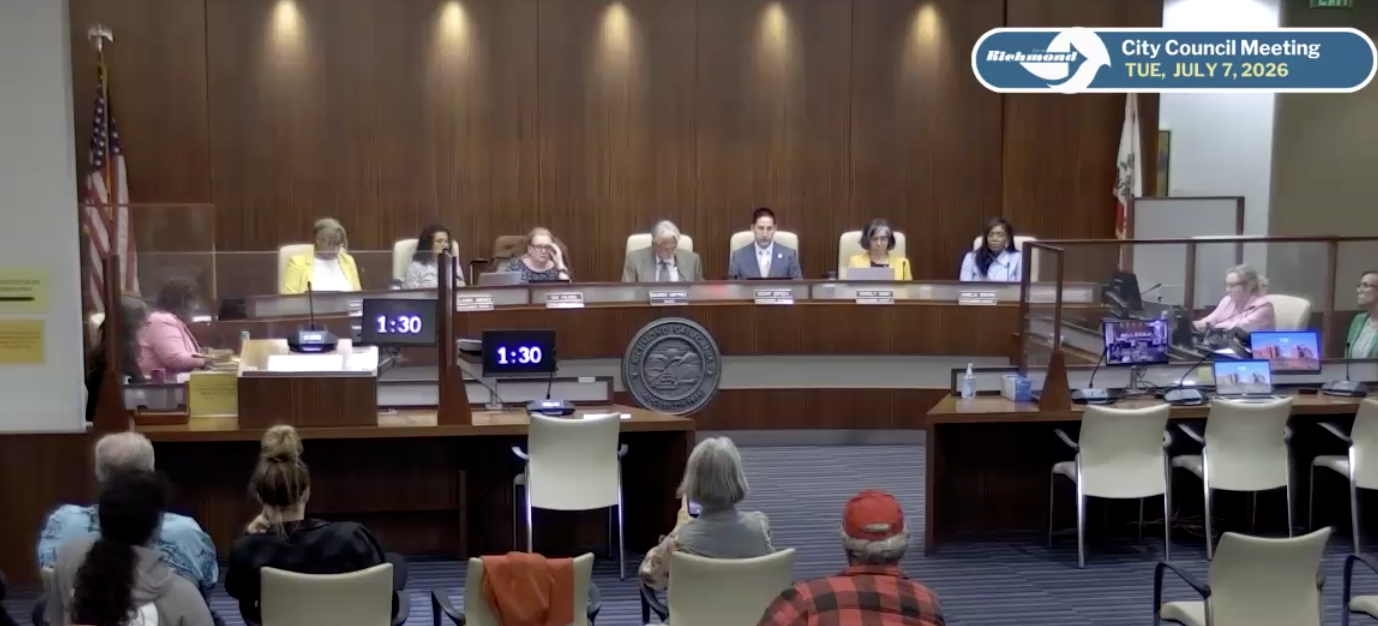
City Council - Jul 07, 2026 - Meeting

City Council - Jul 07, 2026 - Meeting

City CouncilRichmondJuly 7, 2026

Sources:

Locunity is a independent informational service and is not an official government page for this commission.We use AI-assisted analysis and human editorial review to publish information.

Police Equipment Debate Runs Out of Clock as Richmond Council Backs Superfund Cleanup

Richmond's City Council powered through a six-hour marathon session Tuesday night, unanimously demanding a full cleanup of a DDT-contaminated Superfund site and fielding urgent pleas from longshoremen over diverted sugar shipments — but ran out of time before it could vote on the most contentious item of the evening: the police department's military equipment report. The unresolved policing debate, which drew 27 speakers and exposed deep divisions over public safety spending, will have to wait for a future meeting.

  • Police military equipment report draws hours of debate, 27 speakers — but no vote before 11 PM adjournment
  • Council unanimously backs community plan demanding full DDT cleanup of United Heckathorn Superfund site ahead of EPA's August deadline
  • ILWU longshoremen and Filipino community groups urge city to halt sugar unloading at Levin Terminal tied to C&H strike
  • Ethics commission ballot measure blocked from moving up on the agenda; item never reached
  • City lands $11.2 million federal grant for Port of Richmond infrastructure

Police Equipment Report Sparks Marathon Debate, Left Unresolved

The basics: Under state law AB 481, cities must approve annual reports on police use of military-style equipment — or departments lose the authority to use it. Richmond's 60-page report covered 15 drones, 82 rifles, diversionary devices, chemical agents, a tactical robot, and a mobile command center.

Why it matters: Without council approval, the Richmond Police Department's authority to deploy everything from patrol rifles to its drone-as-first-responder program hangs in limbo. The debate also surfaced broader questions about how much the city should spend on police hardware versus community services.

Where things stand: Police Chief Timothy Simmons and Captain John Lopez presented operational data showing 166 uses of classified equipment in 2025 and 766 drone-first-responder deployments. Chief Simmons stressed RPD's equipment is commercially purchased, not military surplus.

"The Richmond Police Department does not have any military equipment that was acquired through the Department of Defense 1033 program," said Chief Simmons. "None of the equipment that is included in our report originated from that federal surplus program."

He highlighted the scope of the reporting burden: RPD's 60-page report dwarfs those of much larger agencies, he said, noting Oakland submitted roughly 57 pages and San Francisco just 13. The report required approximately 500 collective staff hours.

The chief made his most pointed appeal when describing the February 2024 Montalvan Manor incident, in which RPD waited nearly three hours for a mutual-aid armored vehicle while rifle rounds struck patrol cars and penetrated neighboring homes. "We had no capacity at all to try to get to those neighbors, to try to get them out of their homes," he said, making the case for a proposed $483,667 armored rescue vehicle purchase. RPD also requested 10 additional Colt M4 rifles.

The other side: A coalition of more than 12 organizations led by Reimagine Richmond submitted a letter opposing new acquisitions. Andrew Melendez of Reimagine Richmond read portions of the coalition letter, arguing that with crime rates falling, the $1.2 million-plus total cost of military equipment should be redirected to youth programs, libraries, parks, and affordable housing. The letter also noted that 48% of known suspects in equipment deployments were Black — in a city that is 17% Black.

John Lindsey Poland of the American Friends Service Committee, which monitors AB 481 compliance statewide, questioned proposed increases in flashbangs (from 120 to 200) and less lethal munitions, and asked whether the 10 new M4 rifles would expand the total inventory or replace existing weapons.

On the other side, public commenter Don Gosney forcefully defended police equipment needs, referencing the 1997 North Hollywood shootout as an example of why officers need adequate firepower.

Chief Simmons also described a successful de-escalation on July 4th, when officers negotiated for over an hour with a group of roughly 500 people who had barricaded a road — without using force.

Councilmember Claudia Jimenez raised pointed questions about drone acquisitions, noting RPD appeared to have added seven drones since the prior year's report without indicating intent to acquire more. "This nearly doubles the number of drones reported last year to 15," she said, requesting policy updates for new drone models.

Decisions: None. The meeting hit the 11 PM deadline with council members still asking questions. A motion by Councilmember Jamelia Brown to suspend the rules and finish all remaining items failed 2-4 (one abstention). A motion by Councilmember Cesar Zepeda to continue the meeting to Tuesday, July 14, at 5 PM also failed 3-4, in part because the police chief was unavailable on that date. The council voted 5-2 to extend to 11 PM but could not complete the item.

What's next: The AB 481 report must return at a future meeting for a vote. Until then, RPD's equipment authority remains unresolved.


Council Unanimously Demands Full Superfund Cleanup

Why it matters: The 20-acre United Heckathorn Superfund site along the Lauritzen Channel contains DDT and dieldrin concentrations measured at up to 3,800 times above acceptable levels — decades after a 1990s EPA remediation that failed. The EPA is expected to release its proposed cleanup plan in late August, and this resolution puts Richmond formally on record demanding a complete fix before that deadline.

Where things stand: Councilmember Sue Wilson introduced the resolution, framing the stakes in personal terms. "Richmond is an environmental frontline community, so the effects of pollution are felt by the residents here. First and worst," she said.

Janet Johnson of the Richmond Shoreline Alliance and technical consultant Chip Cribble presented the community's preferred approach: building a temporary waterproof barrier — called a caisson — across the channel mouth, draining the water, removing all contaminated sediments, pilings, and capped soil, and disposing of them off-site. The plan addresses what advocates described as a fundamental failure of the original 1990s cleanup, which attempted to cap contamination in place.

More than 20 public speakers testified in support, including representatives from San Francisco Baykeeper, the Sierra Club, Golden Gate Bird Alliance, Green Action, and Richmond residents. Council members asked about enforcement options if EPA chooses a different approach — an appeal to the California Department of Toxic Substances Control was suggested — and about cost responsibility. The cleanup would be paid for by private responsible parties, not the city.

Councilmember Cesar Zepeda clarified the funding mechanism: "Superfund means we're going to get access to the Super Fund. So money from the EPA, from a law that Congress established many years ago."

EPA had sent a letter suggesting the council could wait for the agency's own proposal. Mayor Eduardo Martinez was unmoved: "If we pass this resolution for this plan, we will consider their plan to augment the one that we have chosen to follow."

Decisions: The resolution passed 7-0 (For: Brown, Bana, Jimenez, Wilson, Robinson, Zepeda, Martinez; Against: none).

What's next: EPA's proposed cleanup plan is expected in late August. The resolution formally positions Richmond to push back if the federal plan falls short of complete remediation.


Longshoremen and Filipino Community Demand City Halt Sugar Unloading at Port

Why it matters: C&H Sugar produces roughly 15% of the nation's cane sugar. Its decision to divert raw sugar shipments from its Crockett refinery — where ILWU Local 6 warehouse workers are on strike for better benefits and to preserve retiree healthcare — to Richmond's Levin Terminal raises both labor and environmental concerns.

Where things stand: A coalition of ILWU union leaders, the Contra Costa Labor Council, and Filipino community organizations made urgent appeals during open forum. Mike Villagiante, president of ILWU Local 10, told the council that raw sugar is being stored on the ground at Levin Terminal — a facility designed for coal and petroleum — alleging violations of EPA regulations, combustible dust hazards, and food contamination risks.

Josh Aninger, executive director of the Contra Costa Labor Council, called the sugar diversion to Richmond "union busting" and demanded justice for workers in both Crockett and the Philippines.

Members of the Defend Negros NorCal Coalition connected the sugar to violence in the Philippines, where 19 people were killed April 19–20, including Bay Area activist Lyle Prijoles, and demanded the council halt the unloading.

What's next: City Manager Shasa Curl responded directly: "I've scheduled a call tomorrow morning at 8:30 with some of the participants. And I'll report back to the city council regarding next steps in coordination with community development staff."


Ethics Commission Ballot Measure Blocked, Never Heard

Councilmember Soheila Bana asked to move item Q8 — the Richmond Government Accountability, Transparency and Ethics (GATE) Act, which would place an independent ethics commission on the November 2026 ballot — up on the agenda, arguing that the city attorney's office needed direction before the council's summer recess to prepare the ordinance and ballot materials. Mayor Martinez required a vote. The motion failed 3-4 (For: Brown, Bana, Zepeda; Against: Jimenez, Wilson, Robinson, Martinez). The item was never reached before adjournment, potentially jeopardizing the timeline for the November 2026 ballot.


Minor Items

  • Consent calendar passed 7-0; a contract with Contra Costa County CORE for homeless outreach services (item O7A) was withdrawn by staff.
  • Sewer and stormwater fees for FY 2026–27 adopted unanimously at existing rates — no increase for residential, multi-unit, or commercial properties.
  • Emergency communications volunteers honored with a proclamation declaring April 30, 2026, as Richmond Emergency Communications Volunteer Day. The volunteers installed an emergency antenna atop City Hall, providing a backup communication link to the city's Emergency Operations Center when cell networks fail. David Swanson of the volunteer team encouraged more residents to become ham radio operators.
  • $11.2 million federal grant awarded to the Port of Richmond for Berth 7 improvements through the Port Infrastructure Development Program, acknowledged alongside Congressman Garamendi and Port Director Charles Gerard.
  • Shields Reed Park grand opening set for Saturday, 11 AM to noon, followed by the North Richmond Music Festival from noon to 5 PM.
  • Fire infrastructure survey (closing July 17) seeks resident input on emergency response services and a potential bond measure for fire station repairs; some stations are approximately 80 years old.
  • Public commenters raised concerns about dash cameras on patrol vehicles, public speaking time limits, the city's 22-field deficit per its 2010 Parks Master Plan, and spending priorities related to fire and EMS services.