City Council - Mar 18, 2026 - Meeting
City Council • RichmondMarch 18, 2026
Locunity is a independent informational service and is not an official government page for this commission.We use AI-assisted analysis and human editorial review to publish information.
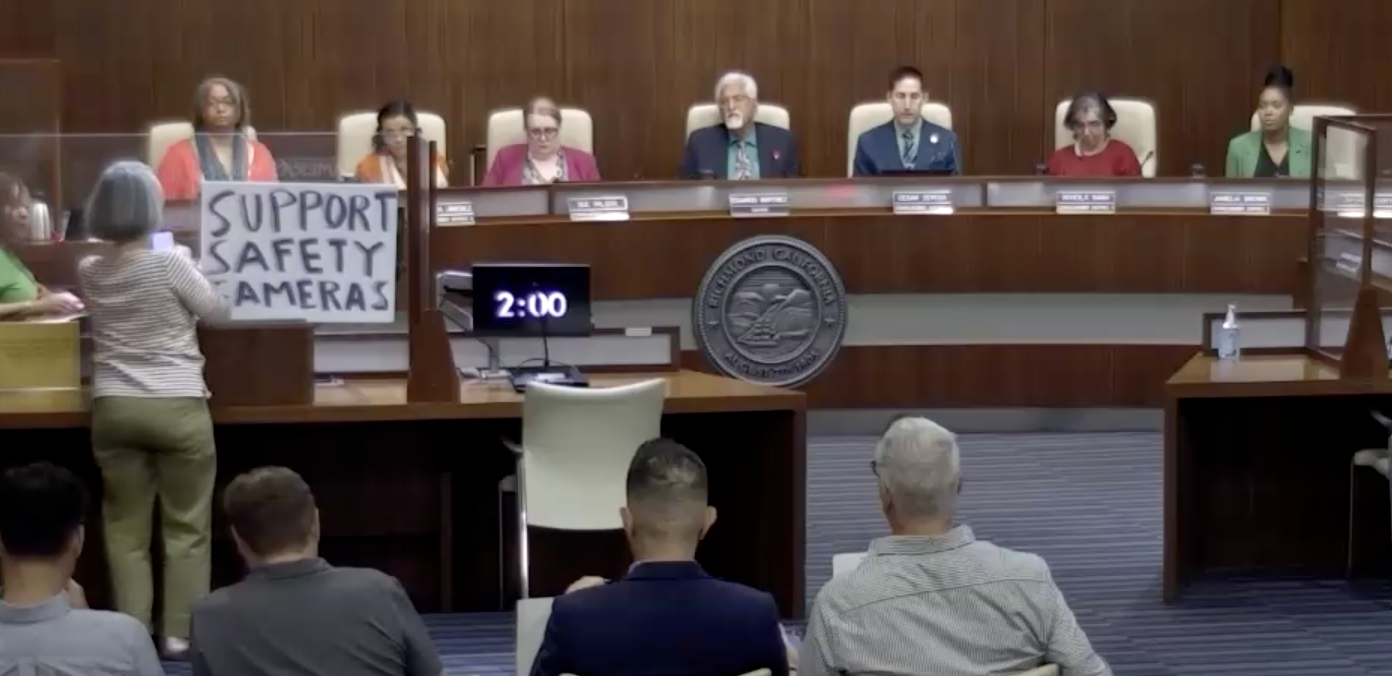
Council Splits 4-3 on Flock Camera Contract as Crime Surge Grips Richmond
Richmond's surveillance debate reached its sharpest point yet Tuesday night, with the City Council narrowly voting to extend a controversial camera contract even as members on both sides acknowledged the company behind it had betrayed their trust — all against a backdrop of doubling shootings, a stalled police contract, and a city scrambling to replace its wastewater operator before time runs out.
Council votes 4-3 to extend Flock Safety surveillance camera contract through year-end after discovery that a hidden "national search" feature exposed Richmond data for nearly three years
Police union members flood public comment demanding a fair contract and the reinstatement of a decorated detective sidelined after an officer-involved shooting
Residents cite 100% increase in year-to-date shootings, four recent carjackings, and 51 unsolved violent felony cases as evidence of a public safety crisis
Council unanimously launches competitive procurement to replace Veolia as wastewater and stormwater operator before the 20-year contract expires in May 2027
$1.4 million in mid-year budget adjustments approved for parks, art underpass lighting, and facilities using surplus utility tax revenue
Flock Cameras Survive, but Trust Does Not
The basics: Continued from March 3, this item asked the council to approve a transitional contract amendment with Flock Safety — the Atlanta-based company operating 188 CCTV, automated license plate reader, and drone-as-first-responder units across Richmond. Public comment had already closed at the prior meeting.
Why it matters: The vote exposed the deepest ideological fault line on the seven-member council: public safety urgency versus data privacy and sanctuary city protections. Every council member who spoke acknowledged Flock had failed the city. The question was whether that failure was disqualifying.
Where things stand: Police Chief Tim Simmons opened by addressing immigration fears head-on. "We do not have a relationship with U.S. Immigration and Customs Enforcement for immigration enforcement purposes," he said.
He then explained why he shut down the cameras on Nov. 19: "I turned the cameras off because it came to my attention that a function was running in the operating system that allowed for a two-way street called the national search feature." That feature, active since early 2023, had made Richmond's camera data accessible to outside agencies without the city's knowledge or consent. Flock never properly disclosed it during training, Simmons said.
The chief framed the stakes in human terms, describing 51 open violent felony cases hampered by the camera blackout — including a senior citizen carjacked and shot, a juvenile left paralyzed, and a homicide at an IHOP. "I have a list of 51 open cases right now that are violent felonies that had we had our cameras operable, if that situation did not unfold with Flock, had they been operable the tool to our disposal," he said.
He acknowledged the breach but noted its limits: "I know that our data became accessible, but we have no evidence that data was extracted from our database and then obtained and used in any way, shape or form."
The other side: Councilmember Sue Wilson led the skeptical case, challenging the often-cited 33% car theft increase by pointing to a different data window. "I want everyone to look at November 2024 to November 2025. In that time period, the number of car thefts went up 50% year to year and the cameras were still on," she said, calling for more rigorous statistical analysis. She made her distrust plain: "I'm open-minded about whether we need and can use cameras here. I'm not open-minded about Flock. I think fool me once, shame on you. Fool me twice, shame on me."
Councilmember Claudia Jimenez argued the company acted in bad faith from the start: "Having a company that, first of all, is making us liable — they put in the contract knowing that we were a sanctuary city that you can share data — that is actually acting in bad faith."
Mayor Eduardo Martinez raised a different alarm, citing a finding from another state. "In Illinois, the Secretary of State's office discovered that U.S. Customs and Border Protection gained access to license plate data through Flock's system in direct violation of their state law," he said, proposing the city seek a California-based alternative vendor.
Councilmember Soheila Bana pushed for the city to purchase its own cloud storage so data ownership would not rest with a private vendor. Vice Mayor Doria Robinson acknowledged Flock's "disingenuous behavior" but asked about contract safeguards that could prevent a repeat.
On the other end, Councilmember Jamelia Brown argued public safety is immigrant safety, noting Flock won its original competitive RFP with 295 out of 300 points. Councilmember Cesar Zepeda invoked specific cases — the paralyzed juvenile, the senior carjacking, the IHOP homicide — where cameras would have aided investigations.
Chief Simmons also disclosed he had issued an RFP on Feb. 27 for alternative surveillance vendors, with responses due March 27.
Decisions: The council voted 4-3 to approve the transitional contract amendment, restoring the cameras through year-end with provisions for unauthorized data sharing protections and data ownership terms to be negotiated by the city attorney and city manager. (For: Brown, Bana, Robinson, Zepeda. Against: Jimenez, Wilson, Martinez.)
What's next: The alternative vendor RFP closes March 27. The city attorney and city manager will negotiate the specific data ownership and unauthorized sharing clauses before the contract is finalized.
Police Union Demands Fair Contract and Detective's Reinstatement
Why it matters: Richmond's police department is critically understaffed, and the officers' contract has been expired since July 2025. Six members of the Richmond Police Officers Association used both pre-closed-session and open forum public comment to press two demands: settle the contract and return Detective Hodges — a five-time consecutive Officer of the Year — to active duty after being sidelined following an officer-involved shooting.
Where things stand: RPOA President Ben Terrio and officers Nathan Lonzo, Kevin Lemus, Alexander Kane, Nicholas Remic, and Don Nelson each spoke. They argued City Manager Shasa Curl's insistence on waiting for written reports before making personnel decisions was unnecessarily delaying Hodges' return, citing past precedent with other detectives who were returned to duty more quickly. Speakers also cited a 100% increase in shootings — 24 versus 12 year-to-date — rising carjackings, and a 60% drop in in-custody arrests since cameras were turned off.
Terrio challenged the city manager's framing directly: "The positions are there. The funding's supposed to be there too. So if hiring officers now suddenly creates a budget problem, then one of two things is true. Either you don't understand your own budget or the original budget was never honest to begin with."
City Manager Curl responded with two personal privilege statements, pushing back firmly. "I make decisions based on written reports. I have said that to you all privately, and I want to say that now publicly," she said. She noted two investigations remain pending — including an administrative review — and said she would not be bullied. Curl also pointed to recruitment progress under Chief Simmons and noted the fiscal year 2025-26 budget was adopted with a 10% vacancy rate already built in.
What's next: The closed session on labor negotiations with six employee organizations produced no final decisions. The contract dispute and Detective Hodges' status remain unresolved.
Residents Sound Alarm on Surging Violence
A wave of public commenters painted a picture of a city at a breaking point. Oscar Garcia, a lifelong Iron Triangle resident, cited the 100% year-over-year increase in shootings and said most residents don't feel safe at night. Tuan referenced an 800% increase in gunfire injuries in the fourth quarter, a human trafficking case, and four carjackings spanning different zip codes. Chris Moore pointed to Oakland's 7-1 vote in favor of similar surveillance technology and argued Richmond's policy decisions were driving crime higher. Edward Escobar of the Coalition for Community Engagement warned that communities of color were paying the highest price.
Counter-speakers offered a sharply different frame. Annie Pannell raised concerns about outside speakers presenting as community members without disclosing financial ties, citing a Spanish-language radio recording of a non-resident confirming he was paid. Sochi, a Richmond Latina resident, named a specific speaker as being compensated by Flock and argued community safety comes from services and systems of care, not surveillance.
Jesse Turan, describing himself as a homeless Richmond resident, delivered one of the evening's most striking comments, saying he has been at the top of the housing priority list for five years with zero assistance. Speaking during the wastewater item, he urged the city to rethink how it treats its unhoused population: "Instead of seeing the homeless as a problem, see them as a resource and invest money into training them so that they can have jobs."
Richmond Begins Search for New Wastewater Operator
The basics: Richmond's 20-year contract with Veolia to operate the city's wastewater treatment plant, 196-mile sewer collection system, and 169-mile stormwater collection system expires in May 2027. Public Works Director Daniel Chavarria and consultant Jacob Geiss presented three service delivery pathways.
Why it matters: The current contract lacks financial accountability and performance penalties. Richmond's wastewater rates are among the Bay Area's highest, and environmental violations have persisted. The city must choose a path before time runs out.
Where things stand: The recommended option — a hybrid model using competitive procurement of a new private operator — carries the lowest risk at $15–$25 million annually and could be implemented within 9–12 months. A fully city-operated model would cost $19–$31 million annually, require 24-plus months, and mean hiring roughly 70 new staff. Asset transfer to another public agency, the third pathway, would take 5–7 years and faces legal and bond covenant barriers. West County Wastewater's general manager had already declined interest, citing different rate structures, an aggressive capital plan, and full staffing.
Council members expressed strong interest in eventually bringing operations in-house. Councilmember Jimenez captured the sentiment: "Sometimes for-profit corporations don't work for our people, don't give us the best service." Councilmember Bana advocated for separating stormwater from the other systems with a shorter contract term to accelerate public control. Councilmember Wilson asked that the RFP be structured so the stormwater piece could eventually be separated. Councilmember Zepeda provided historical context as a former West County Wastewater director, noting that most current council members were not on the body when the Veolia contract was last approved.
SEIU Local 1021 President Kevin Tisdale argued stormwater could be brought in-house sooner, noting the union already holds relevant classifications from the original treatment plant takeover. Resident Sarah Cantor, who lives near the treatment plant, urged a short contract with parallel planning for full public operation.
Decisions: The council unanimously approved the hybrid procurement model and extended the ad hoc committee to support the process. (7-0.)
What's next: Staff will develop and issue the RFP. The ad hoc committee will continue deliberating on long-term alternatives, including the possibility of a shorter stormwater contract term.
$1.4 Million in Mid-Year Budget Adjustments Approved
Why it matters: The adjustments, funded by higher-than-expected utility users tax revenue, address overdue infrastructure and park needs while the city stares down $900 million in unfunded capital projects.
Where things stand: Director of Finance Emily Combs and the city's Deputy Finance Director reported general fund revenues tracking at 52.6% of the $308.5 million budget through December — no red flags. The $1.4 million surplus was allocated to: $700,000 for Richmond Art Lighting Phase 3 (underpass improvements at McDonald, Barrett, and San Pablo avenues), $347,000 for parks play structure replacements and bathroom assessments, $210,000 for a corporation yard fence, $100,000 for facilities maintenance power washing, and $50,000 for key policy initiatives.
Staff highlighted broader fiscal headwinds: personnel costs have risen 30% over four years, from $146 million to $190 million. The KCRT cable franchise fund faces a $416,000 deficit. Federal funding uncertainty could affect the Richmond Housing Authority. The city maintains a 21% minimum reserve target.
City Manager Curl touted recent growth: "We have over 160 grants valued at over $250 million, which is really remarkable for our community."
SEIU President Tisdale offered a reality check, noting SEIU's vacancy rate was 19% — nearly double the 10% budgeted — arguing city services are effectively running at about 80% capacity.
RPOA President Terrio used the budget hearing to press his contract case again, challenging the city manager's framing that hiring officers would create budget problems when positions were already funded.
Decisions: Adopted unanimously, 7-0.
Artist Studio House Advances Toward Historic Landmark
Long Range Planner Michelle Morris and architectural historian Caitlin Hibma presented the landmark overlay district nomination for 771 Ocean Ave. in Point Richmond — the former residence and studio of artist John Haley (1901–1991). Built in 1932, the house is an example of the Second Bay Tradition architectural style, with a 1949 addition designed by pioneering Chinese American architect Roger Lee. Haley, a UC Berkeley art professor, is credited with originating the Berkeley School of modern art. The Historic Preservation Commission found the property met five of six landmark criteria, and the Planning Commission recommended approval on Jan. 15.
Mayor Martinez asked detailed questions about the property's mural, architectural styles, and associated artists including Ansel Adams, Chiura Obata, Hans Hoffman, and William de Kooning, and raised the possibility of future public tours.
Decisions: The ordinance was introduced for first reading, passing 6-0 with Vice Mayor Robinson absent. Second reading is scheduled for March 24.
Minor Items
Housing Authority consent calendar approved unanimously (8-0, including Tenant Commissioner Scott).
City Council consent calendar approved unanimously, 7-0. No items pulled.
Dorn v. City of Richmond litigation deferred to the next meeting; not discussed in closed session.
Laura Sharples and David Sharples requested traffic calming measures — specifically speed bumps — on McBride Avenue between 23rd and 29th streets, citing dangerous speeding and repeated collisions.
Elsa Stevens of Faith in Action East Bay/PICO California urged the council to support SB 995 (Con Justice Act) to strengthen oversight of immigration detention in California.
Items X3 (immigration update) and X4 were not reached due to time constraints.