City Council - Sep 15, 2026 - Meeting
City Council • RichmondSeptember 15, 2026
Locunity is a independent informational service and is not an official government page for this commission.We use AI-assisted analysis and human editorial review to publish information.
Council Orders Immediate Community Input on $550M Chevron Settlement, Pauses Data Centers
Richmond's City Council defied its own staff Tuesday night, voting to launch community engagement on how to spend a half-billion dollars in Chevron settlement funds — even as finance officials warned that the city's operating budget is running a $9.8 million structural deficit beneath the surface. In a separate public hearing that drew more than 40 speakers, the council adopted a 45-day moratorium on new data centers, joining a growing wave of California cities pushing back against AI-driven industrial expansion.
- Council votes 4-1-2 to begin community engagement on $550M Chevron settlement spending immediately, rejecting staff's recommendation to wait for labor negotiations
- $9.8M structural deficit revealed once $50M in annual Chevron settlement revenue is excluded; personnel costs up 53% in five years
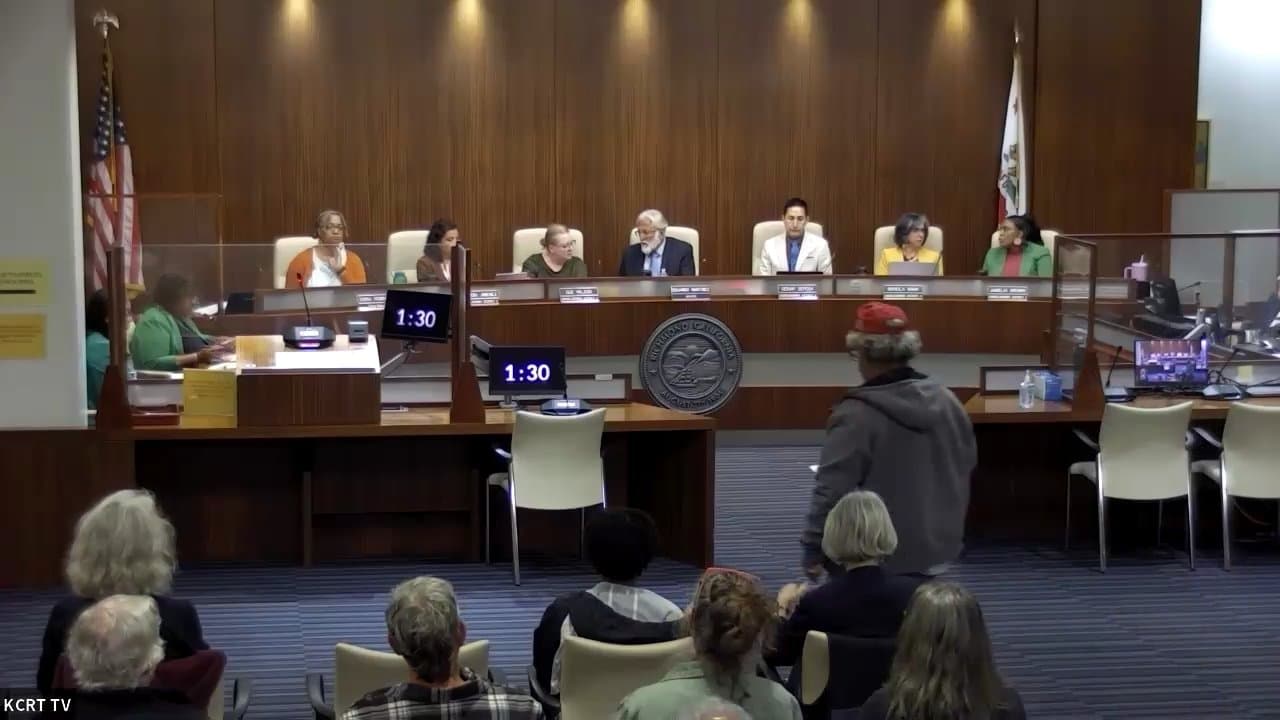
- 45-day data center moratorium passes 6-0-1 as urgency ordinance, with more than 40 speakers — overwhelmingly in support — citing energy, water, and health concerns
- $2.2M in settlement interest earnings approved unanimously to fund Richmond Promise scholarships for approximately 1,300 students
- Police union president confronts council over rejected armored vehicle request, weeks before officers came under fire during Key Boulevard active shooter incident
- Interim city manager negotiations authorized as outgoing City Manager Shasa Curl faces pointed questions over fiscal strategy
The Fight Over $550M: Council Overrides Staff, Orders Community Process Now
The basics: Richmond's 2024 legal settlement with Chevron delivers roughly $50 million a year through 2034 — about $550 million total — designated as "limited term revenue." The council voted in January to hire a $300,000 consultant to lead community engagement on how to spend those funds but has not yet started the process.
Why it matters: Environmental justice organizations that helped secure the settlement say the community has waited two years with nothing to show for it, while inflation erodes purchasing power. Staff, meanwhile, argued they need more data before meaningful engagement can begin.
Where things stand: Finance Director Emily Combs and Deputy Finance Director Mubin Carter presented three options: Option A (wait for a facility needs assessment), Option B (wait for the conclusion of public safety labor negotiations), or Option C (proceed immediately). City Manager Shasa Curl and staff strongly recommended waiting, citing staff capacity constraints and unknown fiscal impacts from pending labor agreements with SEIU Local 1021, IFPTE Local 21, and IAFF Local 188.
Community organizations pushed hard in the other direction. Stephanie Zhang, an organizer with the Asian Pacific Environmental Network, questioned why the consultant hadn't been deployed: "Funds should go toward just transition, not city debt." Ray Scampavia, also with APEN, noted that the city of Benicia has already received and begun planning its own Chevron settlement funds while Richmond's money sits idle.
Erica Seo, a researcher with Communities for a Better Environment, presented findings from a participatory study showing Richmond residents must leave the city for basic health care and urged investment in a public hospital or community clinics.
The other side: Curl pushed back on council criticism of the delay, arguing the fiscal crunch was a product of council decisions, not staff mismanagement. "It was a culmination of decisions. We suggested that the City Council hone in on priorities. We suggested that the City Council consider reducing priorities, and that was not heeded," she said. She added: "I think the council doesn't like the truth and the facts. And it's really difficult because we're working really hard to give you a balanced budget."
Vice Mayor Doria Robinson challenged staff from a different angle, arguing that short-term settlement funds should never be used for ongoing salaries in the first place. "Is it the best fiscal policy to use short-term funds to pay for additional costs in salaries and wages?" she asked. Robinson proposed directing staff to balance the structural budget through expense reduction rather than relying on one-time revenue — effectively calling for an "Option D."
Councilmember Sue Wilson countered that the uncertainty argument was overstated. "The reason that we hired an outside consultant, and we were criticized we spent $300,000, is to take the pressure off of staff," she said. She added that community members expressing preferences don't need exact dollar figures: "You don't need to know whether it's $50 million or $30 million because members of the public don't necessarily know what those things cost."
Councilmember Claudia Jimenez urged the council to reject a scarcity mindset: "We need to be bold to say this is how we are going to invest, this is how we are going to lead."
Mayor Eduardo Martinez offered a substitute motion to engage the community on the entire city budget — not just settlement funds. "We keep looking at the money as special funds that we can decide on how to spend. And we need to think of the entire budget," he argued. His substitute failed 3-4 (For: Martinez, Zepeda, Brown; Against: Bana, Jimenez, Wilson, Robinson).
Decisions: Option C — proceed immediately with community engagement on settlement spending — passed 4-1-2, with a friendly amendment to prioritize council-directed plans, studies, and assessments. Councilmember Soheila Bana and Councilmember Cesar Zepeda abstained; Mayor Martinez voted no.
What's next: Staff must now finalize the consultant contract and launch the community process on settlement spending while simultaneously navigating public safety labor negotiations and a structural budget gap.
Richmond's $9.8M Structural Deficit, Masked by Chevron Cash
Why it matters: Richmond's general fund reported $311.8 million in total revenue for the fiscal year — but $50 million of that comes from the Chevron settlement. Strip it out, and expenditures of $268.4 million exceed ongoing revenues by roughly $9.8 million.
Where things stand: Staff closed a $3.4 million gap this year by applying one-time interest earnings from ARPA and ECIA funds to meet the city's 21% reserve requirement and preserve the $48.5 million limited-term revenue balance. Finance Director Emily Combs warned this is not a sustainable fiscal strategy. Forecasts across pessimistic, middle-of-the-road, and optimistic scenarios all project growing operating deficits in future years.
The numbers behind the squeeze are stark: personnel costs have grown from $146 million to $201 million — a 53% increase — in five years. Staffing grew from 581 to 679 full-time equivalents, a 17% jump. The FY 26-27 balanced budget relies on 12% vacancy savings, or $16.5 million, a figure that assumes a significant number of positions remain unfilled.
The other side: Public commenter Lisa Johnson questioned staff's claim that a pension bond restructuring saved $84 million, noting it creates $35 million in net higher costs from 2035 to 2044. She urged the council to stop characterizing deferred hiring as "vacancy savings" and to plan for the post-settlement fiscal cliff.
Vice Mayor Robinson challenged staff directly on why surplus funds had been allocated to new projects while a deficit existed: "If we were told we had a surplus of $12 million but we had a $10 million deficit, I don't understand why we wouldn't use the surplus to cover the deficit."
Decisions: Council received the Q4 financial report on a 6-0-1 vote (Vice Mayor Robinson abstaining) and adopted year-end administrative budget adjustments on the same margin.
45-Day Data Center Moratorium Passes With Supermajority
Why it matters: Richmond joins a growing list of California cities — including Oakley and Monterey Park — pausing data center development to evaluate environmental, energy, and land-use impacts before applications get in the door.
Where things stand: Community Development Director Lena Velasco explained the regulatory gap driving the urgency ordinance: "The municipal code currently does not have a definition for data centers. So how is staff to apply? Which rules apply to that type of use is important for us to define." The ordinance defines data centers broadly to include AI training, cloud computing, cryptocurrency mining, and colocation services, while exempting subordinate server rooms. A staff amendment allows acceptance and processing of applications during the moratorium but blocks issuance of approvals.
Key concerns cited in staff's presentation include energy strain — data centers could double the city's power usage — water consumption for cooling, diesel backup generator emissions, noise, and displacement of scarce industrial land that creates few permanent jobs.
More than 40 speakers addressed the item, the overwhelming majority in support. Organizations represented included APEN, CBE, Food and Water Watch, Center for Biological Diversity, Fossil Free California, United Native Americans, and the Party for Socialism and Liberation. Walter Zeisser of CBE reported 150 residents attended a rally before the meeting. Erica Seo, also of CBE, cited an Air District health risk assessment showing Richmond residents near the refinery are 3.7 times more likely to develop cancer, urging the council not to add another polluting industry.
The other side: Lisa Johnson raised legal concerns about whether the urgency standard was met given no pending application, citing a Huntington Park case where a similar ordinance was struck down. Councilmember Jamelia Brown asked the city attorney about litigation exposure; the city attorney acknowledged inherent risk but stated the findings were crafted to withstand scrutiny based on precedent from other California cities. Brown ultimately abstained.
Councilmember Bana asked whether existing OpenAI operations at 1411 Harbor Way could be included in the moratorium; the city attorney said no, since that facility is already operational.
Decisions: The urgency ordinance passed 6-0-1 (For: Bana, Jimenez, Wilson, Zepeda, Robinson, Martinez; Abstain: Brown), meeting the required four-fifths supermajority. The moratorium takes effect immediately.
What's next: Staff must return within 45 days with a moratorium report and a possible extension recommendation, which would trigger a community planning process on permanent data center regulations.
$2.2M for Richmond Promise Scholarships
Council unanimously approved $2.2 million from interest income earned on the Environmental and Community Investment Agreement fund to continue the Richmond Promise scholarship program in FY 26-27. The 10-year-old program supports approximately 1,300 scholars annually. Finance Director Combs confirmed the interest earnings were not previously programmed and the ECIA agreement did not restrict their use. The vote was 7-0.
Police Union Confronts Council Over Armored Vehicle
RPOA President Ben Terrio delivered pointed remarks during open forum about the Key Boulevard active shooter incident, in which a woman fired dozens of rounds at officers responding to a welfare check. "Six weeks earlier, this council debated on that exact vehicle. The chief told you we borrowed one nine times last year. He asked whether you would want to wait two hours. The mayor called the vehicle scary," Terrio said. Richmond had to borrow equipment from the Contra Costa County Sheriff and the East Bay Regional Park District to respond.
City Manager Curl praised Chief Elsario and Chief Simmons for their professionalism during several recent violent incidents, including the Key Boulevard shooting, a fatal hit-and-run on 23rd Street, and a quadruple homicide on 15th Street.
Minor Items
- Consent calendar approved unanimously 7-0 with no items removed.
- Interim city manager: Council authorized staff in closed session to negotiate with a selected candidate, with a fallback to a second candidate. Public commenters urged appointing someone with experience who would work collaboratively with unions.
- Year-end budget adjustments adopted 6-0-1 (Robinson abstaining), including $578,000 for KCRT and fleet replacement.
- Nichol Park trees: Three residents urged the council to release an independent arborist report before removing four eucalyptus trees that host raptors and overwintering monarch butterflies. Resident Cecily Hunter noted monarchs are already arriving.
- Marina roller rink: Multiple speakers proposed converting a newly paved remediated site near the marina into a community roller rink and bike area, citing past events at Richmond Crane Way that drew up to 300 attendees.
- OpenAI concerns: Resident Tarnal Abbott raised alarm about an OpenAI robotics factory reportedly coming to 1411 Harbor Way on a 10-year lease, calling AI an existential threat. The city attorney confirmed the project is outside the scope of the new data center moratorium.
- Newsletter censorship: Resident Don Gosney complained about city staff directing edits to neighborhood council newsletters without explaining the legal basis.
- Traffic safety: Resident Jill McLemore requested a speed monitor on Hoffman Street and described ongoing mental health and safety challenges in her neighborhood.