
City Council - Apr 08, 2026 - Meeting
City Council • RichmondApril 8, 2026
Locunity is a independent informational service and is not an official government page for this commission.We use AI-assisted analysis and human editorial review to publish information.
Council Locks In Kids First Youth Funding, Advances ICE Protections
Richmond's City Council unanimously secured millions in annual youth programming by reauthorizing the Kids First fund without sending it back to voters, then turned to strengthen the city's immigrant protections with the Bay Area's most detailed ICE Free Zone ordinance. The marathon session also drew dozens of young people who flooded the chambers to demand real decision-making power, and police union leaders who escalated pressure over officer pay and a detective's suspension.
- Council reauthorizes Kids First youth fund without amendment, preserving 3% general fund set-aside ahead of 2027 deadline
- ICE Free Zone ordinance advances on first reading, barring city property as staging grounds for immigration enforcement
- Dozens of youth deliver research findings demanding safe spaces, mental health access and genuine inclusion in governance
- Police union presses council on pay gap, citing bottom-quarter compensation and demanding return of suspended detective
- Housing Authority adopts five-year plan, advancing Nevin Plaza Phase 2 and Nystrom Village redevelopment for HUD submission
Kids First Locked In Without a Ballot Fight
The council voted 7-0 to reauthorize Article 15 of the Richmond City Charter — known as Kids First — which dedicates 3% of general fund revenues to children and youth services. Rather than sending the measure back to voters, the council chose the most protective path available: straight reauthorization without amendment.
The basics: Article 15 creates the Richmond Fund for Children and Youth, funded by a set-aside from the city's general fund. The program's current authorization expires Dec. 31, 2027. The council faced three options: reauthorize as-is, amend and reauthorize, or place a new measure on the ballot.
Why it matters: With a crowded ballot cycle ahead and fiscal anxiety running high across California, multiple council members warned that asking voters to re-approve the funding could backfire. Vice Mayor Doria Robinson, who moved for reauthorization, put it bluntly: "If we were to take this item and bring it out to the voters at this moment in time, because it's asking for reauthorization for a considerable amount of funds, it may fail considering the environment that we're in."
Where things stand: Mayor Eduardo Martinez framed the discussion around fiduciary oversight, noting that in 2021 and 2023, funds were awarded to organizations in categories the original ballot measure had explicitly excluded — specifically Richmond Promise and the Richmond Public Library. Staff clarified both operated under the charter's collaboration exception with nonprofits, but Martinez pressed for tighter controls: "Our focus is on the fiduciary responsibility we carry as elected leaders to provide proper oversight of voter-approved funds."
Councilmember Cesar Zepeda dug into conflicting language between the original ballot measure, 2018 amendments and the codified municipal code — particularly around whether public agencies like the West Contra Costa Unified School District can independently apply for funds. The city attorney advised that minor scope amendments could be taken to voters separately without reopening the full program question.
Councilmember Jamelia Brown pushed for learning-needs grantees to partner with schools, given low standardized test scores in the district: "I want to make sure that the learning needs category is shifted in a direction to where we are tackling literacy and math improvements and having measurable outcomes." Staff explained this could be incentivized through grant guidelines after an upcoming needs assessment. Councilmember Sue Wilson requested that funded organizations acknowledge taxpayer support. Councilmember Soheila Bana urged swift action, noting the program had already been unnecessarily delayed one meeting cycle.
Staff director Patrick detailed the iterative three-year needs-assessment cycle and upcoming community input process, and fielded questions about oversight board quorum, meeting frequency and vacant youth seats.
Decisions: The motion to reauthorize (Option 1) passed 7-0, with Vice Mayor Robinson moving and Councilmember Claudia Jimenez seconding.
What's next: Staff will launch a community needs assessment and work administratively to clean up language inconsistencies. The oversight board's vacant youth seats will need council appointments.
Youth Flood Chambers With Research and a Challenge
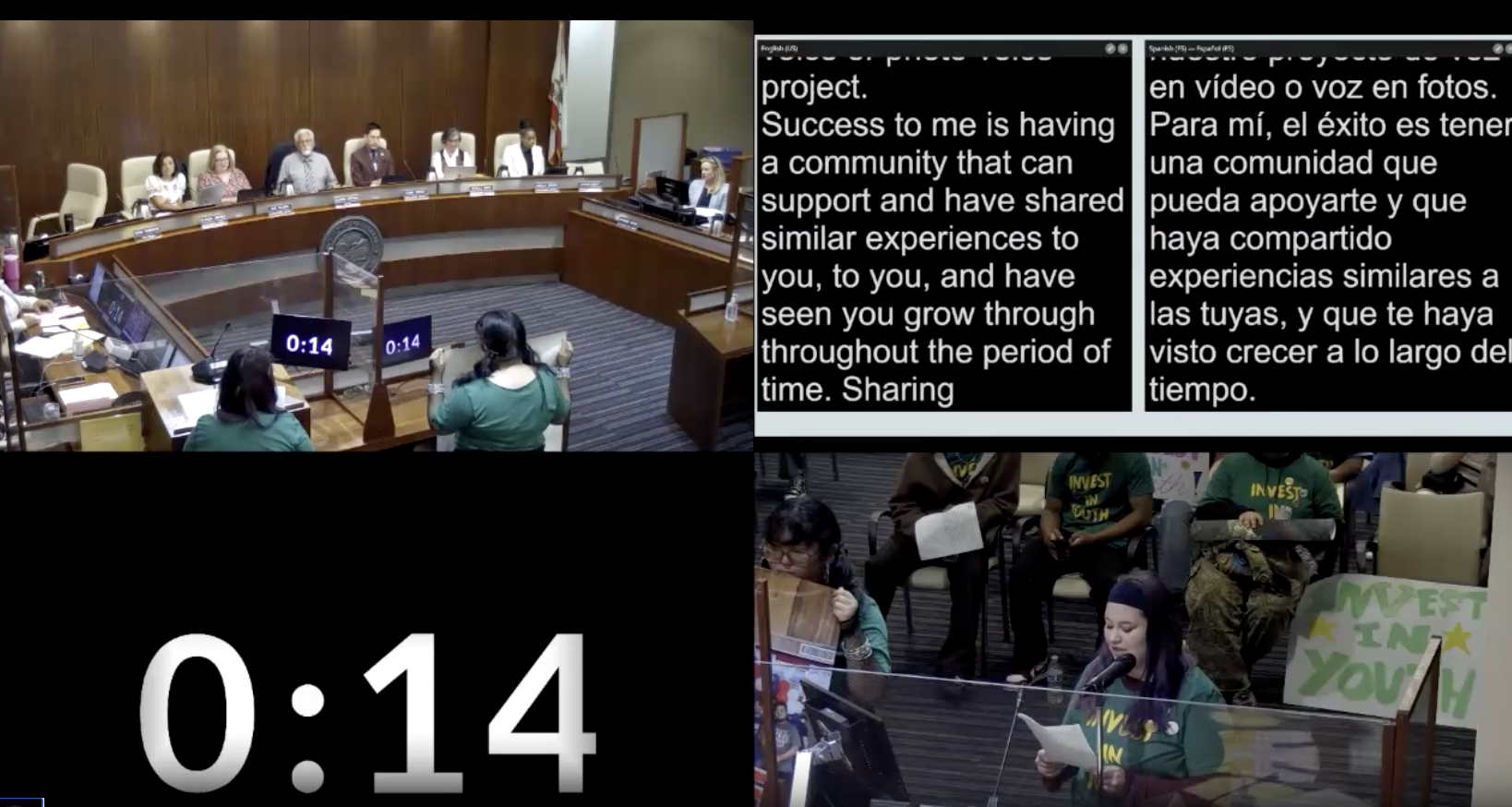
Approximately 30 young people and adult allies from RISE Center delivered a coordinated presentation during open forum, sharing findings from Listening Campaign 2.0 — a research initiative conducted in partnership with Series Policy that engaged over 150 young people ages 14 to 20.
Why it matters: The presentation, timed to coincide with the Kids First vote, brought the human stakes of youth funding directly into the room. Organizers pivoted from a planned community convening to deliver their message directly to council.
The campaign identified three core themes: youth spaces are neglected and under-resourced, with libraries locked and transportation inaccessible; youth feel exhausted and abandoned by adults and systems that claim to support them; and young people are creating their own coping mechanisms because formal support is lacking.
Six recommendations were presented: build relationships grounded in trust, invest in committed youth workers, create free safe third spaces, make schools healing-centered and future-building, embed youth voice in governance and budgeting, and fundamentally restructure adult-held power.
Speakers from the East Bay Center for the Performing Arts, Richmond Outdoors Coalition and Richmond High School also testified. Daffodil Autan, a parent, described her daughter receiving approximately $10,000 per year in scholarship value for year-round artistic training the family could not otherwise afford. Jenny Mulholland Beers, co-founder of the Richmond Outdoors Coalition, reported serving more than 1,400 youth annually with an average of 34 hours outdoors, with data showing improvements in academic engagement and social-emotional growth. Ruthie Dineen, executive director of the East Bay Center for the Performing Arts, noted the center receives only 10–15% government funding and called on the council to support youth safe spaces.
Richmond Advances Strongest ICE Restrictions on First Reading
The council voted 7-0 to introduce amendments to RMC Chapter 2.30, originally passed in 2025 as Ordinance 8-25 NS, that would create some of the most detailed municipal restrictions on immigration enforcement in the Bay Area.
The basics: The ordinance strengthens Richmond's existing sanctuary protections by explicitly prohibiting the use of city property as staging areas, processing locations or operational bases for civil immigration enforcement. It further defines "city resources" to include funds, equipment, communication systems, data systems, office space and parking; formalizes a community-facing communications and preparedness plan; and establishes annual reporting requirements to council beginning May 2027.
Why it matters: Councilmember Jimenez cited a recent case that brought the issue home: "What happened in San Francisco airport was that a TSA employee shared the data of the mom and the girl that got deported. They are from Richmond." She added: "This is important to send a clear message to our community and especially the immigrant community that is under attack right now with this administration."
Where things stand: Senior Assistant City Attorney Kimberly Chen presented the proposed amendments, while Project Manager Gabino Arredondo detailed the draft implementation plan, which will include rapid response network coordination, multilingual materials, immigration safety plan templates and collaboration with schools and neighboring cities.
Council members probed enforcement mechanics and gaps. Councilmember Jimenez asked what happens if federal officers staged on city property; the city attorney confirmed staff would tell them to leave. Vice Mayor Robinson questioned the function of "non-public area" designations and the warrant requirement for federal agents to enter them. Councilmember Zepeda identified a gap: public sidewalks and streets, as public right-of-way, are not covered by the ordinance. He also asked whether independent contractors could inadvertently admit federal agents. The city attorney explained that contractors and volunteers are legally distinct from city personnel and cannot be subjected to city training mandates without reclassification risk.
The other side: Mark Wasberg opposed the ordinance, arguing the city has no power to stop the federal government. But public comment was otherwise heavily supportive. Crescent Diamond of Reimagine Richmond, who identified as a Holocaust survivor descendant, supported the ordinance and expressed concern about delays. Andrew Melendez, a lifelong Richmond resident, praised the inclusion of city-leased and controlled properties. Noel Marisol Cantu, a third-generation resident, noted that cities across Contra Costa County and the South Bay are reaching out to learn from Richmond's model. Carlos Juarez of Reimagine Richmond urged the strongest possible language, emphasizing that fear of enforcement affects whether people seek services and show up to school.
Decisions: The first reading passed 7-0.
What's next: Second reading is scheduled for April 21, with the ordinance taking effect May 21.
Housing Authority Advances Nevin Plaza and Nystrom Village Plans
Sitting as Housing Authority commissioners, the council voted 7-0 to adopt the 2026 annual plan and five-year plan covering 2026–2030, as required by HUD.
Why it matters: Federal compliance, HUD capital funding and ARPA-supported redevelopment of aging public housing all depend on timely plan submission. The plans advance Rental Assistance Demonstration (RAD) conversions — a federal program that allows public housing agencies to convert units to project-based voucher or rental assistance contracts, unlocking private financing for renovations.
Where things stand: Executive Director Antoinette Terrell presented key milestones: Nevin Plaza Phase 1 is complete with 140 units renovated and leasing underway; Phase 2 has executed a land lease agreement and submitted a Senate Bill 35 streamlined application. Nystrom Village received a HUD Commitment to enter into a Housing Assistance Payment Contract in March 2026 and executed its land lease agreement, with community engagement expanding in April. ARPA funds totaling approximately $747,000 — 37% of the allocation — are supporting Nystrom Village pre-development. Richmond Village repositioning is in due diligence with a financing plan expected by September 2026. The Housing Choice Voucher program closeout was completed after HUD approved 2019 audited financial data in September 2025.
The other side: Public commenter Jesse Turan, an unhoused Richmond resident, criticized the city's approach to housing the homeless, citing repeated coordinator turnover and a police encounter at her encampment. She suggested hiring an accountant to oversee expenditures, noting HUD previously withheld funds over mismanagement.
Decisions: The plan was approved 7-0, with Councilmember Bana moving and Councilmember Zepeda seconding.
Police Pay Gap, Detective's Suspension
Police Union Escalates Pressure on Compensation and Staffing
Multiple speakers representing or supporting the Richmond Police Officers Association used both closed-session public comment and open forum to press the council on officer compensation and the suspension of Detective Brandon Hodges.
Why it matters: Richmond officer compensation ranks in the bottom quarter of comparable agencies, driving recruitment and retention problems that directly affect public safety.
RPOA President Benjamin Terrio submitted 30 years of historical compensation data, lateral departure tracking since 2015 and a bargaining brief on step and longevity pay. He told the council: "The data is unambiguous. It's not a minor discrepancy — for a mid-career officer with 10 years of service, our package essentially lags behind." During open forum, Terrio returned to call on the city to bargain in good faith: "Richmond wants a safer city. It's got to support the people who do the work."
Sam Lee, a District 1 business owner, praised the Richmond Police and Fire departments' response to a recent assault on his elderly father but called on Councilmember Brown to address broader safety concerns. Cindy Hayden asked the council not to repeat what she called "inordinate" suspension times applied to previous officers.
The council took no public action on these items, as they fall under closed-session labor negotiations.
Minor Items
- Consent calendar approved 7-0 (excluding two items pulled: records retention schedule update continued to April 21, and Willdan contract pulled for discussion).
- Willdan Financial Services contract approved 7-0 for $59,230 to conduct traffic impact fee and comprehensive user fee studies through June 2028. Public commenter Claudia Citron urged a socioeconomic impact study and community involvement before raising fees.
- Councilmember Zepeda reported testifying at the state Capitol in support of AB 1941 to strengthen enforcement against copper wire theft buyers.
- Vice Mayor Robinson was appointed to the Green Empowerment Zone Executive Port Board.
- Councilmember Bana reported on East Bay Wildfire Coalition consulting and an anti-war statement by women elected officials.
- Jesse Turan called for safe parking areas and tiny home communities as faster, cheaper alternatives to permanent housing, noting millions in unspent Measure X and Chevron funds.