
Richmond Approves Axon Drones, Cameras but Holds Back License Plate Readers
City Council • RichmondOctober 6, 2026
Locunity is an independent informational service and is not an official government page for this commission. All information is sourced from public footage and an analysis of official agendas with the aid of responsible, fact-checked AI. to report an error or omission.
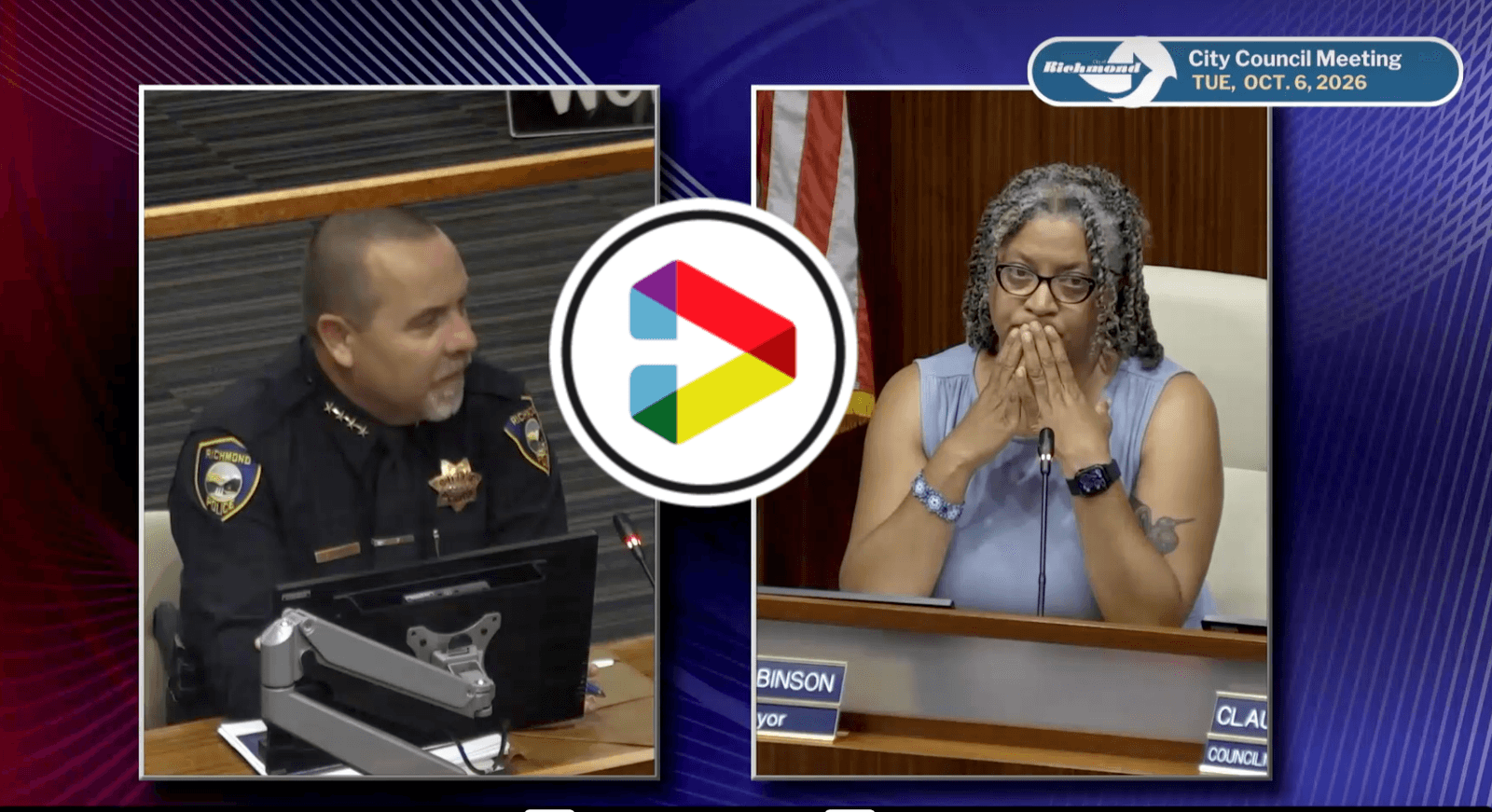
Richmond will expand police drone coverage citywide and replace its Flock cameras. Automated license plate readers, the most contested piece of the package, now face a separate council vote. On a 5-2 vote, the City Council approved Axon and Verkada contracts but directed the City Attorney to negotiate, not finalize, the plate-reader deal and bring it back. The split followed a long Electronic Frontier Foundation presentation finding that outside agencies ran about 96% of searches on Richmond's Flock data.
Axon drones and CCTV approved 5-2; license plate readers carved out for a later vote
EFF: outside agencies ran 2.4M searches on Richmond plate data, including immigration-related ones
Zepeda's approve-everything substitute fails 2-5 as most of the council demands data first
Only 13 detectives cover Richmond, the police chief tells the council
Agenda fight: last-minute consent moves and reordering spark a rules challenge and public complaint
Axon Package Passes, Plate Readers Wait
The council approved Axon drone and CCTV equipment and a Verkada camera contract for city facilities. Plate readers must return for their own vote.
Why it matters: The vote keeps police drone and camera coverage on track as Flock is phased out. It also forces a public, data-backed decision on plate readers in a sanctuary city where immigrant-rights groups say any such network is a risk.
The basics: Richmond police use Flock Safety for 110 automated license plate readers (ALPRs) and one "drone as first responder" covering roughly 60% to 70% of the city. Police Chief Tim Simmons shut Flock down in late 2025 after learning that a national search feature had made Richmond's data reciprocally searchable. The council then asked for a non-Flock option.
Where things stand: Staff proposed adding ALPR, CCTV and drone equipment to the city's existing Axon contract, which already covers body cameras, Tasers, interview rooms and VR training. The amendment adds $3.5M, for a not-to-exceed total of $12M through September 2029, with extensions to 2031. A separate contract with Assure MSP and Verkada, up to $500,000, would cover non-police CCTV at City Hall, libraries, parks, the Port and other facilities.
Simmons pitched Axon as safer by design. It offers no sharing toggle, city-owned hardware, 30-day data purging, storage in AWS GovCloud, a public transparency portal and monthly audits to the Community Police Review Commission. Six drone docks would give full-city coverage, including Hilltop, Carriage Hills and Point Richmond. Simmons also cited state laws SB 34 and SB 54, which limit out-of-state and immigration-related data sharing.
"The Flock system starts open, and you have to go through and close it by way of settings. The Axon system starts closed," said Police Chief Tim Simmons.
"We're not asking tonight for $12 million. We're asking for $3.5 million to add ALPR, CCTV, and drone equipment to our current contract with Axon," said Senior Accountant Stephen Linderman. Linderman said Axon outscored Flock 229 to 209 out of 300 points, and that bundling adds about $1.7M in extra equipment.
The detective gap: Questioning by Vice Mayor Doria Robinson showed the department has 13 detectives, with just four handling burglaries, robberies and vehicle theft citywide. Robinson cited District 3 figures from April through July, including 90 stolen cars and 38 aggravated assaults. Simmons said he would not claim ALPRs reduce crime. "What the biggest value is, is it is a tool and a resource that gives us leads where there perhaps would otherwise be no lead," he said.
The other side: Privacy, immigrant-rights and teacher groups opposed both ALPRs and Axon. They cited an ACLU of Northern California letter, a 14-organization joint letter and a petition with more than 250 signatures. "Sanctuary cannot coexist with surveillance," said Abigail Esquivias, Director of Strategy and External Affairs, Social Justice Collaborative, who also noted Axon's business with ICE. Mike Katsoulekabe, Director of Research, Oakland Privacy, described wrongful arrests caused by plate-reader errors.
Supporters pushed back. "We use technology to solve crimes," said Ben Terrio, President, Richmond Police Officers Association. "The residents of Richmond's safety shouldn't end where other people's fear begins," said public commenter Lori Hart. Public commenter Joe Puglio backed everything except the plate readers.
Decisions and stakeholder impacts: Councilmember Cesar Zepeda offered a substitute to approve everything and keep an off-ramp, noting contracting takes about 60 days or more. It failed (For: 2, Brown and Zepeda; Against: 5). Councilmember Soheila Bana's motion to approve all but ALPRs, adjust the contract amount and have the City Attorney negotiate but not finalize the ALPR contract then passed (For: 5, Brown, Bana, Jimenez, Zepeda, Robinson; Against: 2, Wilson and Mayor Martinez).
"You're sending the city attorney to start the ALPR contract, and I don't want to do that because we haven't seen the data yet," said Councilmember Sue Wilson. Simmons said he would support bifurcating the contract.
Police gain drones and cameras quickly. Opponents won a second public vote on plate readers.
What's next: The ALPR contract returns to the council after negotiation; Bana floated Oct. 27. Robinson wants the Police Strategies data analysis first.
EFF Audit: Outsiders Dominated Richmond Searches
Why it matters: The findings came from Richmond's own partial Flock audit logs. They gave skeptical members grounds to pull plate readers out of the Axon package.
Where things stand: At council direction from Sept. 22, Sarah Hamid, Director of Strategic Campaigns, Electronic Frontier Foundation, presented on ALPR effectiveness and risks.
"Outside agencies ran about 96% of the searches that included Richmond's network, which is roughly 2.4 million searches from more than 4,000 agencies, whereas RPD ran about 89,000," Hamid said.
She also reported:
At least 75 searches that named immigration enforcement as the reason
About 89% of police searches with no case number
Two randomized trials showing no statistically significant drop in crime
Mission creep, including a search tied to an ice cream theft
Hamid argued the harms are vendor-agnostic and that switching vendors resets protections. That answer bore directly on Councilmember Claudia Jimenez's question: "Are you saying that this is the same system, just with different name?"
The other side: Simmons said only complete-plate national searches were possible and that no evidence shows Richmond data was used. He added that Flock data was purged at 30 days. Zepeda distinguished data being accessible from data being accessed. "When our system went down, there was a young person being trafficked in Richmond, and we were not able to help," he said.
Councilmember Jamelia Brown raised a Santa Clara Superior Court ruling against EFF in a San Jose Flock lawsuit. Hamid said the ruling "does not end the matter."
Bana said residents had changed her from "totally pro cameras" to skeptical. She later said of Hamid, "This presenter is not technical; she's an activist." Wilson argued what sets ALPRs apart is "the mass part of mass surveillance."
In public comment, Terrio said of the presentation, "It's not an independent review." Public commenter Claudia Citroën called it "manipulative." Most other speakers backed EFF's warnings.
Consent Calendar Fight Exposes Council Rifts
Where things stand: During agenda review, Bana tried to move several items to consent. A bid to fast-track a Disaster Preparedness Commission (Item 09) failed (For: 3; Against: 3, Brown, Robinson and Martinez; Abstain: 1, Zepeda). Item 010, a police armored-vehicle grant, got no second. The cultural-venues item (011) moved to consent (For: 5; Against: 1, Martinez; Abstain: 1, Zepeda). Bana then won a 6-1 vote, over the mayor's objection, to hear Item 010 after the Police Strategies contract.
Mayor Eduardo Martinez reordered the agenda so the EFF presentation came before Axon. He also bumped the Bay Area Air District's Chevron refinery presentation to the next meeting. "I want to start separating items that are budget-related from items that are more action so that the budget items can be held over for the meetings in which we discuss the budget," Martinez said.
The other side: Zepeda argued that council rules set the order for pulled items and that skipping it requires suspending the rules. City Attorney Moore said the practice was "consistent with our past practice." Public commenter Don Gosney said adding items to consent after the 2 p.m. pull deadline blocks public comment. "So please stop trying to silence us," he said.
Decisions and stakeholder impacts: The consent calendar passed 7-0. The procedural fights helped push Items 09, 010 and the Police Strategies contract past adjournment.
Minor Items
Financial report ordered: The council voted 7-0 for a plain-numbers report on three years of surpluses or deficits; Interim City Manager Mark Scott, at his first meeting, said a basic report can meet the roughly 20-day deadline.
Cultural practice space: The council approved a search for venues for minority cultural groups; Danza Huitzilin's roughly 40 members practice outdoors without restrooms.
Chevron briefing delayed: The Bay Area Air District's preliminary refinery health risk assessment moves to the next meeting.
Items left unheard: The Disaster Preparedness Commission, the armored rescue vehicle grant and the Police Strategies contract amendment were not reached.
Closed session: No final decisions were made on 1689 Regatta Boulevard or on talks with SEIU 1021, IFPTE Local 21, RPOA, RPMA, IAFF Local 188 and the fire managers.
Looking Ahead
The plate-reader contract, the Police Strategies amendment, which Simmons said includes a third-party ALPR auditor, and the Chevron health risk briefing all head to upcoming meetings. Expect the surveillance debate to resume when the ALPR deal returns.