City Council - Jun 09, 2026 - Meeting
City Council • RichmondJune 9, 2026
Locunity is a independent informational service and is not an official government page for this commission.We use AI-assisted analysis and human editorial review to publish information.
Richmond Council Favors Status-Quo Budget but Leaves $2.7M Gap Unresolved
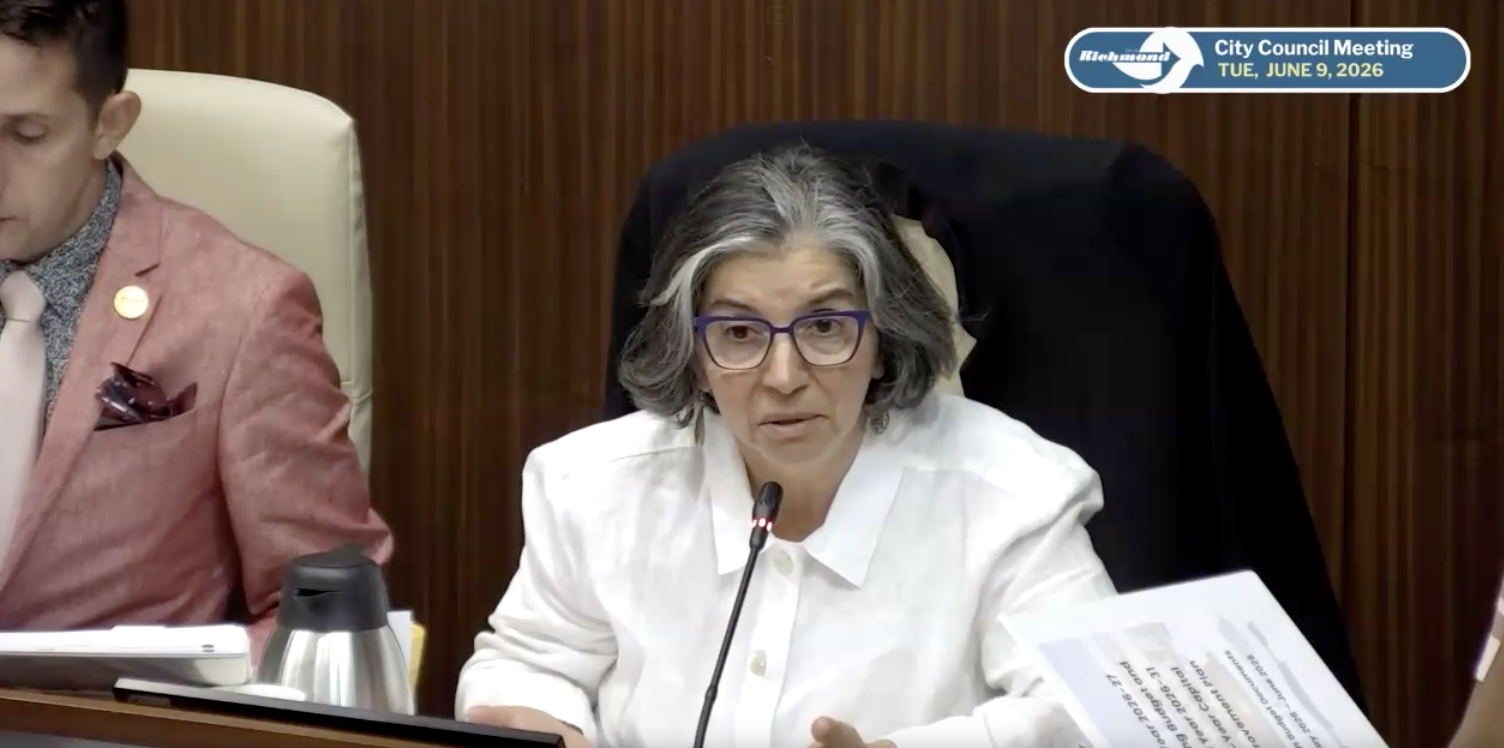
Richmond's City Council spent more than four hours dissecting a draft $215.6 million capital plan and two competing paths for the FY 2026-27 operating budget at a special study session June 9 — then ran out of time before anyone could make a motion. Staff will return June 16 with revised options, one week before the scheduled June 23 budget adoption.
- Council leans toward status-quo budget balanced at a 12% vacancy rate, preserving all current services and key initiatives without tapping reserves
- $2.7M in newly identified shortfalls threatens four active park and trail projects, including the Point Molate Bay Trail and the Richmond Wellness Trail
- Staff recommends sunsetting the $3M e-bike share program that averaged $665 per trip, redirecting focus to a state-funded e-bike lending library
- ROCK Community Advisory Board members push for Care Navigator positions excluded from the draft budget, calling them essential to crisis follow-up
- Rising pension costs cast a long shadow: CalPERS unfunded liability projected to hit $44.3M by FY 2030-31, a 64% increase
- 37 unfunded council initiatives compete for finite staff capacity; staff proposes a scoring framework to sequence the work
Two Budget Paths, No Vote
City Manager Shasa Curl and Finance Director Emily Combs presented the council with a clear fork in the road: Option 1 holds the line; Option 2 opens the books.
The basics: Option 1 is a baseline operating budget balanced by holding open positions to generate $16.4M through a 12% vacancy rate — up from 9.7% last year. It preserves every current service line and previously funded council initiatives, including $1.5M for Black Resiliency, $700,000 for immigration services, and $300,000 for community engagement. Option 2 would keep the same balanced bottom line but free up roughly $6.4M in discretionary funding — $3.08M from key initiatives and $3.3M from reimagining public safety programs — that the council could redirect to cover newly identified project shortfalls.
Why it matters: Since May, staff discovered $2.676M in cost overruns and scope gaps across four active construction projects: the Richmond Wellness Trail Phase 2, the San Francisco Bay Trail at Point Molate ($1M shortfall alone), PG&E-mandated change orders at Shields Reid Park, and a missing restroom from the original scope at Wendell Park. Without new money, projects that already have shovels in the ground could stall.
Where things stand: The council majority signaled clear discomfort with Option 2's trade-offs. Vice Mayor Doria Robinson said she was "of the mind that option one is probably the best option and would like to move forward with that at this time." Councilmember Sue Wilson was more pointed: "I am not willing to mess with the funding of previously approved initiatives that already have funding. But I really do encourage the finance team to go back and find other ways to close that $2.6 million."
Wilson framed the shortfall as manageable in the context of the city's overall spending, calling the amount "budget dust." Councilmember Claudia Jimenez proposed a creative workaround, suggesting the city use $1.8M in unallocated interest earnings from the Chevron settlement — one-time money — to help fill the gap rather than cutting community programs.
The other side: City Manager Curl tempered expectations that the mid-year budget review could bail out unresolved shortfalls, as it has in prior years. "Mubeen told me that we might not have enough money at the end of the fiscal year. So my job is to convey that to you," Curl said, referencing the city's chief financial officer. The warning underscored a structural shift: the historical cushion of unspent dollars may no longer exist.
What's next: Staff will return June 16 with updated options focused on non-discretionary funding sources. Final budget adoption is scheduled for June 23.
The Hiring Wall: 92 New Positions but No Room for More
Why it matters: Richmond added 92 employees since 2021 and negotiated three consecutive rounds of raises, driving general fund personnel costs up by more than $54M. CalPERS unfunded accrued liability payments are projected to climb from $26.9M in FY 2021-22 to $44.3M by FY 2030-31 — a 64% increase that will consume a growing share of future revenue.
Where things stand: The 12% vacancy rate that balances the current budget is itself a symptom: the city cannot afford to fill every authorized position. City Manager Curl was blunt: "It is not sustainable for the city to continue to hire unless there are retirements."
Every department reported being understaffed and under stress, but council members diverged on priorities. Mayor Eduardo Martinez advocated for new positions in the city attorney's office and code enforcement. Vice Mayor Robinson asked whether strategic hires in business licensing and permitting could generate enough revenue to pay for themselves. Councilmember Jamelia Brown took a different tack entirely, asking "if regular council meetings were reduced from the 3 per month to 2, how could resources such as the staff hours, the overtime, the time for agenda preparation, workload, the departmental capacity be redirected to improve service delivery and the project implementations."
Curl said the primary near-term strategy is to become more efficient through technology and innovation rather than hiring.
E-Bike Share at $665 a Trip: Staff Says Sunset It
The basics: The citywide e-bike share program, launched with climate and equity goals, has cost nearly $3M through June 2026 with low utilization and repeat ridership, averaging $665 per trip in city costs. Project Manager Gabino Arredondo recommended concluding the program and redirecting remaining ECIA grant funding to fill a $2.2M shortfall in the separate e-bike lending library — a facility that is part of Richmond's $50M Transformative Climate Communities (TCC) grant from the state. That $2.2M in city matching funds would unlock $2.5M in state construction and operating dollars.
Where things stand: The share program drew passionate defenders during public comment. Salma Biruman, the program's community manager, argued ridership grows with active outreach and that riders continued using bikes after promotional vouchers expired. Shawn Flood, CEO of the e-bike vendor, said 10 additional stations could be deployed immediately with pending encroachment permits and flagged a Metropolitan Transportation Commission grant opportunity due June 22. David Talsma argued the per-trip cost is inflated by one-time acquisition expenses, noting voucher users averaged 7-plus rides compared to 2.25 without vouchers, dropping per-ride costs to around $150.
The other side: Councilmember Cesar Zepeda questioned why the program covered only 13 stations in southern Richmond: "It's not a citywide program. And I want to be able to see, if we decide to move forward with the project again, that it really becomes a citywide program." A public commenter named Isabella called the lending library's $3.4M construction estimate "outrageous" — roughly triple the original $1.16M estimate — and questioned whether it should be canceled entirely. Councilmember Brown asked whether the lending library would perform better than the share program given its poor metrics. City Manager Curl stated flatly that no general fund dollars exist for the bike share and recommended sunsetting it.
What's next: Staff will continue conversations with the vendor, but the budget trajectory points toward winding down the share program. The lending library's fate hinges on whether the council can identify the $2.2M match.
ROCK Program Advocates Push for Care Navigators
Why it matters: Richmond's ROCK (Richmond Operation of Care and Knowledge) crisis response program launched this year as part of the city's reimagining public safety initiative, which has grown 40% to $8.8M in FY 2026-27. But the draft budget does not include two Care Navigator positions that the CCRP/ROCK Community Advisory Board unanimously approved — roles designed to provide follow-up services after an initial crisis response.
Where things stand: Two advisory board members made the case during public comment. Andrew Melendez said the navigator positions connect people with long-term services after a crisis call and are "widely used in similar programs nationwide." Sonia Decker framed the positions as central to the program's founding vision: "This was a part of how the ROCK program was envisioned by the Reimagining Public Safety Task Force." Decker called the navigators "a fiscally responsible choice as it can save the city money in the long run to prevent crisis from continuing."
The other side: Under Option 2, the $3.3M classified as discretionary within the reimagining public safety budget — including $1.9M for Youth Works and $1.3M for unhoused interventions — could theoretically be redirected. But Councilmember Jimenez pushed back hard on that classification: "I particularly feel like we had been putting this money over and over for in-house intervention for youth work and it had been really giving us results in terms of getting more young folks in our city to work. So I don't agree that we need to use that as a slash fund." City Manager Curl acknowledged the classification should have been split to separate staff costs from program costs. The Office of Neighborhood Safety funding was classified as non-discretionary because it supports permanent staffing.
What's next: Whether the Care Navigator positions get funded depends on which budget option the council selects and whether staff can identify alternative funding sources by June 16.
Parks Groups Rally for Point Molate Bay Trail
Why it matters: The Point Molate segment of the San Francisco Bay Trail has a $1M construction shortfall — bids came in at $4.12M versus a 2021 estimate of $3.35M — and advocates from multiple organizations urged the council to close the gap.
Where things stand: Bruce Beyer, chair of the Trails Enrichment Action Committee (TRAC), said his group delivered more than 50 emails of support from organizations including Save the Bay, Citizens for Eastshore Parks, and the Bay Conservation and Development Commission. He emphasized that East Bay Regional Park District paid all design and permitting costs, leaving the city responsible for only one-third of construction. Erin Pang of Save the Bay and Amaya Williams Segovia of Citizens for Eastshore Parks both urged the council to adopt Option 2 and fund the trail.
Separately, the city spends $250,000 annually maintaining Point Molate — a property it still largely owns despite transferring a small portion to East Bay Regional Park District. City Manager Curl said maintenance costs are expected to "increase astronomically" in the next year or two and recommended restarting quarterly Brown Act meetings with the park district to pursue cost-sharing. Councilmember Zepeda supported that direction.
Councilmember Wilson raised concerns about the trail's shoreline stabilization approach, asking for assurance that riprap would not cover 300 feet of beach. Staff clarified the trail and beach stabilization are separate but interrelated projects. Vice Mayor Robinson flagged the project's recurring cost overruns: "I seem to remember this is the second or third funding gap that we are addressing in this project."
37 Initiatives, No Playbook
Administrative Chief Patrick Seals presented a list of 37 council-directed initiatives received since January 2025 — ranging from immigration services and Black resiliency funding to ciclovia events and bus stop bench programs — all competing with core city services for finite staff time.
Staff proposed a five-criteria evaluation framework covering strategic alignment, fiscal impact, service delivery, organizational capacity, and community benefits. Each initiative would receive a score to help determine sequencing. City Manager Curl said there is currently "no criteria in terms of what the order is" and that the lack of consensus creates tension across the organization.
Vice Mayor Robinson recommended organizing initiatives by responsible department and creating capacity-based queues. Councilmember Brown asked how long it would take to clear the existing backlog if no new initiatives were added — a question staff did not directly answer before adjournment.
ALS Paramedic Program: Revenue Options Coming
Fire Chief Aaron Osorio reported that the January presentation on transitioning to an Advanced Life Support paramedic program made clear it would create significant ongoing operational costs for staffing, equipment, training, and oversight. Council previously directed staff to conduct public polling and bring back revenue options.
Osorio noted that if polling supports a general obligation bond (requiring two-thirds voter approval), those funds could only be used for capital projects like fire station upgrades — not ongoing operational costs, which would still require a general fund source. Councilmember Zepeda asked whether the budget could set aside incremental funding now, with reimbursement if a ballot measure passes in November. Curl said the consultant could address that question when results are presented later in June, with full options returning in July.
Minor Items
- Councilmember Soheila Bana urged the city to pursue Prop 4 grant funding — $10 billion statewide, with 40% designated for disadvantaged communities — noting Richmond could qualify for up to $30M for wildfire prevention, parks, and community resiliency centers.
- Public commenter Claudia Citroen called for a forensic audit of tiny home village expenditures, citing $200,000 per yurt per year, and criticized the Office of Neighborhood Safety for serving only 69 people with a $2M budget.
- The city's five-year capital improvement plan totals $215.6M with $13.5M in identified shortfalls and $60M in unfunded needs.
- City Manager Curl highlighted positive momentum: 147 active grants totaling $328M, declining homicide rates, and four park projects under construction.