
Redwood City Rewrites 1987 Vending Rules, Extends Downtown Hours to Midnight
City Council • Redwood CitySeptember 29, 2026
Locunity is an independent informational service and is not an official government page for this commission. All information is sourced from public footage and an analysis of official agendas with the aid of responsible, fact-checked AI. to report an error or omission.
Redwood City's street vendors are about to work under rules written for 2026, not 1987. On Sept. 28, the City Council voted 6-0 to introduce a vending ordinance that brings city code in line with state law and lets vendors stay open until midnight in the downtown entertainment district. Earlier in the meeting, more than a dozen residents pressed the council on license plate reader cameras, ahead of a civil grand jury response due in the coming weeks.
- Vending ordinance introduced 6-0, replacing rules partly unenforceable under state law
- Midnight vending hours approved for the downtown entertainment district after a boundary fight
- About 15 speakers demand ALPR town halls, and some call for ending the contract
- El Camino plan delay fails 2-4, then support passes 6-0 with a data directive
- $738,000 plan expansion approved 6-0 as councilmembers press for community feedback
Vending Rules Get First Rewrite Since 1987
The basics: The ordinance rewrites city code governing motorized and non-motorized vendors, solicitors and charitable sales. "The city has not updated this ordinance since 1987," said Economic Development Manager Amanda Anthony.
Why it matters: Staff said parts of the current code conflict with state law. State law bars Live Scan background checks and misdemeanor penalties for sidewalk vending, and the city's $250 fine exceeds state limits. Vice Mayor Kaia Eakin cited "80% noncompliance, but we haven't really been able to enforce."
Where things stand: Motorized vendors parked longer than 30 minutes would need a city permit, as would all non-motorized vendors. Anyone selling food would also need a county health permit. Motorized vendors must stay 200 feet from schools and parks, and non-motorized vendors must stay 200 feet from farmers markets and special events. All vendors must keep 5 feet from entrances and leave 36 inches of sidewalk clear. Daylighting buffers, which keep sightlines open near intersections, are 20 feet for motorized vendors and 10 feet for non-motorized vendors. Trash and grease rules also apply. Staff's outreach included videos, 70 survey responses and visits to vendors, and the city has budgeted $30,000 for education.
The other side: Vendor Georgette Nelson welcomed the clarity but worried about city fees on top of county permit costs and about exclusion from city events. Maria Diaz-Vivian of the Stand by Heller Neighborhood Association described vendor crowds blocking ADA parking, a bike lane and sidewalks near Middlefield and Cedar. Rona Gundrum flagged sight-line hazards from food trucks near the Target exit.
Councilmembers focused on enforcement capacity. "There's no point in making things that we cannot enforce," said Councilmember Marcella Padilla. Councilmember Jeff Gee wanted enforcement to target "not necessarily the individuals, it's the people that are delivering the carts." Councilmember Diane Howard said "I'm not in favor of a subsidy" and asked to revisit the rules in about a year.
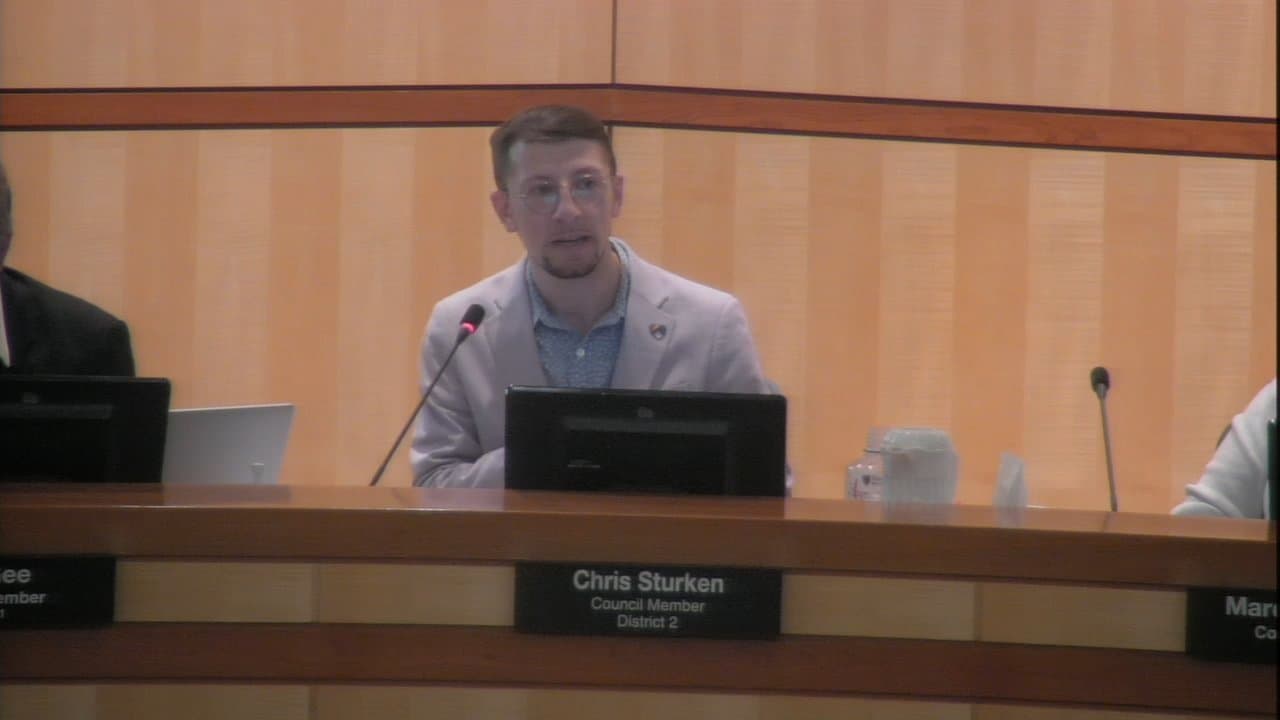
Midnight, but only in a small area: Citing a letter from the Fox Theatre owner, Councilmember Chris Sturken argued that 10 p.m. cutoffs mean "that is honestly a de facto ban on vending." The city attorney disagreed. Community Development Director Jeff Schwob suggested the Downtown Precise Plan's entertainment district. Eakin rejected a broader boundary, saying, "I don't accept your friendly amendment if you're expanding it." Sturken then accepted the narrower area.
Decisions and stakeholder impacts: Eakin made the motion, Howard seconded it, and it passed with Sturken's amendment (For: 6, Eakin, Martínez Saballos, Gee, Howard, Padilla, Sturken; Against: 0; Absent: 1, Chu). Hours in residential areas are unchanged. Vendors gain legal footing and later hours downtown, and in return they take on permits and fees.
What's next: The second reading is planned for October. Fees, including about $700 for motorized vendors, return in November. Mayor Elmer Martínez Saballos suggested a Jan. 1 start date. "I think our policy is only as good as our ability to enforce and educate people on the new rules," he said.
Residents Organize Against License Plate Cameras
Why it matters: The city must respond to a San Mateo County Civil Grand Jury report on its automated license plate reader (ALPR) program. The report is titled "Is Our Flock of ALPR Cameras Being Tended." A new vendor contract is also under consideration.
Where things stand: Most speakers identified themselves as members of Safety Over Surveillance Redwood City, which made this a coordinated push. Lawrence Huang said the council has a moral obligation to seek public input on its response. Amber Garza Washburn, a former prosecutor, summarized the report's findings on audits, data sharing, security and data retention. Jenny Krauss asked for a response independent of the police department.
Several speakers raised concerns about immigrant safety. Immigrant rights advocate Sarah Matlin asked for two accessible town halls that go beyond police presentations, along with disclosure of data sharing. Kathy Baird said ALPR use conflicts with the city's welcoming-city stance. Jose Campos, speaking in Spanish through an interpreter, described losing control over personal data. Bill Newell asked for at least two town halls with two weeks' notice and a response tailored to Redwood City. Tim McKenzie urged the city to cancel the ALPR contract and pursue no other vendor. Clara Juckel, a Police Advisory Committee member speaking as a resident, asked the council to put the response on its Oct. 26 agenda.
The other side: Maria Diaz-Vivian noted that camera evidence helped solve a fatal hit-and-run.
What's next: The council took no action. "The grand jury report is tentatively scheduled to come to this body a week from tonight on October 5th," said City Manager Patrick Heisinger. He said outreach meetings will be held Oct. 7 and Oct. 29 at North Fair Oaks Community Center.
El Camino Plan Survives Delay Bid
Where things stand: Padilla pulled Item 7D, a resolution supporting the Central El Camino Real Plan, from the consent calendar. She said community outreach was lacking. "I would just like to see the numbers along El Camino before we evaluate taking away an entire bus lane and adding to more traffic," she said, seeking ridership figures between Brewster and Finger. A transportation manager said SamTrans had sent the data that morning.
The other side: Gee defended the agency. "SamTrans is the only public transit agency in the country that has achieved over 100% ridership Post-COVID," he said. Sturken wanted the data too but cited the regional transit measure. "The benefits outweigh the concerns that I have at this time," he said.
Decisions and stakeholder impacts: Padilla's motion to continue the item, seconded by Howard, failed (For: 2, Howard, Padilla; Against: 4, Sturken, Gee, Eakin, Martínez Saballos; Absent: 1, Chu). Howard then moved the staff recommendation, with direction to share the ridership data and publicly explain why the plan ends at Brewster. Eakin seconded, and it passed 6-0, with Chu absent. The split was over timing, not direction.
Plan Expansion Approved, With Strings
Item 7G commits about $738,000 to a Wallace Roberts and Todd scope of work for expanding the GDAP area across Woodside Road. Gee noted that early phases include outreach. "We should know about it before we spend $738,000," he said. Sturken reported mixed reactions from businesses. WorldPac and Bear Robotics were enthusiastic, while Express Kitchen and Bath feared displacement if its property owner redevelops. Eakin said the expansion is "costing us an extra $750,000 and that also it's delaying the project by a year." Gee moved the item, Eakin seconded, and it passed 6-0, with Chu absent.
- Miracle League donation: President Scott Morton offered $150,000 for ADA dugouts and bleacher shade at Mitchell Field. Half is grant money that expires at year-end.
- King tide grants: Eakin relayed One Shoreline's forecast and a $75,000 matching grant for mobile home parks facing winter flooding.
- Proclamations: The council recognized Suicide Prevention Month, citing 65 county deaths in 2025, and National Service Dog Month honoring Canine Companions. It also welcomed Alianza Health Services.
- Consent calendar: Remaining items passed 6-0, with Chu absent.
- Community events: Howard invited colleagues to an Oct. 15 HART event and reported a coastal cleanup that drew more than 200 volunteers.
Looking ahead: The Miracle League hosts an Oct. 4 game at Hawes Park. The grand jury report is tentatively set for Oct. 5, and ALPR outreach meetings follow on Oct. 7 and Oct. 29. The vending ordinance's second reading is planned for October, with fees returning in November.