
Council Sends ALPR Grand Jury Response 5-1 Despite Calls to Wait
City Council • Redwood CityOctober 6, 2026
Locunity is an independent informational service and is not an official government page for this commission. All information is sourced from public footage and an analysis of official agendas with the aid of responsible, fact-checked AI. to report an error or omission.
Redwood City met a state legal deadline on its license plate reader program Monday, Oct. 5, 2026, but did not win over the organized residents who packed public comment. The City Council voted 5-1 to approve a mandated response to a civil grand jury report and rejected a push to wait until after two October community forums. The council also moved two quieter items with long tails: a new spot for Broadway on the county's transportation priority list, and water rules that will turn off drinking water for decorative lawns.
- ALPR grand jury response approved 5-1; Councilmember Sturken's delay motion died without a second
- Seven public speakers, most from Safety Over Surveillance Redwood City, pressed for independent audits, warrants and vendor penalties
- Broadway bike project added as sixth countywide transportation priority, 6-0, after a Bay Road debate
- Water code updates approved 6-0, implementing the state ban on watering decorative turf starting January 2027
Grand Jury Letter Clears, Debate Does Not
The basics: Automated license plate readers, or ALPRs, are cameras that log the license plates of passing vehicles. The San Mateo County Civil Grand Jury published a report on ALPR compliance Aug. 3, 2026. Under California Penal Code 933.05, the city must answer each finding and recommendation within 90 days, and the council must approve that answer in a public meeting.
Why it matters: The letter is a legal formality. Advocates argued it overstates fixes to a surveillance program whose future, including its vendor contract, is still undecided.
Where things stand: "We are in full agreement with all the findings and recommendations," said Police Chief Christina Bell. Bell said six of the seven recommendations are already implemented, and one is pending any future vendor agreement.
Bell listed the changes. Policy 427 was revised Sept. 18, 2026. Data sharing with the Stanford University Department of Public Safety ended April 10, 2026. Annual audit reports are now published, and data is kept for 30 days. Bell said the department has "restricted all sharing with outside agencies until we can ensure our data sharing practices are aligned with the new policy."
The other side: Councilmember Sturken argued the response to the recommendations was "just not yet satisfactory," and proposed continuing the item to Oct. 26, after the community forums. Vice Mayor Kaia Eakin, who made the approval motion, refused. "So no, I won't accept the friendly amendment," Eakin said. Sturken then offered a substitute motion to continue the item. It died without a second.
Staff argued delay offered no upside. The city attorney, Assistant City Manager Michelle Paulish-Flaherty and Bell said the letter follows a set formula, and community input would not change it. "If we are in violation of the state law, the AG really can impose penalties on the city," said the City Attorney.
"I think what we need to do is approve and then continue the community dialogue and then see what comes out of it," said Councilmember Jeff Gee.
Decisions and stakeholder impacts: The motion passed. For: 5 (Mayor Elmer Martínez Saballos, Vice Mayor Eakin, Councilmembers Isabella Chu, Gee and Diane Howard). Against: 1 (Councilmember Chris Sturken). Absent: 1 (Councilmember Marcella Padilla). Councilmembers stressed that the letter does not limit later decisions on ALPR technology. The police department gets legal cover, and advocates keep their fight for the contract stage.
What's next: The response is due by early November. Community forums on ALPR are set for Oct. 7 and Oct. 29.
Advocates Draft a Vendor Rulebook
Why it matters: Seven speakers, six of them members of Safety Over Surveillance Redwood City, previewed the terms they will press for when the council weighs a future ALPR vendor contract, or ends the program.
Where things stand: The speakers moved past the letter and focused on the contract fight ahead.
- Clara Jekyll, a Police Advisory Committee member speaking as a resident, proposed a $200,000 fine per unauthorized disclosure. She also asked for immediate termination rights, indemnification, notification, a one-year term and a ban on secondary data use, including AI training.
- Lawrence Wong argued audits cover under 7% of searches, find one to five violations monthly and exclude vendor searches. He suggested discontinuing ALPRs.
- Sarah Matlin cited hundreds of searches for Department of Homeland Security agencies and urged an independent audit rather than a rubber stamp.
- Bill Newell said the city lacked data-sharing approval processes and had mismatched retention rules. He urged warrants, penalties and much shorter retention.
- Tim McKenzie warned that warrantless searches pose Fourth Amendment and court admissibility risks.
- Amber Garza Washburn said any RFP award should follow community input.
- Alfredo Chorro, a Senior Affairs commissioner speaking as a resident, said he was glad the city did not sign with Flock. He worried about another vendor, citing immigrant fears and data security.
The other side: City Manager Patrick Heisinger said he is continuing the request for proposals, or RFP, to learn what vendors offer. "If we stop the process, then we can't get that information," Heisinger said.
Asked about an independent audit, Bell answered: "Absolutely. If it's affordable. Those are expensive, but worth it." She also flagged a concern about "having someone who's non-law enforcement having access to a system that has potential PII information," meaning personally identifiable information.
Decisions and stakeholder impacts: No contract action was taken. Sturken voiced support for fines or damages and for evaluating an outside audit. "I think we all agree with this, the spirit of wanting to gather more community input," said Mayor Elmer Martínez Saballos, who added that contract language would get a deeper look later.
Broadway Muscles Onto County Priority List
Why it matters: Projects on the San Mateo Countywide Transportation Plan list gain access to county and regional funding. The plan will also feed the Metropolitan Transportation Commission's next Plan Bay Area.
Where things stand: Jeff LeCap, program director at the City/County Association of Governments of San Mateo County, presented the plan update. It includes a draft vision, four goals and a single equity definition covering 49% of county households.
Staff's top five projects were the four-track station and grade separations, Bay Road Complete Streets, James Avenue Safe Routes to School, Veterans Boulevard Complete Streets and Vision Zero corridors. El Camino Real multimodal improvements and the ferry terminal were also flagged as regionally significant. Eakin pointed to the Dumbarton rail corridor's potential: "It will provide approximately 24,000 trips a day and approximately 7.3 million trips a year."
The other side: "I would like to swap out the Bay project for improvements to Broadway, if that's possible," said Councilmember Isabella Chu. She cited Walk Bike Thrive outreach, where residents "upvoted Broadway by a ratio of about 4 to 1."
Eakin defended the Transportation Advisory Committee's work: "I hope we don't have a 2-hour conversation about second-guessing a subcommittee whose job it is to look at this." Staff said Bay Road is further along and partly funded. "Broadway needs to start from planning," said Transportation Manager Malahat Orang. LeCap opened the door to a compromise: "we're not committed to the top 5."
Decisions and stakeholder impacts: Gee, Howard and Sturken backed adding Broadway. Heisinger and Director of Engineering and Transportation Tanisha Warner cautioned against over-prioritizing. Eakin moved the staff list plus Broadway, and the mayor seconded. For: 6. Against: 0. Absent: 1 (Padilla). Bay Road keeps its spot, while Broadway cyclists gain a funding path rather than a reshuffle.
What's next: The mayor backed a future study session on roadway prioritization.
Decorative Lawns Lose Their Drinking Water
The basics: Backflow happens when contaminated water flows back into the drinking supply. Assembly Bill 1572 bars using drinking water to irrigate "nonfunctional turf," meaning purely decorative grass.
Why it matters: State law requires local code changes and customer notice before January 2027. "The State Water Resource Control Board may issue civil penalties up to $1,000 per day," said Assistant Director for Public Works Justin Chappell.
Where things stand: Redwood City adopted its cross-connection rules in 2008 and amended them in 2013. A state handbook, effective July 1, 2024, imposes new requirements. The Chapter 38 updates require hazard assessments on all service properties and certified specialists. They also set backflow device standards, including a ban on below-grade devices.
A new Article 9 phases in the turf ban: government properties in January 2027, commercial and industrial sites in 2028, and homeowners association common areas in 2029. Staff plans an education-first approach, with administrative fines when needed. Chappell noted "the law doesn't specifically say what those exemptions are," which leaves staff discretion.
Decisions and stakeholder impacts: Gee said District 1 has many HOAs and offered help with outreach. Chu relayed that "it's more expensive to lay the purple pipe than it is to do potable water," referring to recycled-water lines. She also asked about eligibility for the Lawn Be Gone rebate program. No one spoke during public comment. Howard moved the item, and Gee seconded. For: 6. Against: 0. Absent: 1 (Padilla).
Minor Items
- Consent calendar approved: For: 6, Against: 0, Absent: 1 (Padilla).
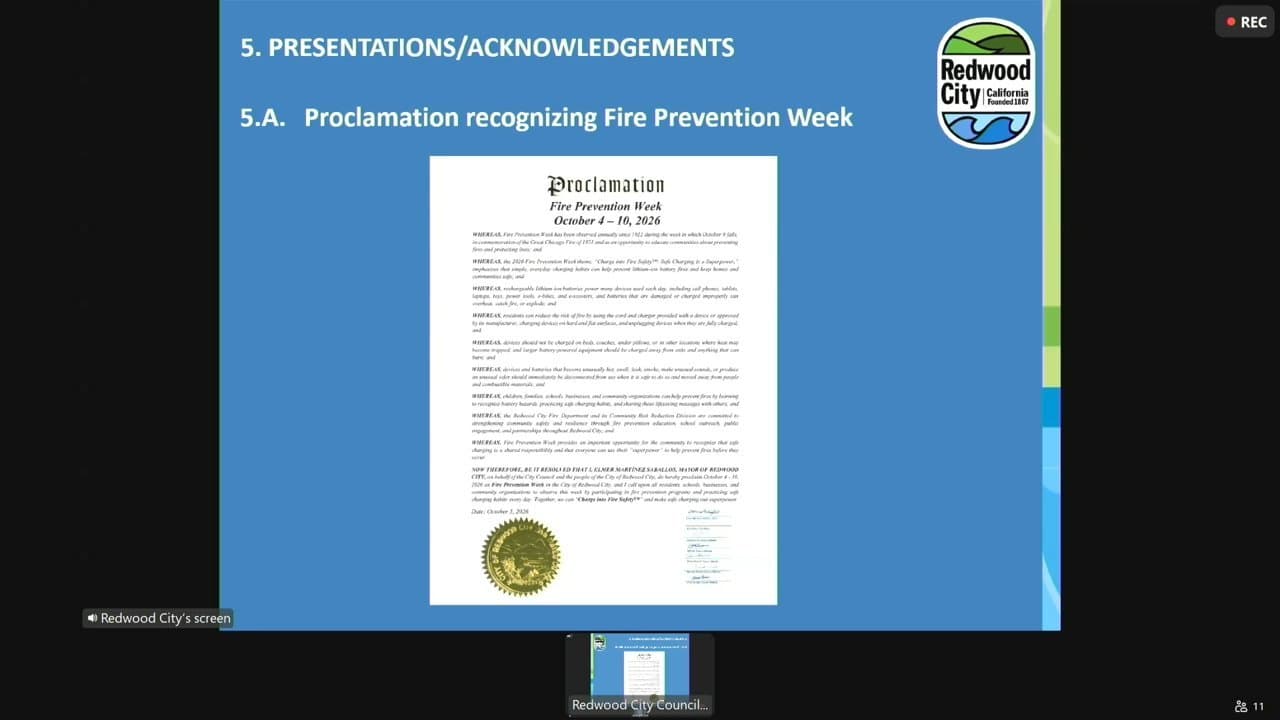
- Fire Prevention Week proclaimed for Oct. 4–10, 2026, with the theme "Charge into Fire Safety," focused on lithium-ion battery risks.
- October named Domestic Violence Awareness Month, honoring CORA, represented by board member Christelle Carlin.
- Four youth-designed voter stickers chosen from 68 entries will be distributed at polling places before the Nov. 3, 2026 election.
- Chu reported on a Vienna social housing workshop. Heisinger flagged outreach on "re-envisioning Lot B, whether or not to place housing on that site," plus a storm preparedness event.
Looking Ahead
Community ALPR forums are set for Oct. 7 and Oct. 29. The council holds a special meeting Oct. 14. The 84-101 interchange ad hoc committee next meets Nov. 6.