
Rancho Mirage Launches Free Sandbag Program Ahead of Forecast Wet Winter
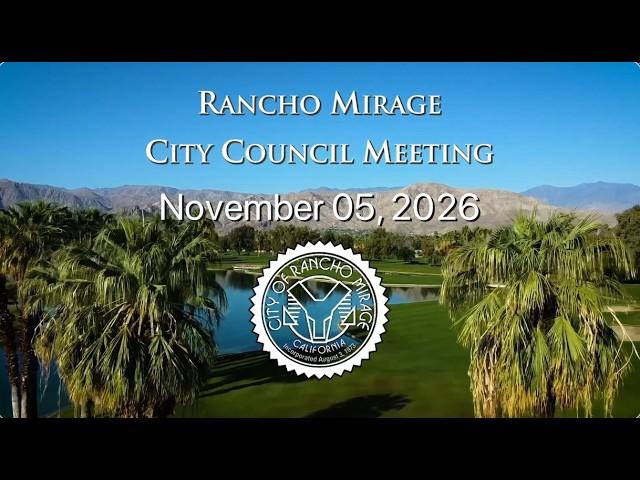
City Council • Rancho MirageNovember 10, 2026
Locunity is an independent informational service and is not an official government page for this commission. All information is sourced from public footage and an analysis of official agendas with the aid of responsible, fact-checked AI. to report an error or omission.
Rancho Mirage is trying to avoid the fire-station crush that marked Tropical Storm Hillary in 2023. The City Council voted 5-0 to hand out free sandbags at City Hall weeks before storms arrive. The council also closed the books on a year that beat revenue projections, started two special-tax annexations and heard airport leaders concede they can do little about the new FAA flight paths frustrating residents.
- Free sandbags, up to 30 per household, approved 5-0 with City Hall pickup and proof of residency.
- $2.5M operating surplus as year-end budget adjustments pass 5-0; reserves end near $56.9M.
- $93.6M airport baggage system, 70% federally funded, breaks ground as flight-path complaints mount.
- Two developments totaling about 18 acres move toward the police-and-fire special tax district.
Sandbags Move From Fire Stations to City Hall
Why it matters: Forecasters cite a 90% probability of a very wet winter. Under the new program, residents can stock up in advance rather than lining up at fire stations as a storm closes in.
Where things stand: Emergency Manager Brian Kephart pointed to the governor's Sept. 21 emergency proclamation and the wet-winter forecast. He said the 2023 distribution during Tropical Storm Hillary exposed two problems: fire stations were not equipped to handle the vehicle traffic, and staff could not verify who lived in the city.
The fix is a counter-service model. Each household may pick up as many as 30 sandbags free at City Hall. Residents must show a utility bill, driver's license or property tax bill, and allotments reset each year.
“We are proposing a proactive approach so residents can prepare weeks ahead of a potential storm instead of hours,” said Kephart.
Council questions clarified a key detail: the bags are handed out unfilled, so residents fill them. One councilmember urged residents to pick them up early and noted that seniors may need help. Mayor Lynn Mallotto thanked staff for the proposal.
The other side: The program's gap surfaced during public comment. Michael Lawler, a public commenter, said that without a place to fill them, empty bags are of limited use. “You need a filling station as well as empty bags,” he said.
Decisions and stakeholder impacts: The council authorized the city manager to create the program in consultation with the city attorney (For: 5, Against: 0, Absent: 0). Fire stations are relieved of storm-time crowds, and residency checks keep the supply for Rancho Mirage households. Residents without the means to fill and haul heavy bags, including seniors, bear the most practical burden under the current design.
What's next: City Manager Isaiah Hagerman's office will set up the program. The council did not take up Lawler's filling-station suggestion.
Revenue Beats Projections; Capital Timing Draws Down Reserves
Why it matters: The year-end report found the city's operations financially sound. A slate of delayed capital projects, not overspending, drove the drop in reserves.
Where things stand: Assistant Director of Administrative Services Joseph Carpenter reported a general fund operating surplus of about $2.5M, roughly $1.4M above budget. Revenues beat projections by 4.5%. Interest earnings led the gains at about $1M, followed by sales tax ($214,000), transient occupancy tax ($158,000) and property tax ($154,000). Transient occupancy tax is the hotel-stay tax central to a resort economy like Rancho Mirage's.
“Rancho Mirage revealed no structural operational issues,” said Carpenter.
The non-operating side ran a $7.48M deficit against about $4.7M budgeted. Carpenter attributed the gap mainly to project timing: the IID Substation, the Ramon Road widening, the sand fence project, and safety and parking work at Rancho Mirage Community Park. Net reserve use came to about $4.9M, and general fund reserves fell from about $61.8M to $56.9M.
Decisions and stakeholder impacts: The council adopted four resolutions covering the city, the community services district, the housing authority and the library and observatory (For: 5, Against: 0, Absent: 0). No one spoke during public comment. The interest-income boost shows how much a large reserve contributes to the city's revenue. Drawing that reserve down for capital work trades some of that earning power for completed infrastructure.
Airport Builds Big as Flight-Path Complaints Mount
Why it matters: Palm Springs International Airport is investing heavily in passenger infrastructure. For many Rancho Mirage residents, though, the airport's biggest local impact right now is noise from new FAA approach routes, which airport officials say they cannot control.
Where things stand: Airport Commissioner Dr. Keith Young said the outgoing baggage handling system broke ground Oct. 20 and will nearly triple capacity. “This is a $93.6 million project,” he said, noting it is 70% federally funded and uses no local tax dollars.
Other projects include:
- New escalators.
- Changes to TSA checkpoint flow.
- Shade structures for Uber and Lyft riders.
- 80 electric vehicle charging stations, which opened Oct. 8.
- New installations through the Art at PSP program.
Young reported 2.35 million passengers year to date. Winter seat capacity is flat, with December slightly up, and the airport expects 30 nonstop routes in season.
Consultant Accenture is helping draft a five-year capital improvement plan for Airport Commission review in December. Priorities include more gates, a federal inspection station and a consolidated rental car facility, which Young called enormously expensive. Financing limits will shape which of those projects can move forward.
The other side: Councilmember Eve Fromberg Edelstein brought resident frustration into the room. “We're getting a lot of complaints about the new FAA flight plan and how it's impacted our residents,” she said, asking whether the airport had contacted the FAA.
Young said the airport controls noise only on the airfield. He pointed residents to the Airport Noise Commission and said the airport can relay concerns, but the FAA sets flight paths. “The impact that we have once the plane is in the air or before it arrives is really beyond our control,” he said.
During public comment, Lawler described planes passing about 2,000 feet overhead. He urged the city to press the FAA and relevant elected representatives. “What's needed is some serious pushback,” he said.
What's next: The council took no action on flight paths. Residents seeking relief will need to engage the FAA, the Airport Noise Commission and their federal representatives. The airport's capital plan goes to the Airport Commission in December.
Two Developments Start Path Into Police-and-Fire Tax District
The basics: Community Facilities District No. 1 is a special tax district. New developments that join it pay a special tax that funds additional police and fire services.
Where things stand: Financial Analyst Jacob de la Cruz said both annexations are required by the projects' conditions of approval.
- Annexation No. 209 covers two parcels totaling about 10.09 acres at Ginger Rogers Road and Via Josefina (Tentative Tract Map 38868).
- Annexation No. 210 covers one 7.92-acre parcel at Dinah Shore Drive and Key Largo Avenue (Parcel Map 39444). Staff said that map is scheduled for Planning Commission approval later this month.
Each resolution accepts the owner's petition, shortens the timeline for the special election, preliminarily approves the annexation map and sets a public hearing.
Decisions and stakeholder impacts: Both resolutions passed (For: 5, Against: 0, Absent: 0 on each), with no public speakers. Annexation means future residents of these projects will help pay for added public safety services, rather than spreading that cost across existing taxpayers.
What's next: Final hearings are planned for Dec. 17.
- Consent calendar: Approved 5-0. Items included the Oct. 15 and Oct. 21 minutes, the quarterly Treasurer's Report, the annual and five-year development impact fee report, contracts and demands.
- Chamber update: Joyce Keel, Chamber Board Chair-Elect, previewed the Nov. 12 Business Expo and Job Fair at Agua Caliente Casino, with about 100 exhibitors and 700 attendees expected. Maddie Bogue of Southern California Edison introduced the Chamber's new Changemakers Collective.
- Honors: Mayor Mallotto recognized Observatory Coordinator Annie Poy for Visit Greater Palm Springs' Hospitality Champion Award. Councilmember Ted Weill received United Cerebral Palsy of the Inland Empire's Heart of Service Award.
- Public comment: Wally Martinez celebrated national election results and criticized data centers. Susan Ragsdale alleged Fair Housing Act violations at a prior residence and submitted documents; there was no council response.
- Closed session: City Attorney Colin Kirkpatrick reported no reportable action on potential initiation of litigation.
Looking ahead: Pending certification by the Registrar of Voters, Councilmember Steve Downs said he, Mayor Mallotto and Councilmember Fromberg Edelstein will return for new terms. The council's Dec. 17 annexation hearings and the Airport Commission's December review of the capital plan come next.