
Commission Approves $60.7M Behavioral Health Hub as Its Own End Nears
Public Works Commission • San FranciscoNovember 12, 2026
Locunity is an independent informational service and is not an official government page for this commission. All information is sourced from public footage and an analysis of official agendas with the aid of responsible, fact-checked AI. to report an error or omission.
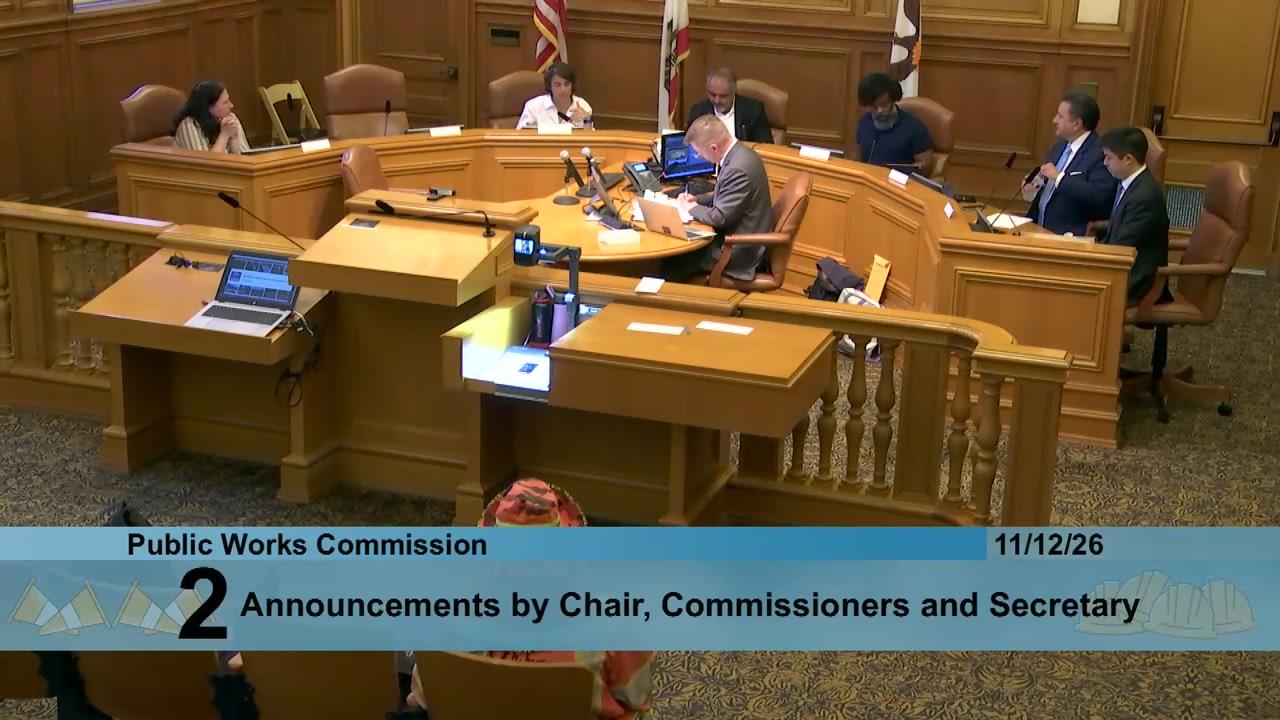
San Francisco's Public Works Commission on Nov. 12, 2026, approved a $60.7M design-build contract for a 24/7 sobering and behavioral health center at 1660 Mission St., weeks after voters approved a measure to abolish the commission itself. The voice-vote approval followed pointed questions about how an $858,270 startup order grew into a $60M contract, with a hard end-of-2028 grant deadline driving the timeline.
- $60.7M contract for 1660 Mission health hub approved on a voice vote; the project must finish by the end of 2028 or the city risks returning grant funds.
- Citywide pavement score holds at 75, with paving funding topping $100M this year.
- Bush, Bayshore, Fillmore, Market and Mission corridors are slated for paving within two to three years.
- Prop A, at about 68%, will eliminate the commission; the City Attorney's Office expects the change before year's end.
1660 Mission: A $60.7M Bet on a Tight Clock
The basics: In a design-build contract, one team handles both design and construction. Charles Pankow Builders holds Contract No. 1000039076 for the project, which will convert the former Department of Building Inspection building into a consolidated Department of Public Health (DPH) facility.
Why it matters: The roughly 95,000-square-foot, six-story building will house a 24/7 sobering center, a behavioral health service center, a pharmacy and administrative offices, City Clinic and DPH offices. The schedule is tied to grant funding, so delays carry a direct financial cost.
Where things stand: Project Manager Youssef Bouhamama said the modification raises the contract by about $59.9M. It moves from an $858,270 Public Works order, which was used to start programming before environmental clearance, to a $60.7M not-to-exceed amount over 820 days. The PennCal and LDA Forge team ranked highest in selection. The fixed budget limit was $68M, and total project funding is $79.3M.
The project is exempt from LEED, Chapter 14B, electrification, Arts Enrichment and Civic Design Review requirements under San Francisco Administrative Code 6.76. It is also exempt from the California Environmental Quality Act (CEQA) under a Class 32 exemption.
Tough questions from the dais: Vice Chair Eleanor Blume pressed on risk: "Do you anticipate that we may potentially see time and cost overruns that are not being encapsulated yet in the proposal in front of us today?"
Bouhamama said scope changes are the main risk. "If DPH do not add things during programming phase and changing scope and so forth, I think we will be able to meet that deadline of end of 2028 to complete the project," he said.
Director Carla Short of San Francisco Public Works spelled out the stakes: "Failure to meet that timeline, I believe, means they would have to give back grant funds."
Chair Fady Zoubi questioned the size of the jump. "This is my first modification that is modifying an $800,000 to a $60 million," he said. Bouhamama replied that staff "were directed to move forward with programming with getting approval through DPW order of that amount of $858,000 just to expedite the start of this project." Zoubi also asked about LEED certification, which Bouhamama said the project is not required to pursue, and about the 9.5% builder fee.
Decisions and stakeholder impacts: The motion passed on a voice vote, and no tally was announced. Commissioner Paul Woolford was absent. Commissioner Gerald Turner framed the project as an anchor for the Van Ness-Mission corridor: "It brings people, including our city employees, into a really centralized corridor that we want to get activated."
DPH and the clients of its sobering and behavioral health services gain a consolidated site. The exemptions mean the building skips the green-building, electrification, public-art and design-review requirements those rules would otherwise impose, in exchange for speed.
What's next: The 820-day contract clock runs toward the end-of-2028 completion target. The main schedule risk is DPH changing the project's scope.
Paving Score Holds at 75 as Budget Tops $100M
Why it matters: The street resurfacing update, the meeting's longest discussion, showed how blocks get chosen, how residents can ask for repaving and which major corridors are next.
Where things stand: Project Manager Paul Barradas reported a citywide pavement condition index (PCI), a 0–100 measure of street quality, of 75, up from 68. Public Works has awarded 18 contracts worth $103.4M in two years. Paving funding has grown from about $44M in 2009 to more than $100M this year.
The city has about 13,000 street blocks. Crews have resurfaced 9,500 of them in 15 years, and roughly 2,800 to 3,000 are planned over the next five years. Each block costs about $270,000 on average.
Blocks are ranked on several factors:
- Pavement condition
- Multimodal routes
- Project readiness and coordination
- Geographic equity
- Resident inquiries
- Available funding
Under "dig once" coordination, paving is timed with other agencies' underground work.
District gap: District averages range from 71 in District 10 to 80 in District 4. "I also really appreciate, while not perfect, that all the districts are actually pretty close," said Vice Chair Eleanor Blume.
Asked by Blume about lower-rated corridors, Barradas said Bush, Bayshore, Fillmore, Market and Mission streets are coming in the next two to three years. "So there's a lot of corridors that are going to be coming online for paving soon," he said.
How residents can weigh in: Commissioner Anthony Rivera asked how a resident or neighborhood group can get a block considered. Barradas said requests come through calls, email, 311, and referrals from the mayor and director.
Regional standing: Asked by Chair Fady Zoubi how the city compares with other Bay Area cities, Barradas said, "We're proud we're the highest score right now out of the major cities."
What's next: The item was informational, and no action was taken.
Voted In, Voted Out: Commission Plans Its Exit
Why it matters: Prop A ends a regular public forum where commissioners questioned Public Works contracts and projects, as they did with 1660 Mission at this meeting.
Where things stand: Secretary Fuller said Prop A drew about 68% support. "Once it is finalized, it would eliminate the Public Works Commission as well as the Sanitation and Streets Commission," Fuller said.
Both bodies were created by Proposition B in 2020, altered by a second Proposition B in 2022 and later targeted by the Commission Streamlining Task Force.
Director Carla Short outlined the remaining steps:
- Certification by the Department of Elections
- Confirmation by the Board of Supervisors
- Chaptering of the charter change by the Secretary of State
"The City Attorney's Office does expect that it will happen before the end of the calendar year," Short said.
The bigger picture: Commissioner Gerald Turner tied the change to a broader shift toward strong departments and mayoral systems. "Los Angeles joined us in eliminating their public works commissions," he said.
Vice Chair Eleanor Blume urged staff to keep the public informed once the commission is gone: "And so continuing to tell that story will be a tremendously important part of what you all do."
Chair Fady Zoubi reflected that "this commission was voted in by the people and voted out by the people," and saved his fuller remarks for the final meeting.
What's next: No action was taken. The commission's last scheduled regular meeting is Dec. 10, 2026.
Minor Items
- Consent calendar passed on a voice vote. It covered the Oct. 22, 2026, minutes, a Fire Training Facility design contract modification and a Hall of Justice elevator modernization modification.
- Illegal dumping sting: An Oct. 29-30 overnight operation in Chinatown, the Tenderloin and the Bayview produced about a dozen citations and multiple warnings.
- Completed projects: The Castro Muni Station elevator has opened, and the landmarked Carnegie-era Mission Branch Library reopens after a restoration of just over three years.
- Closed session: Commissioners met privately with the City Attorney's Office on a proposed settlement in the Rodriguez litigation, then voted not to disclose the discussion.
- Public commenter H. Brown, a volunteer trash collector, pitched a $1M July 4 "trash lottery" and a custom trash cart design.
Looking Ahead
Public Works gave out 1,372 sandbags at its first Sandbag Saturday near Fort Mason. Weekly demand has risen from about 800 to about 1,400, and more than 30,000 sandbags are on hand. Four Sandbag Saturdays are planned through early December. The commission's final regular meeting is Thursday, Dec. 10, 2026, at 11 a.m.