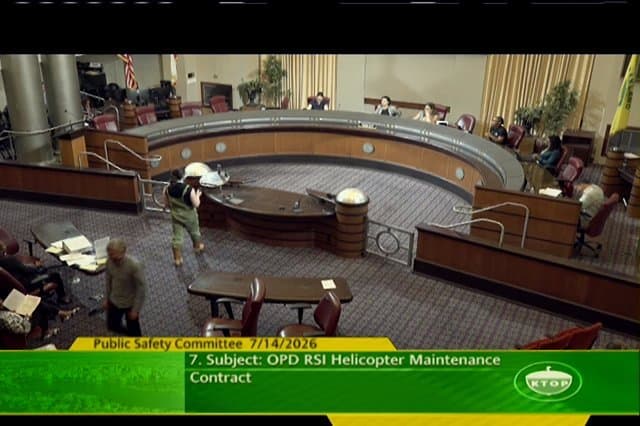
Public Safety Committee - Jul 14, 2026 - Meeting
Public Safety Committee • OaklandJuly 15, 2026
Locunity is a independent informational service and is not an official government page for this commission.We use AI-assisted analysis and human editorial review to publish information.
Council Approves Seven Surveillance Tools, Defers ALPR Fight to Fall
Oakland's Public Safety Committee cleared a packed agenda on July 14, advancing every item to full council — but the most explosive issue of the night, Flock license plate reader cameras, was pulled before a vote could be taken, ensuring a major policy battle will greet council members when they return from recess. Sixteen public speakers turned out to oppose the cameras, making it the largest comment block of the evening and a preview of the fight ahead.
- Seven OPD surveillance technologies approved for continued use; contentious ALPR/Flock camera review deferred to fall
- Sixteen speakers condemn Flock cameras, citing ICE data-sharing, a 0.17% utilization rate, and privacy violations in other states
- Committee unanimously backs transition from aging police helicopters to a fixed-wing aircraft that would slash maintenance costs by two-thirds
- $513,000 contract approved for Oakland Peace Academy to professionalize violence intervention workforce
- Councilmember Fife pushes to redirect future federal JAG grant funds toward rape kit processing and cold case investigations
Surveillance Standoff: Flock Cameras Deferred as Opponents Fill the Room
The headline item of the night — the annual review of OPD's surveillance technologies required under Oakland Municipal Code 9.64 — ended with a split decision: seven technologies approved, one yanked from the agenda entirely.
The basics: Oakland law requires annual committee review of each surveillance technology the police department operates, including drones, Cellebrite mobile forensics, pen registers, thermal imaging (FLIR), live stream transmitters, CrimeTracer/CopLink databases, and crime lab biometrics. This year, the review also included the automated license plate reader (ALPR) program — the Flock Safety cameras the council budgeted $2.25 million for in December.
Why it matters: OPD itself asked to remove the ALPR item. "OPD is requesting that the ALPR automated license plate reader for 2025 annual report be removed from the agenda as the policy changes recommended in the report and accompanying revised Department of General Order are not contained within the resolution," said Acting Deputy Chief Omar Daza-Quiros, Oakland Police Department. Translation: the policy changes OPD wants to make to its ALPR rules were never written into the resolution the committee was being asked to approve — a procedural mismatch that forced a delay.
Where things stand: Acting Deputy Chief Daza-Quiros walked the committee through the remaining technologies. OPD conducted 131 drone deployments in 2025, using the same drones donated by the community in 2022. "These are the same drones that we've had since 2022. These drones were donated to us by the lovely community of Oakland. So we had two separate donations totaling $100,000," he said, noting aging batteries are limiting the fleet's effectiveness. On mobile forensics, he reported Cellebrite achieved a 95% success rate in extracting data from cellphones, compared to 62% and 3% for competing vendors. OPD installed 86 pen registers in the reporting period — 80 with warrants, six under exigent circumstances including a school shooting threat. The department is also transitioning from CrimeTracer to Peregrine for better auditing of database queries.
Councilmember Ken Houston was the sole vocal supporter of the Flock cameras, noting constituent demand. "As a representative of District 7, I get emails, calls that support this Flock. I mean, I don't get that many that do not," he said. He moved to approve the remaining seven technologies, with the ALPR sub-item removed.
Sixteen Speakers, One Message: No Flock
Though the ALPR item was officially pulled, the public comment period became a de facto hearing on Flock cameras. Sixteen speakers — spanning high schoolers, tech workers, immigration advocates, and longtime Oakland residents — overwhelmingly opposed the cameras.
Daniel Hoffman, a public commenter who identified himself as a District 1 resident with nuclear weapons Q clearance, presented a data analysis calculating that ALPR systems generated just 1.1 million hot-list alerts out of 638 million license plate scans — a 0.17% utilization rate.
Erin Fenyas, a public commenter from District 5, cited cases in other states where Flock shared footage with Customs and Border Protection and a Texas sheriff tracking a woman who had an abortion. Angela Maddox, a public commenter, warned that Flock processes data through Amazon AI centers globally and claims no liability for abuses. Jesse Rosemore, a public commenter, argued that even if cameras were turned off, the commute-pattern data already collected could enable targeted ICE abductions.
Mark, a public commenter from the Tech Workers Coalition, urged skepticism about OPD's capacity as data stewards, noting the messiness and missing data in the department's own surveillance reports. Bria Woodland, a public commenter who identified herself as a fourth-generation Oakland native from District 3, called the surveillance expansion "complete disregard for my privacy." Kendra Ferguson, a public commenter and Japanese American descendant of World War II internment camp survivors, drew parallels between wartime "safety measures" and mass surveillance.
Decisions: The committee voted 3-0 to approve the remaining seven technologies and forward them to the July 21 City Council agenda (For: Councilmember Rowena Brown, Councilmember Ken Houston, Chair Charlene Wang; Absent: Councilmember Carroll Fife).
What's next: The ALPR/Flock item will return after legislative recess with revised policy language. The Flock contract may still be unsigned — Blair Beekman, a public commenter, noted it was unsigned as of May. Both OPD and opponents will have months to organize before the fall showdown.
Aging Helicopters Get a Contract — and a Consensus Push Toward Replacement
In a rare moment of unanimous agreement across ideological lines, all four council members and OPD's own air unit signaled they want to replace Oakland's two police helicopters — from 1990 and 1993 — with a fixed-wing aircraft.
Why it matters: The committee approved a two-year, $850,000 annual maintenance contract with Rotorcraft Support Inc. (RSI), with an optional two-year extension totaling $3.4 million — the same budget OPD has held for six years despite rising costs. But the debate quickly became about whether the city should keep pouring money into rotary aircraft at all.
Where things stand: Captain William, Oakland Police Department, presented the case for a fixed-wing aircraft at $5 million — compared to $6 million for a new helicopter — with annual maintenance roughly one-third of helicopter costs and a life expectancy of 40-plus years versus 10 for rotary. "The fixed-wing aircraft dependent upon financing options should actually pay for itself in as little as 15 years," he said.
Councilmember Carroll Fife championed the transition most forcefully: "I think it's imperative that this body prioritized a fixed-wing aircraft for fiscal purposes, but as well as the environmental impact that it has on communities that frequently have high-speed chases, which are extremely dangerous and highly restricted throughout the state of California as being potentially deadly."
Councilmember Rowena Brown flagged a $15 million wrongful death lawsuit against RSI stemming from a 2000 fatal crash in Fresno involving maintenance issues. Chair Charlene Wang noted that reimagining public safety studies found helicopter operational costs to be roughly four times those of a fixed-wing aircraft. Even John Van Wiggin, OPD helicopter unit supervisor, expressed preference for the fixed-wing option.
Decisions: Passed 4-0 (For: Brown, Fife, Houston, Wang). Councilmember Fife stated the fixed-wing transition should be prioritized in the next biennial budget.
DVP's Data System Praised as a Model; Privacy Policy Amended
The Department of Violence Prevention's Apricot360 case management system drew rare, unqualified praise from the committee — and a policy tweak that unlocks program evaluation data for gender-based violence services.
Why it matters: Measure Z evaluators from the Urban Institute found they lacked individual-level data to assess DVP's gender-based violence programs. The amended policy changes language around personally identifiable information from "not entered" to "not required," allowing participants to voluntarily opt in to share data while maintaining VAWA-compliant consent protections.
Where things stand: Deputy Chief Jenny Lynchy, Department of Violence Prevention, reported that in 2025, approximately 36 DVP staff and 170 community-based organization staff used Apricot360, maintaining records for about 2,400 individual participants. The system costs $125,000 annually — half from general funds, half from external grants. "Apricot360 is invaluable in our work in many ways. It's allowed us to ensure alignment with best practices specifically relating to Ceasefire Lifeline," she said.
Councilmember Brown called the system a model for other city departments. "It seems very clear that the program and the system is working very well. And it also sounds like maybe we should duplicate it and other departments could utilize it as well," she said.
Decisions: Passed 4-0 (For: Brown, Fife, Houston, Wang). Forwarded to the July 21 City Council agenda on consent.
Federal Grant Sparks Debate Over Priorities
The committee approved OPD's $324,324 FY2025 Edward Byrne Memorial Justice Assistance Grant — but the discussion revealed a growing push to redirect future federal dollars away from equipment and toward crime victim services.
Why it matters: The JAG allocation breaks down to $25,000 for non-POST training, $66,892 for technology upgrades (aging computers incompatible with Windows 11), $100,000 for marine maintenance, and roughly $100,000 for helicopter maintenance. Council members questioned why the money wasn't going to investigative backlogs.
Councilmember Fife was blunt: "I would like to also explore, as I've said now for six years, alternative uses, particularly if there's any way that we can investigate rape kits or any way we can look into supporting more investigations." Councilmember Brown agreed, noting she found the public speaker's list of alternative eligible uses compelling. Asada Olubala, a public commenter, read aloud the JAG program's eligible uses, including crime prevention, drug treatment, mental health programs, and crime victims assistance.
Decisions: Passed 4-0. Forwarded to the July 21 City Council agenda.
Emergency Management Pact Renewed
Oakland Fire Department's Olga Crowe presented the renewal of a no-cost, 10-year operational area agreement with Alameda County covering emergency preparedness, response, recovery, and mitigation. The agreement, in place since 1995, expired in December 2025.
Benefits include quarterly government meetings, approximately a dozen joint training opportunities per year, joint exercises, and access to the AC Alert notification system. Recent coordination examples included tsunami response planning and a cyber-attack response.
Chair Wang asked about Oakland's emergency siren system, referencing the Maui wildfire and San Francisco's offline sirens. Crowe reassured the committee: "Most of our sirens are fully functional and operational. We have a couple that are currently in maintenance status. But the siren schema around the city is such that even if one is out, there are others around the area that would sound."
Decisions: Passed 3-0 (For: Brown, Houston, Wang; Absent: Fife). Forwarded to the July 21 City Council agenda on consent.
Minor Items
- $513,000 Bright Research Group contract for training and capacity building of violence intervention workers, including the Oakland Peace Academy fellowship developed with the Urban Peace Institute and funded by the Green Light Fund. The Oakland-based, women-of-color-owned firm was the only vendor meeting all minimum qualifications from a five-submission RFQ. Passed 4-0.
- CHP electronic reporting MOU replaces a manual process where OPD staff photocopied collision reports and mailed them. The Mark 43 records system now enables electronic submission at no cost, feeding statewide traffic safety data used to identify dangerous intersections. Passed 4-0.
- Outstanding committee items accepted as scheduled, despite public commenter Jesse Rosemore demanding the committee schedule a long-pending resolution to civilianize sworn OPD desk positions — the longest item on the pending list without a hearing date.
- Open Forum highlights: Nita B, a longtime street vendor, demanded the city stop enforcement raids on vendors and conduct a legal review, arguing practices violate SB 946 (Safe Sidewalk Vending Act). Silica Thomas requested speed cameras, speed bumps, and street redesign for 85th Avenue after three gun violence deaths in January and three more deaths plus five injuries from a hit-and-run in May 2026. Councilmember Fife delivered a passionate defense of her community organizing record: "I was an organizer in the streets of West Oakland for almost 30 years before I got here, which is what put me here. So check my record before you come up here talking about me."
- June 23 meeting minutes approved 3-0.