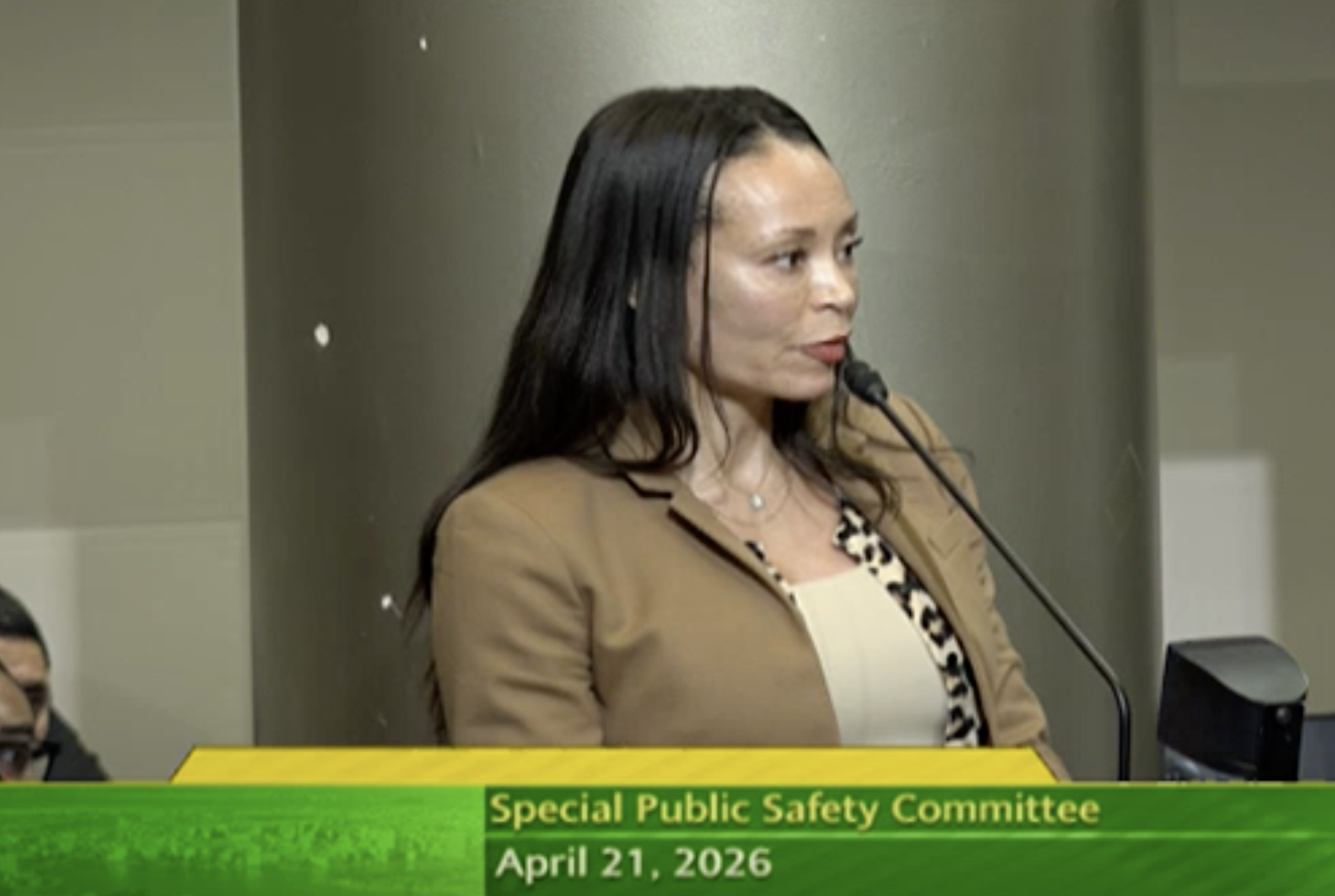
Public Safety Committee - Apr 21, 2026 - Special Meeting
Public Safety Committee • OaklandApril 21, 2026
Locunity is a independent informational service and is not an official government page for this commission.We use AI-assisted analysis and human editorial review to publish information.
Audit Exposes Police Oversight Crisis as Tech Contracts Divide Committee
Oakland's Public Safety Committee waded through a marathon agenda that laid bare the city's competing pressures: a police department nearing the end of a two-decade federal consent decree but still struggling with racial discipline disparities, voter-created oversight agencies starved of the staff to do their jobs, and a pair of surveillance technology contracts that split the committee along ethical lines.
City Auditor Michael C. Houston finds police oversight agencies meet only 60% of their legal mandates due to frozen positions, vacancies, and charter conflicts
Cellebrite phone extraction contract advances 3-1 after Councilmember Fife quotes Martin Niemöller in conscientious objection over Israeli company's ties to ICE
OPD switches to Peregrine records platform over Palantir concerns, gaining data audit controls in $1.024M deal that also passes 3-1
OPD achieves Task 5 compliance for first time under the federal consent decree, but 2024 racial discipline disparity alarms committee ahead of May 27 court hearing
Ceasefire-Lifeline contracts approved after department discloses loss of $5 million in state gun violence funding
Only 26 of 43 Oversight Mandates Met
Why it matters: Oakland voters passed Measures LL and S1 to create robust police oversight — a Police Commission, the Community Police Review Agency (CPRA), and an Office of the Inspector General. A new city audit reveals those agencies lack the staff and legal clarity to fulfill the mandates voters gave them.
City Auditor Michael Houston delivered a blunt assessment:
"The Commission, CPRA and OIG met only 26 of 43 select city charter and Municipal Code requirements."
The numbers are stark. The Police Commission has one full-time staff member responsible for 44 legal mandates. CPRA has only three of seven line investigators needed to meet the charter's ratio of one investigator per 100 sworn officers. The OIG's audit positions are frozen, forcing the office to spend $122,500 contracting with an outside firm.
Auditor Houston also flagged structural conflicts between the Municipal Code and the City Charter around hiring and firing authority for the CPRA director and Inspector General, and warned that the City Administrator's involvement in IG performance appraisals threatens the office's independence. He made two recommendations: the City Attorney, Ryan Richardson, should provide independent staffing analysis, and the City Council should adopt Municipal Code revisions and pursue charter changes as needed.
Where things stand: CPRA Director Tony Lawson reported his agency is actively hiring two to four additional investigators from a pool of 40 to 50 applicants. Auditor Houston confirmed that the stalled 2024 enabling ordinance proposal would resolve many inconsistencies:
"A lot of the inconsistencies could be addressed by just moving that enabling ordinance forward."
The other side: Two council members announced competing legislative paths. Councilmember Carroll Fife said she would pursue enabling ordinance amendments as the faster, cheaper route:
"I'm going to try to move the less burdensome, financially burdensome route through amending the enabling ordinance."
Councilmember Ken Houston countered that charter changes are necessary and said he would begin drafting them immediately.
Public commenters from the Coalition for Police Accountability and community advocates urged the council to resurrect the 2024 enabling ordinance rather than pursue a lengthy charter amendment process. Millie Cleveland, chair of the Coalition for Police Accountability, said the agencies' inability to meet mandates is the result of council's failure to provide resources, not the agencies themselves. Rashida Grinage, a public commenter, agreed, emphasizing that charter-municipal code disparities can be rectified by the City Council without going to the ballot.
Decisions: Received and filed, 4-0 (For: Brown, Fife, Houston, Wang).
What's next: The enabling ordinance and charter change proposals will be developed on parallel tracks. Budget season will test whether the council funds the frozen OIG positions and additional CPRA investigators.
Fife Breaks With Committee on Two Surveillance Tech Contracts
Cellebrite: "The Only Voice for Our Victims"
The basics: OPD sought renewal of a $140,000 contract with Cellebrite, an Israeli-based company whose technology extracts data from cell phones pursuant to search warrants. The department performed over 700 extractions in 2025, with more than 33% involving Android devices that only Cellebrite can reliably process.
Why it matters: Sergeant Yun Zhao of OPD's Cold Case Division told the committee that the department evaluated GrayKey, Motorola's service, and XRY Pro — none matched Cellebrite's capabilities for current Android models. Chief James Beere made an emotional case that the technology is often the only way to speak for homicide victims and human trafficking survivors, noting that victims' phones frequently contain critical evidence.
The other side: Councilmember Carroll Fife delivered a detailed conscientious objection, quoting Martin Niemöller's "First they came…" poem and arguing that Israeli-based tech companies are deploying surveillance tools used against activists globally. She specifically cited Cellebrite's use by ICE and drew parallels to Oakland's earlier Flock camera debate. Public commenter Madeline Stacy noted ICE's increasing spending on Cellebrite and urged a competitive solicitation for alternatives. Assata, a public commenter, took the opposite view, supporting giving OPD every tool needed for investigations.
Councilmember Rowena Brown, citing her legal training, acknowledged the search warrant safeguards and moved the item forward.
Decisions: Approved 3-1 (For: Brown, Houston, Wang; Against: Fife). Forwarded to the May 5 City Council on non-consent, meaning it will receive a full council debate.
Peregrine: Audit Controls Gained, Palantir Ties Questioned
The basics: OPD asked to replace Crime Tracer, a records search platform it has used since 2012, with Peregrine Technologies at a cost of approximately $1.024 million over three years — about $224,000 more than the current system over the same period. The competitive solicitation was waived because major regional partners including San Francisco, Sacramento, and Alameda County are migrating to Peregrine, taking their searchable data with them.
Why it matters: Crime Tracer has no audit trail — OPD cannot see who externally accesses its data or monitor internal usage — and forces data sharing with all subscribers without an opt-out option. Peregrine offers opt-in sharing, full audit trails, and real-time access monitoring, directly addressing longstanding Privacy Advisory Commission concerns. Chair Charlene Wang noted an Atlanta Police Department study showing a 21% crime reduction from the technology.
The other side: Public commenter Madeline Stacy warned that Peregrine is led by a former Palantir executive and is working with the National Fusion Center Association, potentially giving ICE access to local data. Fife again objected, warning that local investment in companies with troubling ties makes them "too big to fail where no one else can scale technology." Beere emphasized that SB 54 protections prevent immigration data sharing and argued the technology helps bridge OPD's staffing gaps.
Decisions: Approved 3-1 (For: Brown, Houston, Wang; Against: Fife). Forwarded to the May 5 City Council on non-consent.
OPD Hits Task 5 Milestone, but Racial Discipline Gap Looms Over Consent Decree
Why it matters: The Negotiated Settlement Agreement stemming from the Delphine Allen v. City of Oakland lawsuit has governed OPD for more than two decades. Achieving compliance with Task 5 — investigation quality — is a milestone. But a 2024 disparity in how Black and Hispanic officers are disciplined compared to white officers threatens the department's progress on Task 45 ahead of a May 27 court hearing.
Deputy Chief Lisa Ausmus opened with the good news:
"I am happy to report that we are now currently in compliance with Task 5."
All 12 cases reviewed in the 12th sustainability report were found satisfactory. On Task 2 — the requirement that 85% of Internal Affairs investigations be completed within 180 days — OPD has climbed from 65% to 80% compliance across quarters, and Ausmus expressed confidence the department would hit 85% by the fourth quarter of 2025.
The most contentious discussion centered on Task 45, discipline equity. The 2024 Internal Affairs Bureau outcome study revealed white officers were sustained at significantly lower rates than Black and Hispanic officers. Despite extensive analysis with Stanford researchers, OPD could not pinpoint the source of the gap. A preliminary 2025 report submitted to the court on April 13 showed no statistically significant disparity, with five-year averages of white officers sustained at 9%, Hispanic at 8%, Black at 7%, and Asian at 5%.
OPD has launched a qualitative study with a cross-section working group, implicit bias training for IA investigators, a Stanford body-worn camera review, and a perceptions survey. OPD Data Manager Kristin Burgess-Medeiros confirmed the 2025 data showed no significant gaps.
Chair Charlene Wang pressed on the cultural dynamics inside IA, noting the report's finding about "likability" influencing outcomes:
"When an officer is well liked, sometimes that can influence whether the IAB is willing to discipline that officer."
Public commenter Millie Cleveland of the Coalition for Police Accountability urged the council to fund the Inspector General to sustain compliance. Assata reminded the committee that 118 of 119 plaintiffs in the original lawsuit were African American, challenging any suggestion that racial disparities no longer exist.
Decisions: Received and filed, 4-0.
What's next: A May 27 court hearing will assess Task 45 compliance. The qualitative study and Stanford body-worn camera review are ongoing.
Ceasefire Contracts Approved After $5M State Funding Loss
Why it matters: Oakland's Department of Violence Prevention (DVP) lost an expected $5 million in CalVIP state grants, forcing a pivot to general fund dollars for its flagship gun violence reduction strategy. The committee approved $350,000 in contracts — a $200,000 amendment to an existing University of Pennsylvania research contract and a $150,000 grant to Faith in Action East Bay — to keep the Ceasefire-Lifeline program running.
DVP Chief Dr. Holly Joshi and Deputy Chief Jenny Linchey presented the two contracts. The UPenn amendment adds qualitative evaluation — interviews with participants, life coaches, and the Ceasefire partnership team — to a quantitative study that previously found 31.5% of a nearly 50% homicide reduction from 2012 to 2017 was directly attributable to Ceasefire. Faith in Action East Bay, the faith-based organization that helped bring Ceasefire to Oakland in 2012, would continue staffing custom notifications and call-ins.
Joshi explained the CalVIP loss:
"They had much less money to give out than they did in the past, and they had record breaking increase in requests for CalVIP dollars, mostly due to the federal cuts that people were experiencing across the state."
Only 10% of CalVIP applications were funded statewide.
Joshi described an intensive life coaching model:
"Right now we have about 110 of Oakland's highest risk individuals on life coaching inside the DVP. So what we're looking at weekly, internally, and then quarterly with the mayor is fidelity to an intensive case management model."
Councilmember Ken Houston demanded accountability, insisting on biannual reports with results-based data:
"We just seem like we just give money away and that has to stop."
The biannual reporting requirement was incorporated into the motion. Chair Charlene Wang raised concerns about regional gun violence flowing into Oakland from surrounding cities.
Decisions: Approved 4-0 with biannual reporting requirement. Forwarded to the May 5 City Council on consent.
Minor Items
Outstanding committee items schedule approved 4-0.
Federal task force annual reports covering OPD's participation in U.S. Marshals, FBI Safe Streets, FBI Child Exploitation, ATF, Secret Service, and DEA task forces forwarded to the May 5 City Council, 4-0. Acting Captain Jeff Simocum committed to more uniform report formatting next year. Public commenter Assata Olawale raised concerns about sanctuary city tensions with federal partnerships.