Public Safety Committee - May 26, 2026 - Meeting

Public Safety Committee - May 26, 2026 - Meeting

Public Safety CommitteeOaklandMay 26, 2026

Sources:

Locunity is a independent informational service and is not an official government page for this commission.We use AI-assisted analysis and human editorial review to publish information.

Council Advances $47M Violence Plan Amid Police Staffing and 911 Concerns

Oakland's Public Safety Committee forwarded the city's first Community Violence Reduction Plan under Measure NN to the full council without a recommendation — a signal that sharp disagreements over police hiring shortfalls and 911 hold times could reshape how $47 million a year is spent for the next four years. The committee also advanced a FEMA-approved hazard mitigation plan that could eliminate Oakland's post-disaster cost share and cleared three service contracts.

  • $47M/year violence-reduction plan heads to full council on non-consent after committee members flag police staffing gaps, 911 failures, and CBO accountability concerns

  • OPD reaches compliance with all 51 federal oversight tasks for the first time in the Negotiated Settlement Agreement's history

  • FEMA approves Oakland's updated hazard plan the same day it reaches committee; AB 2140 adoption could zero out the city's disaster cost share

  • Committee chair shares five-minute 911 hold time and questions whether plan allocates enough to reach 700-officer mandate


The Big Debate: Oakland's Violence Plan Has $47M a Year but No Committee Endorsement

The committee spent more than 80 minutes on the 2026–2030 Community Violence Reduction Plan before sending it to the June 2 City Council meeting on non-consent — meaning the full council must debate the item rather than approve it in a batch. All four members present voted yes to forward (For: 4, Against: 0, Absent: 0), but the placement signals that the plan is far from settled.

The basics: Measure NN, approved by 71% of Oakland voters in 2024, generates $45–$47 million annually through parcel and parking taxes. The measure requires the Oakland Public Safety Planning and Oversight Commission (OPSPOC) to draft a four-year plan governing that spending. Roughly 60% of post-administrative funds go to police services and 40% to violence prevention, with about $3 million to the Oakland Fire Department. The plan sets goals including reducing homicides and shootings by 10% annually, improving violent-crime clearance rates by 10% by 2034, answering 90% of 911 calls within 15 seconds, and maintaining at least 700 sworn officers and 480 firefighters.

Why it matters: The plan is a strategic framework — not a line-item budget — but it sets the guardrails for how Oakland spends its single largest dedicated public-safety revenue stream. Finance Director Brad Johnson made the distinction explicit:

"This plan is the framework by which we will go through that allocation process, but it is not the allocation itself. In your budget process you have the ability to do that fine tuning and determination work."

City Attorney Selia Warren further constrained the committee's role, advising that members cannot modify the plan. The full council can approve or reject it; rejection sends it back to the commission with comments.

604 Officers, a 700 Mandate, and the Math That Doesn't Add Up

The sharpest tension in the room centered on police staffing. OPD currently has 604 sworn officers — 96 short of the voter-mandated 700. OPD Deputy Chief Anthony Tedesco laid out the arithmetic:

"We need to have 50 recruits into an academy, and we need to have a minimum of three academies a year in order to build to this. And it's going to take more than one fiscal year to get to 700." Attrition is running at 5.5 officers per month.

Chair Charlene Wang pressed on whether the plan's 3–7% allocation for recruitment and retention was adequate given the mandate.

"The ballot measure text makes clear that 700 officers is the voter mandate. And yet when I look at this current plan in the retention and recruitment allocation, it's a 3 to 7%," Wang said.

She also shared a personal experience that animated her concern about 911 response times:

"I placed another call and at the 32nd mark I thought, let me actually time this. And I was on hold for five minutes."

Wang urged investment in NextGen 911 technology and suggested OPD partner with youth mentorship organizations to build a recruitment pipeline:

"Identify that young person who is least likely to enroll into the police department, because that is probably the person that should consider a career in law enforcement."

Feelings vs. Facts: The Misinformation Question

Councilmember Carroll Fife raised a different concern: how the plan measures whether residents feel safe when crime statistics are falling but public perception is not. Fife referenced text messages about alleged misinformation circulating from within OPD about crime data:

"If we have the same folks that are working to keep the city safe spreading misinformation about what's actually happening, we're fighting against ourselves. And I don't see a place in the plan that addresses that."

Fife also demanded honesty about what the department can realistically produce from its academies.

"I am tired of over promising and under delivering. I want to just be straight up about the realities of what we can produce so that we're being honest with the public," she said.

CBO Accountability: Is 10% Enough?

Councilmember Ken Houston zeroed in on accountability for community-based organizations receiving violence-prevention grants. Under current rules, Community-Based Organizations (CBOs) that fail to deliver results face a 10% funding penalty. Houston argued that is not a meaningful deterrent:

"If you give somebody a million dollars and I don't have to bring back result-based accountability, I got to give you $100,000 back and I can keep $900,000. What you going to do?" He pushed to raise the penalty to 25%.

Chief of Violence Prevention Holly Joshi with Oakland's Department of Violence Prevention said the department has been evolving from its unfocused early years into a mission-driven agency.

"We were stood up in 2019 and we were absolutely not focused. Over the past two and a half years, we've been given the permission to focus," Joshi said.

She added that a new RFP process has produced a fresh ranked list of CBOs for the first time:

"This is the first time since I've been at the Department of Violence Prevention that we've had a new list, a new ranked list of community-based organizations to choose from."

Public Comment: Praise, Concern, and a Call for Youth Strategy

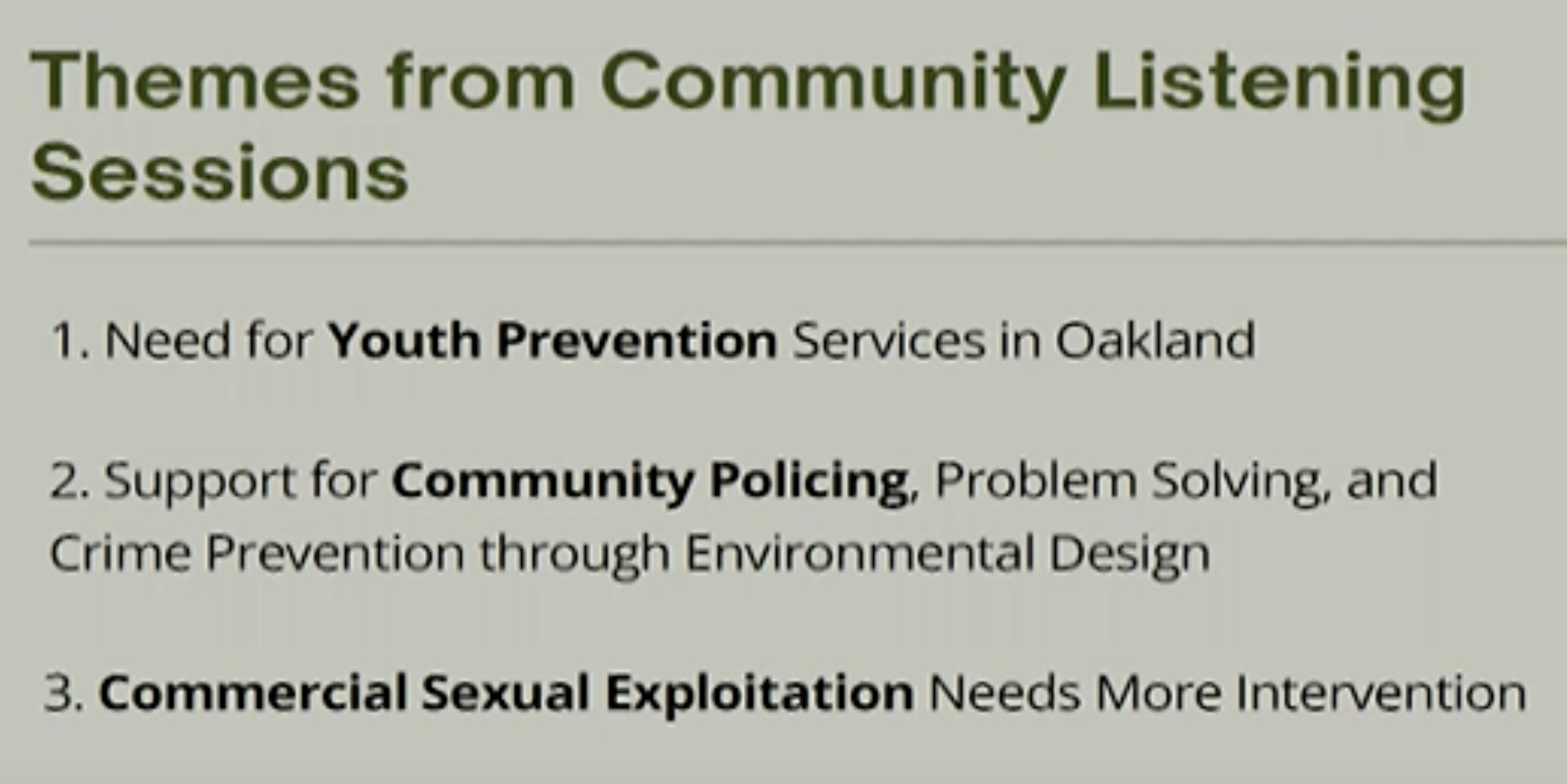
Three community members spoke on the plan. Colleen Brown, Chair of the Community Policing Advisory Board, noted that the final plan removed references to her board and softened language from "will" to "may" regarding community policing activities, weakening commitments to neighborhood outreach. Gabriel Garcia, Policy and Advocacy Director at Youth Alive, commended the plan's comprehensiveness but urged Oakland to develop a cohesive youth prevention strategy bridging probation, Oakland Unified School District, the Oakland Fund for Children and Youth, and CBOs, citing California DOJ data showing gunshot survivors are 60 times more likely to become homicide victims. Rajni Mandal, a District 4 resident, supported the plan and commended OPSPOC's governance framework.

Oakland Public Safety Planning and Oversight Commissioner Yoana Tchoukleva emphasized the plan's intentionally high-level nature:

"What we are doing is setting goals and strategies that are high level. And then the activities themselves are determined by the departments each year."

What's next: The full City Council takes up the plan on June 2 on non-consent, guaranteeing a floor debate. Council members can approve or reject but not amend — a constraint that could force a binary choice on a plan that most committee members praised in principle but questioned in execution.


Historic First: OPD Achieves Full Compliance With All 51 Federal Oversight Tasks

During public comment on outstanding committee items, Rajni Mandal, a District 4 resident, announced that OPD had reached compliance with all 51 tasks of the Negotiated Settlement Agreement for the first time in the department's history. Mandal credited Mayor Barbara Lee, Interim Chief James Beere, Assistant City Administrator Michelle Phillips, and other officials. She noted that a federal court hearing the following day would likely focus on whether the progress can be sustained.

Why it matters: Oakland has been under federal court oversight for more than two decades following the Riders police misconduct scandal. Full compliance across all 51 tasks — a milestone no previous OPD leadership achieved — could begin the process of ending court supervision, but only if the department demonstrates the reforms are durable.


Oakland's Hazard Plan Wins FEMA Approval, Could Save Millions After Disasters

The committee unanimously forwarded the 2026–2031 Local Hazard Mitigation Plan to the June 2 council meeting as a public hearing (For: 4, Against: 0, Absent: 0). FEMA approved the plan on the same day as the committee hearing.

The basics: The plan identifies 72 mitigation actions addressing earthquakes, wildfire, severe weather, flooding, sea level rise, and other hazards, developed by city departments and the Port of Oakland. Risk-ranking methodology was updated to incorporate equity, displacement, economic, environmental, and transportation impacts, using the General Plan's environmental justice element rather than relying solely on CalEnviroScreen.

Why it matters: Under AB 2140, adopting the plan as a General Plan Safety Element amendment could reduce Oakland's post-disaster local cost share from 25% to 0% — a potentially massive savings in a city that sits on the Hayward Fault. Emergency Planning Coordinator Veronika Cole noted that outreach reached approximately 300 individuals through multilingual meetings in West Oakland, Chinatown, Downtown, Fruitvale, and East Oakland, plus a 131-response multilingual survey.

Councilmember Carroll Fife asked about changes to the CalEnviroScreen tool and whether draft revisions to its disadvantaged-community designations would affect the plan. Strategic Planning Manager Laura Kaminski confirmed Oakland's analysis goes deeper than CalEnviroScreen alone.

What's next: The item goes to the June 2 council meeting as a public hearing.


Minor Items

  • PMAM Corporation false alarm contract — The committee approved a $1.13 million, five-year sole-source contract with PMAM Corporation to continue managing OPD's false alarm reduction program, which has operated since 2013. The program is self-funded through alarm fees (Fund 2411). The Department of Workforce Standards confirmed no local or small businesses can provide the service. (For: 4, Against: 0, Absent: 0; forwarded to June 2 on consent.)

  • OFD background investigation contract — A $500,000 contract with Elite Corporate Solutions for pre-employment background checks was approved after Councilmember Fife flagged an error in the staff report's data table showing $500,000 per year rather than the total over five years. OFD Chief Damon Covington clarified actual annual spending would be $50,000–$60,000 for roughly 50 backgrounds per year. Councilmember Houston raised broader concerns about contracts that do not require council check-ins. (For: 4, Against: 0, Absent: 0; forwarded to June 2 on consent with corrected supplemental report.)

  • May 12 meeting minutes approved 3-0 (Councilmember Houston absent at meeting start).

Council Advances $47M Violence Plan Amid Police Staffing and 911 Concerns | Public Safety Committee | Locunity