
Desert Hot Springs Spells Out Where Street Vendors Can Set Up
Public Safety Commission • Desert Hot SpringsNovember 12, 2026
Locunity is an independent informational service and is not an official government page for this commission. All information is sourced from public footage and an analysis of official agendas with the aid of responsible, fact-checked AI. to report an error or omission.
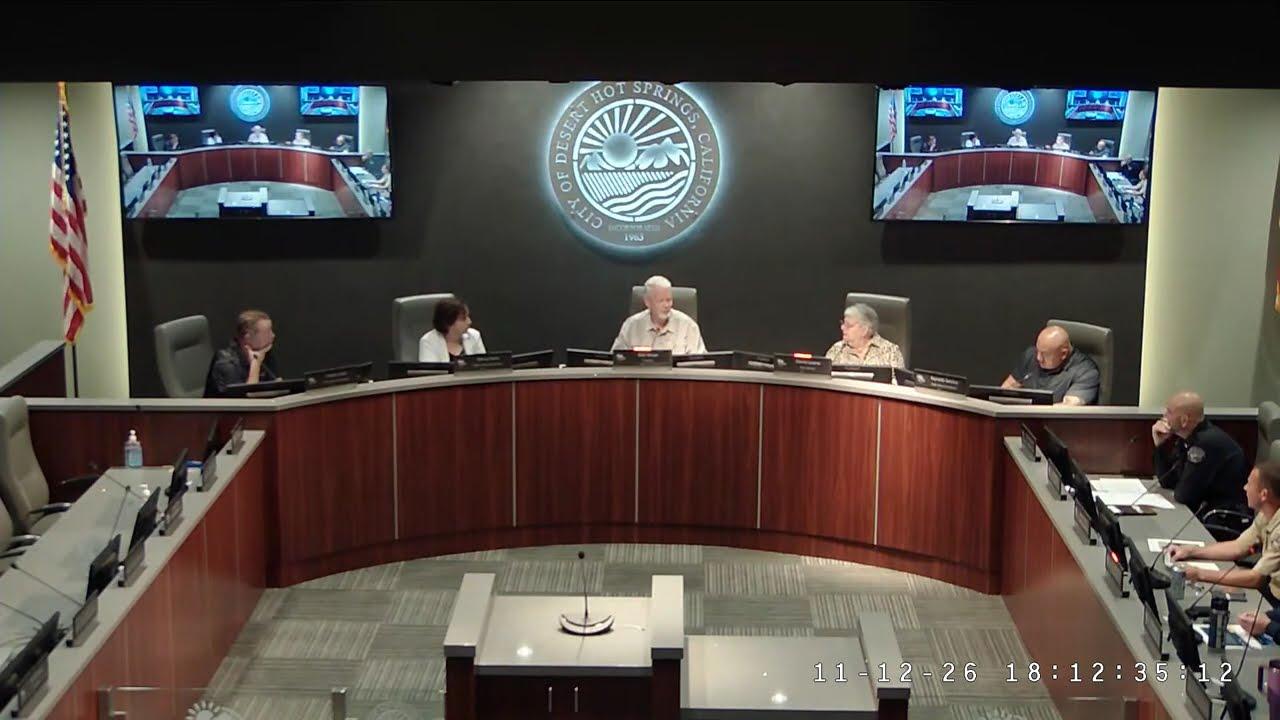
Desert Hot Springs' Public Safety Commission spent the largest share of its Nov. 12, 2026, meeting on a practical question: where street and food vendors can legally operate, and what happens when they cross the line. No policy changed. Staff walked commissioners through permit, setback and private-property rules, and police and code compliance reported their October numbers.
- Vendor rulebook explained: Staff described the Palm Drive corridor ban, 36-inch sidewalk clearance and private-property limits.
- Violent crime down 25%, property crime down 40% year over year, with an 84% clearance rate.
- Code compliance issued 32 citations totaling $27,200 and outlined its slow path to abatement.
- Compliance budgets on target about five and a half months into the fiscal year.
- Renewed state traffic grant will fund holiday DUI and speeding patrols and a checkpoint.
Vendor Rules: Permits, Setbacks and No-Go Zones
The basics: The city regulates two categories differently. Sidewalk vendors fall under Chapter 5.28. Mobile food facilities, meaning trucks and other vehicles, fall under Chapter 5.52 as staff cited it.
Why it matters: Vendors are a visible part of the city's small-business economy. The rules determine where they can sell, and what residents and property owners can do when vendors show up in the wrong place.
Where things stand: Sidewalk vendors need a city permit, a business license and a seller's permit. Food vendors also need county environmental health approval unless they are exempt. Sidewalk vendors may not operate in these places:
- On private property
- In the Palm Drive safety corridor
- Within one block of signalized intersections on Pierson Boulevard and Camino Aventura
- In residential zones, if they are stationary
Vendors must keep 36 inches of clear sidewalk. They must also stay 10 feet from driveways, 30 feet from crosswalks and 200 feet from other vendors.
Mobile food facilities face their own limits. They are restricted on residential streets, except for vehicles selling prepackaged goods. They are also restricted on streets posted above 35 mph, near schools and bus stops, and on private property without a temporary use permit. Allowed hours vary by zone.
Commission Chair Walt Meyer said he raised the issue after seeing a vendor block part of a street with cones. After the presentation, he concluded that this is allowed with a permit.
The other side: Commissioners pressed on enforcement. They asked how permits are displayed, who monitors vendors and how vendors can be removed from private plazas. Staff said county stickers tie food permits to specific vehicles, and officers patrol daily. A property owner can call non-emergency dispatch. If the vendor has no temporary use permit, code compliance can step in. "We can show up and we can issue a citation," said compliance department staff.
Budget check: The same item covered compliance division spending.
- Code compliance: The amended budget is $1.52M, up from $1.43M adopted. Spending to date is $437,407, including $195,702 in encumbrances. That is 28.9% spent when encumbrances are excluded.
- Animal Care and Control: The amended budget is $1.75M, up from $1.5M adopted. Spending to date is $891,121, including $337,312 in encumbrances, or 31.7% excluding encumbrances.
Chair Meyer asked staff to explain encumbrances so the public would not misread early-year spending. Encumbrances are funds committed to contracts, such as a dog behavior trainer, but not yet paid out. "It's not necessarily money that's been spent, but it's money that is 100% accounted for," staff said.
What's next: No action was taken. Property owners dealing with vendors on private plazas can call non-emergency dispatch.
Code Compliance: Two Weeks to Fix, Months to Abate
Why it matters: Blight enforcement shapes how residents see their city, and the process moves slowly by design.
Where things stand: In October, code compliance logged:
- 160 service requests
- 116 notices of violation
- 76 new cases
- 532 inspections
"We issued 32 citations with a dollar amount of $27,200," said code compliance staff. Staff also showed cleanups on Palm Drive and Escalante, including work by the CERT team. Only two dedicated code officers staff that team.
The process aims for voluntary compliance. A notice typically gives a property owner two weeks to fix the problem. Final notices, repeated citations and eventually an abatement warrant follow. If an owner does not pay, "it will be assessed on their property taxes, typically with added fines and penalties," said compliance staff.
The other side: Commissioner Charles Lantz urged staff to publicize the cleanup work. "Residents are constantly talking about the state of the city," he said. Staff said the department has no dedicated social media and would send photos to the city's social media team. Staff noted the department removed hundreds of tons of trash last year.
Decisions and stakeholder impacts: Chair Meyer noted that enforcement never recovers its costs. That leaves taxpayers covering much of the work, while negligent property owners eventually face liens on their tax bills.
What's next: Residents can report violations, including anonymously, through the MyDHS app.
Police: Crime Down, Hiring Up, Holiday Patrols Coming
Why it matters: Falling crime and a hiring push are reshaping both public safety and the police budget.
Where things stand: In October, police logged:
- 1,604 calls not initiated by officers
- 1,164 officer-initiated calls
- 61 collisions
- 152 citations
- 126 arrests
"Our violent crime is down 25% over 2025," said a police lieutenant. Property crime fell 40%. Crimes against society rose 49% as proactive drug and weapons arrests increased. The clearance rate for Group A offenses, the most serious category in federal crime reporting, was 84%.
Year-to-date spending stands at 48% of the police budget and 52% of the dispatch budget. "We're overhiring. We have about 7 new officers coming in," the lieutenant said. Lateral hires and new-officer equipment are adding to the costs.
Pedestrian risk: A commissioner suggested handing out reflective items to people crossing at night. The lieutenant said earlier darkness will likely increase pedestrian collisions. He added that since the Legislature changed jaywalking laws, pedestrians cannot be cited unless they impede traffic.
What's next: The state Office of Traffic Safety grant was renewed Oct. 1. It will fund dedicated traffic shifts, DUI and speeding patrols, and a checkpoint with a date still to be announced. Officials said the department also hopes to return its motor unit to Palm Drive.
Minor Items
- Animal control: Staff reported 152 service requests, 49 citations, 64 animals received, 17 returned to owners and 7 adopted. Staff also highlighted a Pacific loon rescued and taken to the Desert Wildlife Center.
- Fire report missing: No fire department report was presented for a second consecutive month, reportedly amid a leadership change.
- Community event: Commissioners praised police outreach at 7-Eleven and discussed a National Night Out-style event with a touch-a-truck.
- Potholes: Commissioner Lantz said Public Works fixed potholes within about two days. He urged residents to report problems through cityofdhs.org.
- Agenda: The commission approved the agenda by voice vote, and the clerk announced it passed unanimously. No numeric tally was recorded.
Looking Ahead
Chair Meyer will miss the January meeting, and the vice chair will preside. Also in January, police will take part in the first College of the Desert Career Conference at the Public Safety Academy.