
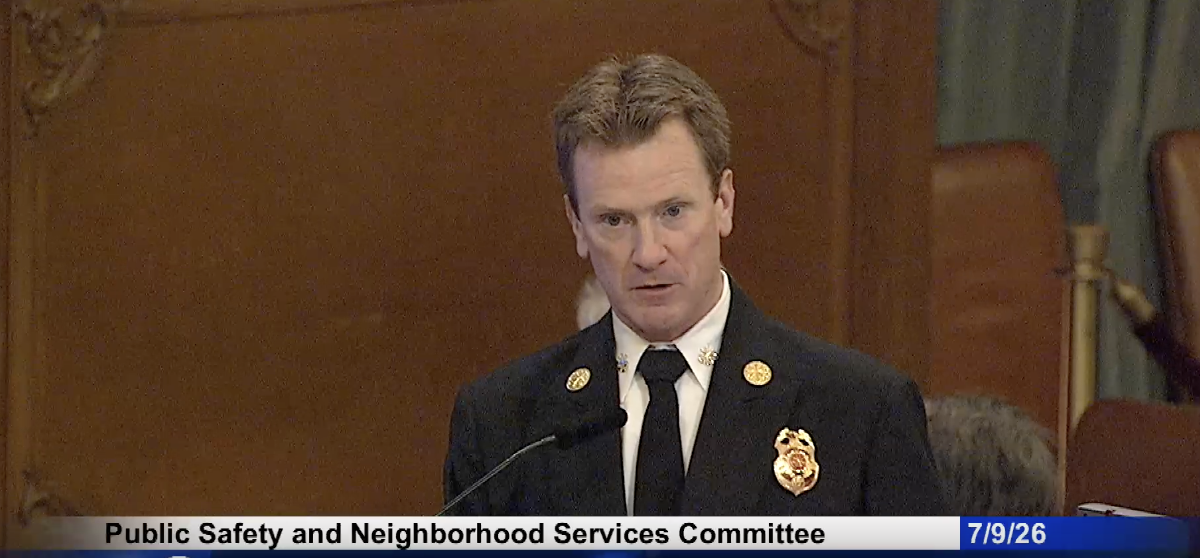
Public Safety and Neighborhood Services Committee - Jul 09, 2026 - Regular Meeting

Public Safety and Neighborhood Services Committee - Jul 09, 2026 - Regular Meeting

Public Safety and Neighborhood Services CommitteeSan FranciscoJuly 9, 2026

Sources:

Locunity is a independent informational service and is not an official government page for this commission.We use AI-assisted analysis and human editorial review to publish information.

Drug-Free Housing Clears Committee After Emotional Debate Over Recovery, Relapse and Eviction

San Francisco's Public Safety and Neighborhood Services Committee tackled the city's most contested homelessness policy in years on July 9, advancing a drug-free supportive housing ordinance with new anti-eviction safeguards alongside a resolution to expand the speed camera program that has slashed dangerous speeding 80%. Every item on the agenda passed unanimously.

  • Drug-free permanent supportive housing ordinance advances with guarantee that no resident is evicted into homelessness after relapse, drawing the meeting's largest and most emotionally charged public comment
  • Speed camera resolution urges Sacramento to expand the program beyond 33 locations after one year of dramatic results — and 11 pedestrians already killed in 2026
  • Fireworks penalty ordinance fills an enforcement gap after a July 4th weekend that left four people blinded and five with lost hands
  • Two code-cleanup bills and three liquor licenses clear committee without opposition

Recovery, Relapse and the Right to Housing

After more than two years of legislative work, Chair Matt Dorsey brought his drug-free permanent supportive housing ordinance to a pivotal committee vote — and spent much of the hearing navigating fierce, deeply personal testimony from both sides of the debate.

The basics: The ordinance (File 251003), co-developed with Board President Rafael Mandelman, requires that new city-funded site-based PSH for young people experiencing homelessness prohibit on-site illicit drug use. Legal substances like alcohol and marijuana are not affected. It also requires the Department of Homelessness and Supportive Housing to survey current PSH residents about housing preferences and adopt rulemaking standards for evictions.

Why it matters: Between 2020 and 2025, 784 people died of drug overdoses inside PSH units — housing that accounts for just 1.5% of San Francisco's total housing stock. During that same period, the city spent $2 billion on PSH with none allocated to drug-free recovery housing. An EMC Research poll found 69% of 400 San Francisco voters support creating drug-free PSH options.

Where things stand: Dorsey introduced key final amendments that became the hearing's fulcrum. The first guarantees no resident is evicted for a single relapse. The second requires that before any eviction for illicit drug use, HSH must confirm the resident has been offered alternative housing or shelter — ensuring no one is evicted into homelessness.

"Public support for drug-free supportive housing turns out to be overwhelming, with 69% saying yes and only 31% saying no," said Chair Dorsey. He emphasized the legislation does not eliminate drug-tolerant housing but creates a parallel recovery-oriented option.

Recovery advocates packed the hearing. Richard Beale, director of recovery services at the Tenderloin Housing Clinic and co-founder of Bad Brothers Against Drug Deaths, who celebrated nearly 31 years of sobriety, told the committee: "I strongly support drug-free supportive housing ordinance because people in recovery deserve more than just housing. They deserve an environment where recovery can grow."

Tom Wolf, a recovery advocate, put numbers behind the argument: "784 people died of a drug overdose inside that housing. All the while, the city spent $2 billion over those five years on permanent supportive housing." Elizabeth Funk cited a Tenderloin Housing Clinic survey in which 71% of 450 residents said they preferred drug-free environments. Amber Richmond, celebrating seven months sober, described overdosing alone on her bedroom floor while housed — testimony that illustrated why, for some residents, housing without a recovery environment is not enough.

The other side: The Coalition on Homelessness, the Treatment on Demand Coalition, and the Office of Racial Equity pushed for stronger safeguards. Lucas Illa of the Coalition on Homelessness supported drug-free housing in principle but zeroed in on what happens after a second relapse: "On the second relapse, there isn't an opportunity to get placed in drug-tolerant PSH. It's not stated in the legislation. It says shelter or another alternative form of housing."

Justice Dumlau of the Treatment on Demand Coalition echoed that concern, urging that the alternative for someone facing removal should be drug-tolerant PSH — not shelter. Ray Orfeano, a peer responder and KCC resident who is five years sober, shared a harrowing personal story: he was found "half dead" in PSH, hospitalized for two years while his housing was held, and returned to sobriety — arguing his survival shows the value of not evicting people.

Jennifer Friedenbach of the Coalition on Homelessness praised recovery advocates in the room but urged protections to prevent the ordinance from increasing evictions. A Coalition organizer who had gone two years drug-free before relapsing in a single night warned that the threat of eviction would cause people to hide their use from case workers.

Curtis Bradford, a Tenderloin community organizer celebrating 15 years clean, credited Housing First for saving his life and cited city data showing 93–96% of PSH residents remain stably housed, arguing for modifications rather than a new model.

Brittany Chikwata from the Office of Racial Equity requested three specific changes: rename "drug tolerant" housing to "standard PSH," delay enactment six months for rulemaking, and replace "eviction" language with "relocation." She warned: "We don't want an unintended consequence of this term to make it such that legislators don't support the allocation of funding for permanent supportive housing because it has the name and pathology of being drug tolerant."

Decisions: Dorsey responded to concerns in detail, clarifying that the amendments guarantee alternative housing for anyone facing removal and that a robust rulemaking process will follow adoption. He cited endorsements from Dr. Keith Humphries (Stanford, former Obama drug policy advisor), Dr. Anna Lembke (Stanford addiction medicine director), BAAD, Mothers Against Drug Deaths and Addiction, the Salvation Army, and the American Addiction Recovery Association. The committee voted 3-0 to adopt the amendments and forward the ordinance as a committee report. (For: Dorsey, Wong, Sauter; Against: none; Absent: none.)

What's next: The amended ordinance goes to the full Board of Supervisors on July 14 as a committee report. A rulemaking process at HSH will follow to establish eviction standards and resident survey procedures.


Crash Survivors, Bereaved Parents Urge Sacramento to Allow More Speed Cameras

Why it matters: One year after San Francisco launched its speed enforcement camera program, the 33 camera locations have reduced illegal speeding by an average of 80%. But with 11 pedestrians already killed in 2026 — including a two-year-old — the city wants more.

Chair Dorsey introduced a resolution (File 260499) putting the Board of Supervisors on record in support of the program, authorized by state law AB 645 championed by former Assemblymember Laura Friedman and current City Attorney David Chu, and urging state lawmakers to allow additional camera locations. "Speed has dropped an average of 80% at the 33 locations in this program, many of them in my district," Dorsey said, noting that District 6 has many dangerous arterials where drivers behave as if on a highway.

Vice Chair Danny Sauter described how initial constituent skepticism gave way to demand: "But very quickly, as people have gotten used to them and as they've seen and felt the streets around these cameras get safer, get slower, that has quickly changed to how can we get more of these?"

Public comment was overwhelming and wrenching. A parent described how their son Andrew was killed by a speeding car on Franklin Street in front of Sherman Elementary — and how the announcement of a speed camera finally resolved the problem where other traffic calming measures had failed. Paul, a District 8 resident, described riding his two-year-old daughter on his bicycle through streets where a friend and colleague, Lovisa, was killed by a speeding driver near City Hall five years ago. Lori Lai of Families for Safe Streets shared her own hit-and-run experience on Alemany Boulevard. John Lowell, a District 6 resident and certified crash survivor, described being hit by a speeding vehicle at 14th and Mission in 2001. Susan George, a physician and District 9 resident, described treating a 30-year-old cyclist who became a quadriplegic.

Jodi Medeiros, executive director of Walk San Francisco, brought the statistics into sharp relief: "Every day on average, three people are hit while walking in San Francisco, and 11 pedestrians have already been killed already this year, including a two-year-old."

Only one commenter, Yolanda Catsalco, expressed skepticism about the surveillance technology's origins.

Decisions: The committee voted 3-0 to forward the resolution as a committee report. (For: Dorsey, Wong, Sauter; Against: none; Absent: none.)

What's next: The resolution goes to the full Board on July 14. Expanding the program beyond 33 locations requires state legislative approval.


New Penalties for Illegal Fireworks After Devastating July 4th Weekend

Supervisor Alan Wong introduced an ordinance (File 260543) creating San Francisco's first local enforcement mechanism for illegally discharging fireworks — a practice already banned but, until now, lacking any penalty officers could cite.

Why it matters: The 2023–2024 Civil Grand Jury identified illegal fireworks as a year-round public safety problem and recommended additional legal tools. This July 4th weekend gave the recommendation devastating urgency. "Emergency departments and first responders saw a sharp increase in serious injuries over the holiday weekend at General Hospital. Doctors reported devastating trauma, including four people who lost eyes and five people who lost hands," Supervisor Wong said.

The graduated penalty structure sets first offenses as infractions carrying $125–$250 fines — less than a typical speeding ticket — while repeat offenses within five years can be charged as misdemeanors with fines up to $750 and possible jail time.

Carl Nicita, SFPD government affairs manager, told the committee that the department has logged approximately 1,700 fireworks-related dispatch calls since 2017, with nearly two-thirds concentrated in June and July. "This ordinance does not create any new prohibitions, but it does establish an enforcement mechanism for conduct that is already prohibited under San Francisco law," he said.

Deputy Chief Patrick Rabbit of the San Francisco Fire Department reported 576 calls in a single 24-hour period on July 4th, including 17 grass fires, 55 trash fires, six serious injuries requiring transport, and an autonomous vehicle fire caused by spent fireworks. Mary Ruiz De La O, staff counsel for the SF SPCA, testified that 40–50% of dogs have noise sensitivities and that low-income families and unhoused residents with pets are disproportionately affected. Jenny Perez of the Veteran Affairs Council described impacts on veterans with PTSD, people with traumatic brain injuries, and children on the spectrum.

The other side: Justice, a District 1 resident, raised concerns about racial disparities in enforcement and the lack of a community education component. Avi Fry, an attorney with the ACLU of Northern California, opposed the ordinance, arguing it targets consumer-grade fireworks rather than the dangerous ones causing injuries: "This ordinance creates penalties for safe and sane fireworks like sparklers and snappers."

Wong pushed back directly on equity arguments: "Low-income communities, immigrant communities, and communities of color are not less deserving of protection from dangerous and harmful activity." He committed to pairing the law with public education and multilingual outreach.

Decisions: The committee voted 3-0 to forward with a positive recommendation. (For: Dorsey, Wong, Sauter; Against: none; Absent: none.)

What's next: The ordinance goes to the full Board of Supervisors.


Minor Items

  • Obsolete book-rental law repealed (3-0): Supervisor Wong's code-cleanup ordinance (File 260544) eliminates a Police Code provision requiring anyone under 21 to obtain parental permission before renting a book from a for-profit "circulating library" — a relic of a bygone era. Vice Chair Sauter co-sponsored and praised library accessibility. No public comment.

  • Archaic health code rules scrapped (3-0): A companion ordinance (File 260545) repeals Health Code provisions governing the transport of bread through city streets in open containers and the sterilization and licensing of industrial wiping rags — rules now superseded by modern food safety and workplace standards. No public comment.

  • Love Potion Library liquor license approved (3-0): A Type 42 on-sale beer and wine license for a romance bookstore, tea room, and wine bar at 284 Noe St. in the Castro. Zero letters of protest; Supervisor Mandelman supports.

  • Del Rio Produce Market license transfer approved (3-0): A Type 21 off-sale general license transfer for the market at 2214 Clement St. in the Richmond. One letter of protest; no station opposition. Supervisor Chan supports.

  • Food Folk license transfer approved (3-0): A Type 20 off-sale beer and wine license transfer for the artisanal market at 210 Clement St. in the Richmond. Zero letters of protest. Supervisor Chan supports.

Drug-Free Housing Clears Committee After Emotional Debate Over Recovery, Relapse and Eviction | Public Safety and Neighborhood Services Committee | Locunity