
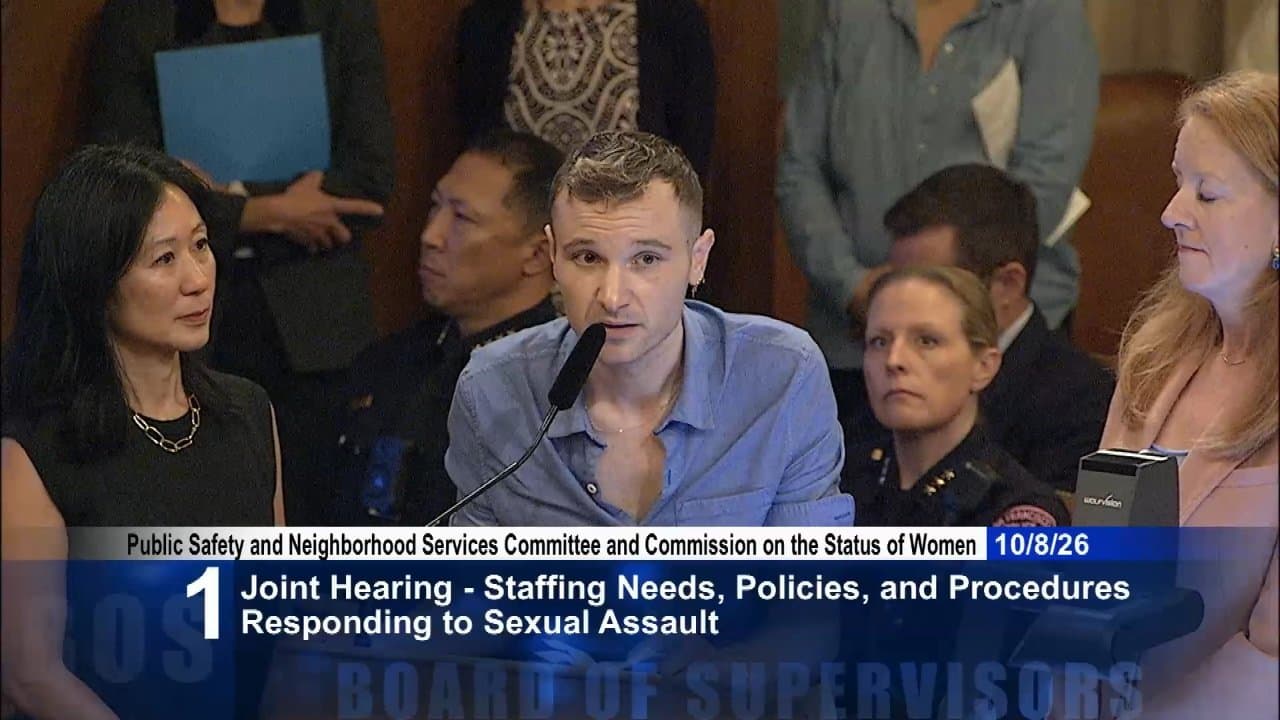
Supervisors Press SFPD on Inactive Rape Cases as Police Pledge Reforms
Public Safety and Neighborhood Services Committee • San FranciscoOctober 8, 2026
Locunity is an independent informational service and is not an official government page for this commission. All information is sourced from public footage and an analysis of official agendas with the aid of responsible, fact-checked AI. to report an error or omission.
San Francisco police went before supervisors on Oct. 8, 2026, to explain why most reported sexual assaults end up in an "inactive" file, and they left with a list of dated promises. In a first-ever joint session with the Commission on the Status of Women, the Public Safety and Neighborhood Services Committee heard and filed the hearing 3-0. Supervisor Myrna Melgar said she will introduce a resolution to lock those pledges in.
- 68% to 76% of 2022-2025 sexual assault cases ended inactive, and the victims' office says many belong with prosecutors.
- The Special Victims Unit has 31 investigators against a need of 41. The chief pledged at least five more by year-end.
- No SVU investigators are certified in trauma-informed interviewing, and SFPD asked supervisors for training money.
- SFPD stopped short of a Philadelphia-style independent audit but agreed to a quarterly forum.
- SFPD tied its 14% clearance rate partly to not seeking Ramey warrants.
- Survivors and advocates demanded independent oversight and criticized elected officials.
Inactive Cases: Where SFPD and Victims' Office Split
Why it matters: Between 68% and 76% of sexual assault cases from 2022 to 2025 ended in "open-inactive" status. Today, 92% of inactive cases are more than a year old. Chair Supervisor Danny Sauter called the 14% clearance rate "half what the national average is, lowest among California cities."
The basics: Probable cause is a lower bar than proof beyond a reasonable doubt, which is the standard needed to convict.
Where things stand: Ivy Lee, Director of the Mayor's Office for Victims' Rights, presented a "ladder" of burdens of proof. She argued that a credible non-consent account, forensic confirmation and an identified suspect together meet probable cause. She added that under California law, a sole victim's testimony can be enough. She recommended that every such case go to the district attorney so an attorney makes the charging decision.
"Respectfully, we fundamentally disagree that these are cases that should be inactive," said Director Lee.
Supervisor Bilal Mahmood, District 5, said about 30% of inactive cases have an unknown suspect, which means 70% have a known one. He noted the DA charged 37 of 52 rape cases presented last year. He then asked SFPD: "You have a survivor's testimony, is that sufficient to take that case to a DA?" An SFPD official answered yes.
The other side: "Probable cause is the standard in which we investigate," said Captain Twomey, Commanding Officer of the Special Victims Unit. He said cases that reach that standard go to the DA. He cited Dallas, Fort Worth and a 45-year practice mirroring federal crime reporting. He also said no other California agency he knew of uses the inactive category.
Assistant Chief Nicole Jones said other counties get Ramey warrants, which are arrest warrants issued directly by judges. San Francisco consults the DA first. "I think that we aren't closing as many cases because of that, because we are not getting Ramey warrants and making arrests," said Assistant Chief Jones.
Supervisor Matt Dorsey, District 6, was blunt about the stakes: "I worry that we are at least statistically sending a message to survivors, but more worryingly to me, to rapists, that this is a statistically easier crime to get away with in San Francisco."
Decisions and stakeholder impacts: Assistant Chief Jones conceded, "we're not here to say that in every single case we have gotten this right," and agreed a look-back review is needed. In response to Supervisor Alan Wong, District 4, SFPD said there are no minimum steps required before a case goes inactive today. A standardized checklist is coming. SFPD said cases are reactivated through new leads such as DNA matches or witnesses, and it plans an internal review of past cases.
What's next: SFPD said it expects to comply with the National Incident-Based Reporting System (NIBRS) in about a year and a half. It will retire labels like "suspicious act towards female," a code a survivor's report received instead of sexual assault, according to testimony read by SHARP Director Lila Carrillo. Captain Twomey committed to aligning documentation with national reporting standards by June.
Thin Ranks, Untrained Investigators and a Funding Ask
Why it matters: Investigators handling sex crimes fell from 60 in 2019 to 31 today. Supervisor Jackie Fielder noted that is roughly twice the rate of SFPD's overall decline. Each investigator handles roughly 105 cases a year.
Where things stand: "Our most recent analysis found that SVU needs 41 investigators. Today, we have 31," said Captain Twomey. Twenty-two of those 31 can be assigned sexual assault cases. Missing persons and financial crimes have been moved out of the unit, and a new staffing analysis is due in 2027.
Chief of Police Derrick Lew cited the June 2025 analysis, which was based on work by Matrix Consulting. "We are committing to getting to that 41 number, and so I think by the end of the year, we are hoping to add at least five investigators," said Chief Lew.
Training gap: Commissioner Miri of the Commission on the Status of Women established the baseline. "My understanding is that currently zero SVU investigators have completed and been certified in that training," she said. She was referring to Forensic Experiential Trauma Interview (FETI) certification, a trauma-informed interviewing method.
Assistant Chief Jones set a goal of training all SVU sexual assault investigators by the end of 2027. She noted that state POST training standards are not trauma-informed. "I will be honest, funding will be a constraint for us," she said.
Chief Lew asked the Board for funding help. He favors a $2,000, 16-hour in-person course with role-playing over a roughly $600 online option, and he flagged the cost of backfilling officers while they train.
Patrol officers will begin recurring training in January on taking, classifying and routing reports. SFPD has also added trauma-informed content to the academy. A plan to scale training to 800+ officers is due in about six months.
Decisions and stakeholder impacts: The cost now lands in the Board's budget negotiations. Melgar asked SFPD to attach "a name, a number, and a quantity, because when we vote on it, I want people's names on it."
Accountability Test: Audits, Forums and Survivor Check-Ins
Why it matters: Philadelphia has used an outside advocate audit since 1999. Supervisors and advocates see independent review as the real test of whether reforms stick.
Where things stand: Director Lee recommended an annual independent review modeled on Philadelphia's partnership with the Women's Law Project. She framed it as quality control, not blame. Captain Twomey announced an annual case quality review starting next year. It will include SVU, the DA and law enforcement partners, and outside advocates will be added gradually after a City Attorney privacy review.
The other side: When Chair Sauter asked SFPD to commit to the Philadelphia Model, Captain Twomey hedged: "I don't know if the Philadelphia model itself will actually work in San Francisco based on California law." He committed only to "some form of independent auditing."
Decisions and stakeholder impacts: Commission Vice President Ani Rivera secured a commitment to quarterly confidential reviews of prior inactive cases if the City Attorney allows them. "I think what I'm open to is creating some sort of forum quarterly," said Chief Lew. Jones confirmed that SHARP, the victims' office and the DA would take part.
Survivor contact: "Some of them have waited weeks, if not over a month, to know that there was an investigator assigned," said Director Lee. She called SFPD's 48-hour assignment goal aspirational.
Captain Twomey described a new order requiring investigators to contact survivors when a file reaches 30 days. Contact is also required at milestones such as forensic results, charging decisions or arrests. He committed to formal contact standards and monthly supervisory case reviews by December. Supervisor Wong pressed for substance over status updates, saying survivors need to hear "what progress has been made and what they can expect going forward."
Commissioner Sophia Andari said survivors often don't know they can request a support person. Jones pledged an immediate fix. Commissioner Ann Moses warned, "if the quality of experience is terrible, folks are not going to report."
Survivors and Advocates Fill the Room
Why it matters: More than 20 commenters spoke, and many raised the same demands: independent oversight, trauma-informed training and enforceable survivor rights.
Where things stand: Attorneys from the Cooperative Restraining Order Clinic described a broad pattern of failure. "Under Marsy's Law, they have the right to be kept informed, but in practice, I watch survivors wait for updates that never come," said Alicia Justin Cook, Supervising Victims' Rights Attorney. A supervising legal advocate said survivors wait up to four hours at stations and are turned away without any tracking.
Chelsea, Co-President of the San Francisco Women's Political Committee, urged SFPD to "adopt the Mayor's Office of Victims' Rights recommendations in full, especially an annual independent audit." Civil attorney Jessica Dayton said: "One account is evidence. One account is testimony. One account is enough."
A Mission father, Nakia, said an investigator's first response about his daughter was "why should I believe your daughter?" He doubted online training would help. Dr. Sarah Metz, who chairs the San Francisco Sexual Assault Response Team, said sitting through a training alone is not enough.
Who gets overlooked: Melgar opened the hearing by noting that 1 in 6 men and 2 in 5 gay men experience sexual violence. Nearly half of transgender and non-binary people do as well. The Alice B. Toklas LGBTQ Democratic Club echoed those concerns.
In response to Supervisor David Chen, SFPD said it does not collect immigration status. When asked whether it analyzes demographic data, Assistant Chief Jones said, "Not consistently, I would say no."
The other side: Several commenters turned on City Hall. Brad Chapin objected to press characterizations of the assault he reported as groping. He said the SVU detective had not contacted him, and he directly addressed committee members. Other commenters criticized supervisors and Board President Mandelman, and one called for Nancy Tung's resignation. No official responded on the record.
Minor Items
- The committee and the Commission on the Status of Women met jointly for the first time, with six commissioners present.
- Melgar sponsored the hearing (File No. 260893), with co-sponsors Dorsey, Chen, Chan and Fielder.
- The committee reconvened no sooner than 1:45 p.m. for a separate hearing on citywide drug market conditions.
Looking Ahead
The hearing was filed on a roll call vote (For: 3, Wong, Mahmood, Sauter; Against: 0; Absent: 0). Melgar plans a resolution urging the Police Commission to formalize SFPD's commitments, followed by a future update hearing. Commission President Diane Jones Lowry said formal recommendations will follow and asked for check-ins every six months.
Watch for these benchmarks:
- December: contact standards and monthly case reviews
- January: patrol training begins
- Year-end: at least five new SVU investigators
"Trust is not built in one hearing. It is built by what we do after it," said Captain Twomey.