
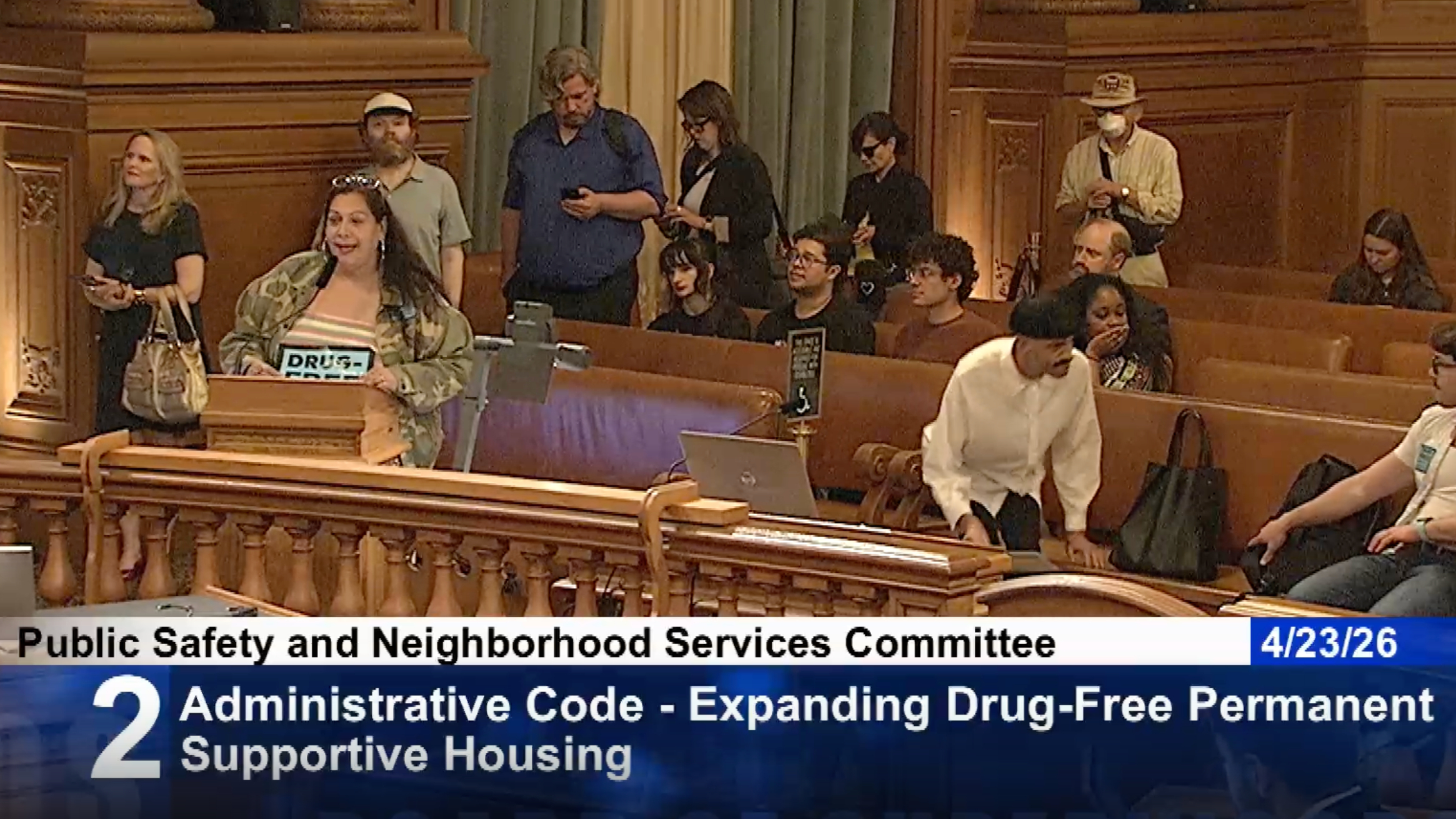
Public Safety and Neighborhood Services Committee - Apr 23, 2026 - Regular Meeting

Public Safety and Neighborhood Services Committee - Apr 23, 2026 - Regular Meeting

Public Safety and Neighborhood Services CommitteeSan FranciscoApril 23, 2026

Sources:

Locunity is a independent informational service and is not an official government page for this commission.We use AI-assisted analysis and human editorial review to publish information.

Drug-Free Supportive Housing Mandate Advances After Marathon Debate

San Francisco's Public Safety and Neighborhood Services Committee unanimously forwarded a landmark ordinance requiring all new city-funded permanent supportive housing to prohibit illicit drug use — a sweeping policy shift debated for over an hour with more than 20 public speakers. The committee also took action to protect Junior Reserve Officers' Training Corps (JROTC) programs threatened by school district budget cuts and sharpened a resolution condemning ICE activity at SFO to safeguard the city's sanctuary legal standing.

  • Drug-free housing ordinance clears committee 3-0 after emotional testimony from recovery advocates, housing providers, and Permanent Supportive Housing (PSH) tenants split on whether the mandate will save lives or push vulnerable residents onto the streets

  • JROTC preservation resolution advances as retired military instructors warn that budget cuts could permanently eliminate programs serving nearly 1,000 students

  • ICE condemnation resolution amended to correct factual claims about SFPD's response at SFO, a move designed to protect sanctuary city policy from federal legal attack

  • Haight Street music venue wins liquor license with no opposition and SFPD support


A City Reckons With Drug Deaths in Taxpayer-Funded Housing

The basics: File No. 251003, co-authored by Chair Matt Dorsey, District 6, and Board President Rafael Mandelman, District 8, would require all new city-funded site-based permanent supportive housing to operate as "drug-free" — meaning illicit substances are prohibited, though legal intoxicants like alcohol and marijuana would still be allowed. The ordinance also directs the Department of Homelessness and Supportive Housing to survey existing PSH residents about whether they want drug-free or drug-tolerant housing, and establishes city policy to expand drug-free options to meet that demand. It does not apply retroactively to existing facilities or scatter-site housing, and includes a resolution waiver process for funding drug-tolerant housing when justified.

Why it matters: Of San Francisco's roughly 9,000 permanent supportive housing units, only 42 are currently drug-free. Twenty-six percent of the city's overdose deaths occur inside PSH — a figure that has become a flashpoint in the city's homelessness and addiction policy debate. The ordinance represents the most significant potential shift in the city's $300M-plus homelessness housing portfolio in years, moving from a near-universal harm-reduction model toward one that creates a parallel drug-free track.

Where things stand: Dorsey framed the measure as an overdue correction to a system that assumes all PSH residents want drug-tolerant environments.

"I think it's time to end the arrogance of assuming, as I think policymakers mistakenly have, that everyone in permanent supportive housing is an active drug user or is okay being in communities that are drug tolerant," he said.

He cited a DePaul University study finding that residents of substance-free Oxford House settings had double the abstinence rate compared to other aftercare, and noted that Stanford's Dr. Keith Humphreys — a former Obama administration drug policy advisor — endorsed the legislation.

Dorsey emphasized the ordinance's limited scope:

"This is making sure that we are designating local dollars that may be used for drug-free options that they shall be used for drug-free options. But it doesn't say no to a single state dollar for traditional California-style housing first."

Supervisor Alan Wong, District 4, offered direct support.

"I support this legislation because it recognized something very basic. If someone is trying to get sober and stabilize their life, the city should be willing to offer housing that supports that goal," he said.

Vice Chair Danny Sauter signaled his vote early:

"I will be supportive of this. I think there's probably things in here that need to be sharpened up."

Supporters packed the hearing. Mirac Fittro, speaking as vice president of the SF Young Democrats and a board member of the American Addiction Recovery Association with three years of sobriety, argued the city "forcibly damns" recovering residents to environments that perpetuate addiction. Bill Maher, a former San Francisco supervisor, called current PSH "an abject failure," citing the 9,000-to-42 ratio of drug-tolerant to drug-free units. Amber Richmond, who stabilized in Section 8 drug-free housing, said the legislation creates a voluntary option rather than automatic eviction for relapse. Erica Sandberg read the names of some of the 960-plus people who have died of overdose in PSH on behalf of Gina McDonald, co-founder of Mothers Against Drug Addiction and Death.

The other side: Housing providers and harm-reduction organizations pressed for amendments rather than outright opposition. Jesse Rollins, representing the Tenderloin Neighborhood Development Corporation and the Supportive Housing Providers Network, asked the committee to prevent eviction solely on substance use, allow tenants to remain housed while alternatives are found, remove the funding ban on low-barrier PSH in favor of a recovery housing pilot, and noted that current PSH leases already prohibit on-site illicit drug use.

Lauren Hall, co-founder of DISH (Delivering Innovation in Supportive Housing), which serves more than 800 San Franciscans, pushed back on the funding restriction.

"We are not drug tolerant. We are people tolerant," she said, warning the mandate could hamstring the incoming HSH director's flexibility.

Justice Dumla of the SF AIDS Foundation and Treatment on Demand Coalition said the legislation pits drug-free housing against existing PSH unnecessarily and called for stronger eviction protections. Adam Francis of the San Francisco Marin Medical Society, representing 3,500 physicians, supported the drug-free housing model but asked for "prioritization ahead of exclusivity" and better step-up services for people who relapse.

Cody Keene of the Supportive Housing Provider Network warned that federal continuum-of-care funding threshold changes could cost the city tens of millions if it cannot invest local dollars in low-barrier housing. Chirag Bhakta of Mission Housing, co-developer of a 136-unit PSH facility, argued the legislation reframes systemic underfunding as individual failure.

Personal testimony cut both ways. Larry Ackerman, a retired UCSF medical scientist, shared that his husband entered rehab, relapsed once, was evicted the next morning, and died from an overdose within a year. Apple, of the Treatment on Demand Coalition, described surviving homelessness and opioid withdrawal while five months pregnant — crediting the fact that she was not required to be abstinent with staying alive long enough to reach recovery.

Decisions: The committee voted 3-0 to forward the ordinance to the full Board of Supervisors with a positive recommendation (For: Wong, Sauter, Dorsey; Against: 0; Absent: 0). Several housing providers signaled they will push amendments at the full board. Dorsey pointed to Section 12K6 of the ordinance, which requires HSH and DPH rulemaking on eviction procedures, as the mechanism for addressing concerns about due process.

What's next: The full Board of Supervisors will take up the ordinance. Opponents are expected to push for amendments strengthening eviction protections and removing the prohibition on new city funding for low-barrier PSH.


JROTC Programs Face Permanent Loss if SFUSD Cuts Instructors

Why it matters: San Francisco's JROTC programs have rebounded to nearly 1,000 students across six high schools, but the district's budget shortfall now threatens instructor positions — and losing even one program could be permanent because of a national waiting list for Army-funded slots.

Where things stand: Supervisor Alan Wong introduced File No. 260223, a resolution urging SFUSD to preserve JROTC. He shared his personal history as a student trustee at Lincoln High School who advocated for the program despite never participating himself.

Four presenters laid out the stakes. Chris Chisholm, Senior Army Instructor at Galileo High School with 23.5 years of Army service, described JROTC as a leadership and character development program "often misunderstood as a military program." Celeste, a Lowell High School senior and four-year cadet, described how the program developed her self-motivation and leadership confidence. Isabella Pham, a JROTC alumna, credited the program with mentorship and community building.

Retired Lt. Col. Doug Bullard, SFUSD JROTC Director of Army Instruction with 29 years in the district and 23 years of active duty, provided critical operational context. After voters affirmed JROTC through Proposition V in 2008, SFUSD cut its own funding, forcing three schools to operate with one instructor instead of the Army-required two — for over a decade. In 2022, three programs nearly closed. The Army fully funded a recovery effort for two years, pushing enrollment to nearly 1,000. Now SFUSD's budget gap threatens those gains.

"If we lose a JROTC teacher or program, it's different than a math teacher. First of all, it's very hard to find qualified people," Bullard warned.

Decisions: No public comment was offered. The committee voted 3-0 to forward the resolution to the full board (For: Wong, Sauter, Dorsey; Against: 0; Absent: 0).

What's next: The resolution heads to the full Board of Supervisors as SFUSD continues its budget deliberations.


ICE Resolution Gets a Legal Tune-Up to Shield Sanctuary Policy

Why it matters: Chair Matt Dorsey amended a resolution condemning ICE action at San Francisco International Airport — not to soften the condemnation, but to correct factual claims that he warned could be used against the city's sanctuary legal standing.

Where things stand: File No. 260307, continued from the April 9 meeting, originally stated that SFPD "formed a barrier around the ICE agents without requesting to see proper documentation." Dorsey proposed replacing that language with an accurate description: SFPD "responded to a 911 call for service, made contact with the involved parties and confirmed the individuals were ICE agents." A second amendment replaced "recommit to" with "continue to abide by" regarding sanctuary city policies, and a third updated the resolution's long title.

Drawing on his experience in the City Attorney's office defending sanctuary policies, Dorsey cautioned:

"If we are going to put into the public sphere that undocumented immigrants can't trust law enforcement, then it defeats the purpose of having a sanctuary city policy at all."

He referenced historical precedent involving the juvenile probation department under the George W. Bush and Obama administrations.

Vice Chair Danny Sauter asked to be added as co-sponsor. Peter Olney, a retired ILWU organizing director, was the sole public commenter, urging the strongest possible sanctuary policy.

Decisions: The committee voted 3-0 to adopt the amendments and forward the resolution to the full board (For: Wong, Sauter, Dorsey; Against: 0; Absent: 0).


Minor Items

  • Liquor license approved for The Mellow SF at 1401 Haight Street — a Type 90 on-sale general music venue license with four SFPD conditions including noise control and loitering prevention. Zero protest or support letters were filed. Park Station had no opposition. Supervisor Dorsey noted the applicant had the support of Supervisor Bilal Mahmood, Supervisor, District 5. Approved 3-0.