
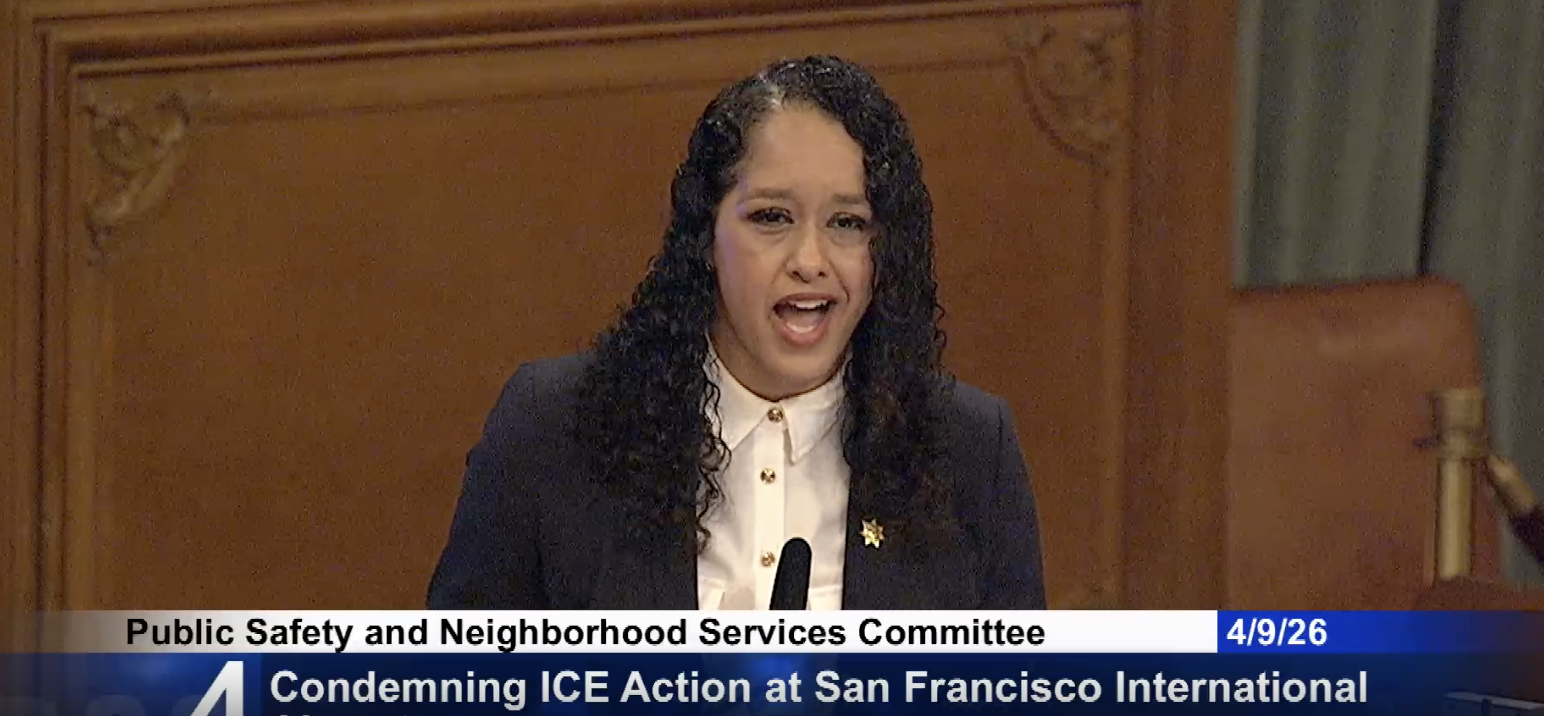
Public Safety and Neighborhood Services Committee - Apr 09, 2026 - Regular Meeting
Public Safety and Neighborhood Services Committee • San FranciscoApril 9, 2026
Locunity is a independent informational service and is not an official government page for this commission.We use AI-assisted analysis and human editorial review to publish information.
ICE Resolution Stalls After DA, Police Chief Challenge Factual Claims
San Francisco's Public Safety and Neighborhood Services Committee pumped the brakes on a high-profile resolution condemning federal immigration enforcement at SFO after the city's own District Attorney, Police Chief, and Sheriff told supervisors the measure's language was factually wrong — and risked doing more harm than good to immigrant trust. The April 9 session also saw two liquor licenses approved over split community reactions and a citywide dog spay-neuter mandate shelved in favor of a UC Davis research partnership.
- ICE resolution delayed to April 23 after DA, Police Chief, and Sheriff push back on claims SFPD assisted federal agents at SFO
- District Attorney calls resolution "politically performative," says it undermines agencies already committed to sanctuary
- New Parkmerced sports bar approved 3-0 despite residents citing late-night crime and a recent shooting at the shopping center
- Citywide mandatory spay-neuter law shelved for up to a year as UC Davis veterinary school studies shelter data
Sanctuary City Resolution Hits a Wall of Friendly Fire
The basics: A resolution introduced by Supervisor Connie Chan (File 260307) condemned an ICE enforcement action at San Francisco International Airport on March 22, urged Congress to fund TSA, and called on local law enforcement to recommit to sanctuary city policies. The committee took it out of order — then spent more than 40 minutes hearing from the Police Chief, District Attorney, and Sheriff, all of whom said the resolution got the facts wrong.
Why it matters: At a moment of escalating federal immigration enforcement, the city's top law enforcement officials say inaccurate claims about local police cooperating with ICE could erode the very trust in sanctuary protections that immigrant communities depend on. Getting the language right is not a technicality — it shapes whether undocumented residents feel safe calling 911.
Where things stand: Chair Matt Dorsey, Supervisor, District 6, opened with an extended history of sanctuary policy, tracing it from LAPD's 1970s Special Order 40 through Mayor Feinstein's 1989 implementation. He framed the legal stakes bluntly:
"The biggest favor that we could do to Stephen Miller and Donald Trump is to do something that gets San Francisco on the wrong side of the U.S. Justice Department," said Chair Dorsey.
Police Chief Derrick Lew then walked the committee through a detailed timeline of the SFO incident. Officers responded to a 911 call reporting a crying woman at Terminal 3 — not to an ICE coordination request. The lieutenant on scene verbally directed officers not to assist with the immigration enforcement action once ICE agents were identified. The uniformed officers seen escorting the detained person were Customs and Border Protection personnel whose uniforms resemble SFPD's, not San Francisco police.
"To be clear, there was no prior coordination. There was no prior communication from ICE to us, or vice versa, period," said Chief Lew.
He added: "SFPD did not participate in or assist with the enforcement action. We did not detain, handcuff, or physically restrain any individual."
Chief Lew explained why a dozen officers appeared on scene — the 911 call escalated through normal dispatch protocols — and acknowledged it was logical for onlookers to assume coordination. SFPD proposed replacing the resolution's claim that officers "formed a barrier around the ICE agents" with language stating they "responded to a 911 call for service, made contact with the involved parties and confirmed the individuals were ICE agents."
The other side: District Attorney Brooke Jenkins delivered the sharpest rebuke, calling the resolution "overbroad" and challenging its premise.
"Rather than simply focusing on what is being done by this federal administration, it includes language that seeks to have our three respective agencies reaffirm our commitment to sanctuary city, as though that is something that is in question right now," said DA Jenkins.
She noted she was the first prosecutor in the country to publicly commit to prosecuting ICE for law violations in San Francisco. Jenkins argued the resolution's language — and the board's failure to verify facts before drafting — sowed exactly the kind of distrust the city cannot afford: "There is language in this resolution that mischaracterizes what took place at SFO, period."
Jenkins also reframed SFPD's on-scene role: "They are protecting the people from the harm of those agents. They are making sure that no lives in our city are lost the way that they were in Minneapolis."
Sheriff Miyamoto struck a more conciliatory tone, reaffirming his commitment to sanctuary while asking for collaborative drafting. He explained that the only circumstance under which his office communicates with ICE involves individuals with serious violent felony records.
Vice Chair Bilal Mahmood, Supervisor, District 5, acknowledged the factual mischaracterization and disclosed that he had been consulting with Chief Lew on a separate ordinance to codify SFPD's agent-identification directives into the administrative code.
Three public commenters urged the committee to go further. Tom Yankowski, a member of a Noe Valley/Glen Park immigrant protection group, called for a citywide operational plan modeled on Denver's executive order requiring police intervention when ICE uses force and body camera documentation of federal enforcement actions. Pete Cronowit called for funding grassroots rapid-response organizations. Jerry Garber said residents don't feel the city is communicating effectively about its sanctuary protections, describing neighborhood efforts to monitor schools, senior facilities, and parks.
Decisions: The committee voted unanimously, 3-0, to continue the resolution to the April 23 meeting as a courtesy to the absent sponsor, Supervisor Chan, giving time for language amendments. (For: Dorsey, Mahmood, Wong; Against: none; Absent: none.)
What's next: Amended resolution language incorporating SFPD's proposed factual corrections is expected at the April 23 Public Safety and Neighborhood Services Committee meeting. Vice Chair Mahmood's separate ordinance codifying SFPD sanctuary directives could surface in parallel.
Parkmerced Sports Bar Approved Over Neighbors' Crime Fears
Why it matters: A full-liquor sports bar is headed to a Parkmerced shopping center that long-time residents describe as a deteriorating environment of late-night partying, parking-lot drinking, and — most recently — a shooting. Whether the new owner's promised security measures hold up will be a real-time test.
Where things stand: Officer Brandon Erickson of SFPD's Alcohol Liaison Unit presented the police report for Bark 77 at 77 Cambon Drive (District 7), seeking a Type 48 on-sale general public premises license. The location sits in a high-crime area but a low-concentration census tract for liquor licenses. Taraval Station raised no opposition. The ALU recommended approval with four conditions covering noise control, entertainment permit compliance, loitering prevention, and litter management.
Bar owner Fergal McElhenny and his general manager outlined plans including $4,000 ID scanners, security patrols of surrounding parking areas, and a policy of confiscating fake IDs to be turned over to Taraval Station.
Jacqueline, a Parkmerced Shopping Center representative of 15 years, spoke in support, saying existing alcohol-licensed businesses are food-focused restaurants without full bars and that Bark 77 would activate the space, increase foot traffic, and reduce parking-lot drinking by giving people somewhere to go.
Antonio, a local laundromat owner of 16 years, also supported the bar, calling it a social gathering space the community has missed since a similar establishment closed in 2019 during COVID.
The other side: Two long-time residents pushed back. Patrick Kelly, a Parkmerced resident since 2007, strongly opposed the license, citing an inability to sleep until 3 a.m. on weekends due to noise from a prior bar, unenforced no-trespassing signs, late-night parking-lot drinking, and a previous bar owner who refused to take responsibility for patron behavior outside.
Rebecca Shannon, a 17-year Parkmerced resident, described worsening crime in the area, parking-lot partying, drug dealing, unresponsive police, and a recent Saturday morning shooting at the mall. She raised concerns about noise from an outdoor area with big-screen TVs during sporting events and asked that safety issues be addressed before the bar opens.
Decisions: The committee approved the license 3-0. (For: Dorsey, Mahmood, Wong; Against: none; Absent: none.) Chair Dorsey acknowledged neighborhood concerns but expressed confidence the proprietor would engage with the community. The resolution moves to the full Board of Supervisors with a positive recommendation.
Citywide Dog Spay-Neuter Law Shelved for UC Davis Study
The basics: File 251162 would have required all dogs in San Francisco to be spayed, neutered, or chemically sterilized — expanding the current pit-bull-only mandate — with an unaltered dog permit process.
Why it matters: Instead of rushing a blanket mandate, the committee is pivoting to evidence-based policymaking with a major research university. The outcome of this study could reshape the final ordinance — or kill it.
Where things stand: Chair Dorsey announced three concrete steps taking effect during the continuance: the SFSPCA will increase transfers from Animal Care and Control's shelter to at least 300 dogs per year; SFSPCA and ACC will partner with UC Davis's veterinary school to analyze shelter data and intake trends; and ACC and SFSPCA will meet quarterly to track progress. The City Administrator's office will report back in six months.
"This is going to give us time to conduct a thorough analysis with the University of California at Davis, one of the nation's preeminent veterinary schools and research institutions," said Chair Dorsey.
Dr. Richard Vouillier, a UC Davis professor emeritus and representative of the Canaan Dogs Club of America, testified that the evidence doesn't support the approach. "Mandatory spay laws generally don't work," said Dr. Vouillier, who recommended mandatory microchipping with two-year renewal databases instead. Barbara Link Smith of the American Kennel Club offered the organization's support for thoughtful policymaking.
Decisions: Supervisor Alan Wong, Supervisor, District 4, was excused before the vote (2-0). The ordinance was continued to the call of the chair for up to one year. (For: Dorsey, Mahmood; Against: none; Absent: Wong.)
What's next: The City Administrator's office will report back in six months. The UC Davis analysis and quarterly ACC-SFSPCA meetings will determine whether the ordinance returns in revised form.
Minor Items
- Tazza D'Amore Cafe liquor license approved 3-0. The 23-year-old cafe at 700 4th Street near San Francisco's Caltrain station won a Type 21 off-sale general license to sell packaged beer, wine, and spirits as it expands into an adjacent storefront left vacant after the previous tenant of 50 years died during COVID. The cafe is partnering with Go Hill Pizza and Mitchell's Ice Cream. Nine SFPD conditions include restricted sales hours (11 a.m.–7 p.m.) and no single-serve containers under 100 mL.