
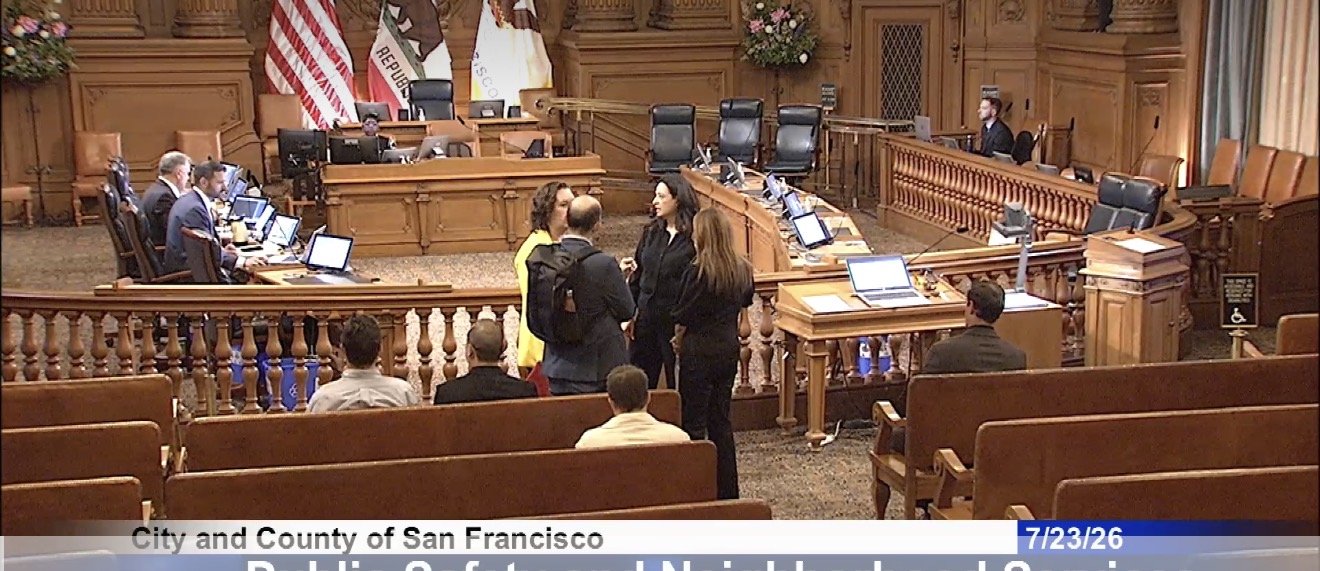
Public Safety and Neighborhood Services Committee - Jul 23, 2026 - Regular Meeting
Public Safety and Neighborhood Services Committee • San FranciscoJuly 23, 2026
Locunity is a independent informational service and is not an official government page for this commission.We use AI-assisted analysis and human editorial review to publish information.
SF's Deadly Heat Gap: One Staff Member, $400K, and a City Not Ready
The San Francisco Board of Supervisors' Public Safety and Neighborhood Services Committee spent the better part of two hours on July 23 confronting a blunt reality: the city has a detailed plan to survive extreme heat, but almost no money to carry it out. Board President Rafael Mandelman led the hearing, which drew presentations from five city departments and a parade of community advocates all delivering the same message — invest now, or people will die.
- Major hearing reveals San Francisco's heat resilience program runs on roughly one full-time employee and $400,000 in city funding — while New York City spends $34 million on heat pumps alone
- UCSF researcher reports 95% of surveyed vulnerable residents experienced negative health impacts during heat events
- Vice Chair Sauter signals interest in legislation requiring maximum indoor temperatures for rental housing
- Six community groups — from climate advocates to physicians to affordable housing operators — call for bond funding and stable CBO investment
- Four Tenderloin and Pacific Heights liquor licenses approved unanimously and forwarded to full board
A City With a Map but No Gas in the Tank
San Francisco's extreme heat hearing laid bare a dangerous mismatch: strong interdepartmental planning, almost no implementation dollars, and a climate that is already punishing the city's most vulnerable residents.
The basics: The hearing examined the city's Heat and Air Quality Resilience Project — known as "Hacker" — established in 2021 and staffed by approximately one full-time employee cobbled together from multiple departments. The program has produced a 31-strategy resilience plan, facilitated 17 quarterly coordination meetings, and helped Public Works secure a $12 million tree-planting grant for 3,500 trees in environmental justice communities. Only 34% of San Francisco homes have air conditioning — the lowest rate of any major U.S. city.
Board President Rafael Mandelman opened by recounting the Sept. 1, 2017, heat event that killed six people. "Temperature hit 106 degrees, the hottest ever recorded here. Six people died that day in San Francisco and San Mateo County, each of them elderly, each of them alone," he said. "At the peak of the crisis, 19 people were waiting for ambulances the city did not have." He noted the city broke temperature records twice in 2026.
Why it matters: The presentations exposed a gap between planning and spending that multiple officials described in strikingly candid terms.
Dr. Nita Thakur, a UCSF PRIZE Center researcher, presented findings from the Community Climate Collaborative showing that "95% of those surveyed reported experiencing at least one negative health impact during the extreme heat events." Most lacked resources for structural changes to their homes. "The problem is not that people do not understand the risk," she said. "The problem is that many lack the resources to act on what they know."
Dr. Thakur identified three priorities: climate-resilient housing with passive and active cooling, stronger connections between health care providers and community-based organizations, and multilingual communication through trusted partners. She pointed to Los Angeles, Portland, and New York City as models: "Our sister city in LA recently passed a policy where indoor temperature maximums cannot be above 78, and so that sets a target."
The Funding Chasm
Matt Wolf, DPH climate health program manager, detailed the public health stakes: EMS calls surge 73% during extreme heat risk days. He noted that San Francisco is less competitive for state heat grants because it has fewer total heat days than inland cities — even though its lack of air conditioning makes each event proportionally more dangerous.
Alex Morrison, of the Office of Resilience and Capital Planning, confirmed the program's skeletal staffing. "Most of that is volunteered time that is taking away from other things that the other departments are supposed to be doing," he said. Asked whether the planning work had actually improved the city's position, Morrison was blunt: "I think I'm pretty worried. I think that one of the things we've seen is like the things that kick cities into action often is having a major event."
Cindy Comerford, SF Environment Department climate program manager, outlined the scale of the building challenge: 18,000 buildings need conversion by 2040 to meet decarbonization goals. The Climate Equity Hub's direct-install heat pump program receives just $400,000 in city general fund support. "Just to give you an example, and I know New York City is a much larger city than San Francisco, but they invested $34 million in heat pumps," she said.
Board President Mandelman did not hide his frustration. "We're doing $400,000, which I'm thankful for, but it. Right," he said, trailing off. He later crystallized the hearing's central finding: "My impression is you've given us the road — like we have the map now, but we don't have the resources to actually go down the path and get to the place we want to go."
Emergency Response: Better, but Not Enough
Mary Ellen Carroll, executive director of the Department of Emergency Management, described significantly improved protocols since 2017, including pre-translated alert messaging, community preparedness exercises, and investment in existing community facilities rather than standalone cooling centers. Traditional cooling centers, she said, go largely unused: "That's why they really aren't part of our portfolio. We have instead invested in existing community facilities that people go to and want to go to."
But Carroll also acknowledged the fundamental political challenge: "You don't feel it until you feel it. And that is the challenge that we have."
Community Voices Sound the Alarm
Six public commenters — all from organized advocacy, medical, and housing groups — delivered a unified message: fund building-level resilience now.
Mark Pahalski, TNDC director of facilities, offered a concrete example of what creative investment looks like. He described solving a heat-sink building's cooling problem at one of the nonprofit's affordable housing sites: "With a bit of creative engineering, I was able to provide air conditioning to every resident for $50,000" — compared to $2–4 million quoted for conventional HVAC. He argued that preventive maintenance costs two to four times less than reactive response.
Ashley Peck of Brightline Defense highlighted that 18,000 SRO residents in more than 500 buildings face trapped heat and poor ventilation. She announced a pilot combining tenant surveys, indoor temperature monitoring, and disaster preparedness training.
Robin Cooper, a psychiatrist representing San Francisco Physicians for Social Responsibility, warned that extreme heat causes cognitive impairment, violence, and increased suicide rates, and that severely mentally ill individuals die at three times the normal rate during heat events.
Susan Green of the SF Climate Emergency Coalition, Alexander Chen, a UCSF medical student, and Tracy Flor Figueroa of the Sierra Club San Francisco Bay Chapter all called for bond funding for heat pumps, stable CBO funding, and building weatherization as the most effective resilience investments.
Where Things Go From Here
Vice Chair Danny Sauter signaled he may pursue legislation to set maximum indoor temperatures for rental housing. "And I think we're all familiar with the concept of requiring landlords to maintain a minimum temperature in the winter," he said, drawing an analogy to existing tenant protections.
Board President Mandelman said the city systematically underinvests in infrastructure: "We in this city, I think we systematically underinvest in infrastructure. We're not where we need to be in a whole host of ways around infrastructure." He called on policymakers and the mayor's office to engage more deeply on green infrastructure investment.
Decisions: The hearing was continued to the call of the chair (For: 2, Against: 0, Absent: 1 — Supervisor Dorsey and Vice Chair Sauter voting aye, Supervisor Wong excused). Mandelman indicated the continuation is intended to bring the mayor's office before the committee to discuss investment commitments.
Minor Items
- Reggie and Maude's (456–460 Larkin St.) approved for a Type 48 on-sale liquor license, expanding the acclaimed Out of Sight pizzeria into a full bar at Turk and Larkin in the Tenderloin. Approved 2-0, forwarded to full board.
- Tenderloin Museum (835 Larkin St.) approved for a Type 64 theater liquor license to serve alcohol during events and programming. Approved 2-0, forwarded to full board.
- College Market (995 Ellis St.) approved for a Type 21 off-sale general liquor license transfer. Approved 2-0, forwarded to full board.
- Hello Mart (2135 Buchanan St., Pacific Heights) approved for a Type 20 off-sale beer and wine license transfer. Approved 2-0, forwarded to full board.
- Vicious and dangerous dog hearing officer hired, resolving a backlog of unheard cases. Lorenzo Rosas from Supervisor Cheryl's office confirmed the hire. Item filed 2-0.