
Rental Scammers Outpace Police and Prosecutors, Supervisors Hear
Public Safety and Neighborhood Services Committee • San FranciscoNovember 12, 2026
Locunity is an independent informational service and is not an official government page for this commission. All information is sourced from public footage and an analysis of official agendas with the aid of responsible, fact-checked AI. to report an error or omission.
Overseas fraud rings, burner phones and copied listings are hitting San Francisco renters in ways police and prosecutors struggle to stop, city officials told the Public Safety and Neighborhood Services Committee on Nov. 12, 2026. The committee heard and filed the rental scam hearing 3-0. It also continued an illegal dumping hearing after Public Works acknowledged deep staffing gaps, and voted 3-0 to urge the full Board to block a liquor license for a Park Merced bar.
- Rental scams: prevention over prosecution. Treasurer, DA and SFPD officials describe the limits of enforcement; hearing filed 3-0
- Nonprofit housing workers push for platform accountability and data sharing with frontline providers
- Illegal dumping outreach staff down to three field coordinators. Enforcement actions fell from more than 11,000 to about 4,500
- Only about $47,000 of nearly $128,000 in dumping citations has been collected; hearing continued 3-0
- 3-0 vote against Bark 77's beer and wine license after District 7's supervisor asks for a denial for the first time
Rental Scams: City Bets on Prevention, Not Arrests
Why it matters: Chief Assistant Treasurer Amanda Fried cited 65,000 reported rental scams nationally, with losses totaling $65 million. Young adults are hit hardest. Once the money is gone, it rarely comes back.
"But it is not common for people to get their money back, which is why prevention is so important," said Fried, responding to Supervisor Alan Wong, District 4.
Where things stand: The Treasurer's Stop Scams SF program includes scam alerts, multilingual financial counseling, scam monitoring and a citywide coordination effort. It also plans listing-verification standards. Fried said scammers commonly copy real listings or impersonate landlords on platforms such as Craigslist, Zillow and Facebook Marketplace.
Supervisors asked about generative AI, outreach to Meta and Craigslist, bank reversals and possible legislative levers. Fried said the city is focusing on coordination first and may return with local policy ideas. Wong stressed that scams often target the city's most vulnerable residents.
The enforcement wall: Matt McCarthy, Chief of the White Collar Crime Division at the San Francisco District Attorney's Office, said fake identities, emptied accounts, slow search warrants and foreign suspects who cannot easily be extradited stall cases. He said his office will charge any scam it can prove, regardless of the dollar amount. Prosecutors cannot force platforms to remove fraudulent listings, however.
"We don't have legal authority to order it to be taken down," said McCarthy.
Captain Mike Conyers of the SFPD General Crimes Unit said police handle about 2,500 financial crimes cases a year. He said many victims never get a follow-up call.
"Unfortunately, there is no system right now in place if a case doesn't get assigned for the victim to be contacted," said Conyers.
The other side: Four public commenters pressed for faster, broader action:
- Lauren Rice, a nurse, nearly lost money to a copied listing. She urged stronger platform accountability and simple reporting tools.
- Jenny Ristow, a housing locator at Compass Family Services, said scams on Craigslist and Facebook Marketplace frequently target her Spanish-speaking clients who have limited tech experience.
- John Ellis, a Resident Advisory Board member, asked the Treasurer to share warnings and data with frontline housing providers. He said scams can derail tenants' exits from supportive housing.
- Megan Rohr, a Compass Family Services employee and Human Rights Commission commissioner, praised Stop Scams SF trainings. She cautioned that verification steps should not delay housing placements and flagged landlord AI tools that may misflag eviction notices.
Decisions and stakeholder impacts: The hearing was heard and filed. For: 3 (Sauter, Wong, Mahmood), Against: 0, Absent: 0. No legislation advanced. For now, the main protections for young renters, low-income families and supportive housing tenants are education and coordination. Platforms face public pressure but no new city mandate.
What's next: The Treasurer's Office expects to convene city partners over the next year and may return with local policy proposals.
Illegal Dumping: Thin Ranks, Thin Collections
Why it matters: Public Works enforcement actions fell from more than 11,000 to about 4,500. Of nearly $128,000 in citations, only about $47,000 has been collected. That weakens deterrence in hotspots such as Chinatown, the Tenderloin and Bayview.
Where things stand: Committee Chair Danny Sauter opened by demanding concrete plans from the department.
"What I don't believe we have is a suite of tools and specific commitments from Public Works on what will be tried to improve the situation," said Sauter.
Ramses Alvarez, Community Engagement Division Manager at San Francisco Public Works, laid out how 311 reports are routed and how the ONE Team uses progressive discipline. Fines range from $250 to $1,000. Cleanup costs run from $430 to $15,000 per site.
"We're currently short-staffed with 3 field coordinators and 2 administrative staff and are in the process of hiring 4 additional field employees," said Alvarez.
Alvarez said 104 candidates qualified for the four open positions. He described an overnight Oct. 29 stakeout in Chinatown. The department's planned tools include:
- Live video plus license plate readers, starting in Bayview
- Vehicle booting under SB 1218
- A staff position dedicated to a supervisor's cost-recovery ordinance
Kevin Flanagan, Senior General Manager at Recology, described the company's sweep routes and locking carts. Committee members asked about repeat offenders, contractors without San Francisco ties and trash can design. Ian Schneider, Government Affairs Manager at Public Works, said rummaging and excess waste will likely persist regardless of can design.
The SRO gap: City code requires only "adequate" garbage service and sets no minimum for single room occupancy hotels. Supervisor Bilal Mahmood, District 5, asked how Tenderloin service levels could be made sufficient. Public Works said that would require a legislative change.
Sauter asked how much time would be freed by changing the bin storage, or toter, rules. Alvarez estimated about half of each coordinator's day, Monday through Friday. He said a complaint takes roughly a month to move from report to inspection.
The other side: John Ellis of the Resident Advisory Board supported enforcement and SRO occupancy limits. He also asked for service capacity checks, wheelchair access and city control over enforcement data.
Decisions and stakeholder impacts: The hearing was continued to the call of the chair. For: 3 (Sauter, Wong, Mahmood), Against: 0, Absent: 0. Property owners could face booting and cost recovery. SRO tenants could gain if service minimums are written into code.
What's next: The hearing will return at the chair's call. Hiring, camera approvals, booting and cost recovery remain under committee review.
Park Merced Bar License Hits a Wall
The basics: A Type 42 license allows on-sale beer and wine. Bark 77, at 77 Cambon Drive in District 7, needed a city finding that the license would serve "public convenience or necessity."
Where things stand: Officer Brandon Erickson of the SFPD's liaison unit to the California Department of Alcoholic Beverage Control reported that no protest or support letters had been filed. He said police classify the area as a low-crime plot and recommended approval with five conditions.
Supervisor Miriam Melgar, District 7, who is not a committee member, disputed that crime characterization. She cited 86 police reports in 2025, above the 81-report high-crime threshold. She also pointed to understaffing at Taraval Station and a stabbing the night before the hearing. Melgar had never opposed a license in six years in office.
"I'm here to ask that you not approve this license," said Melgar.
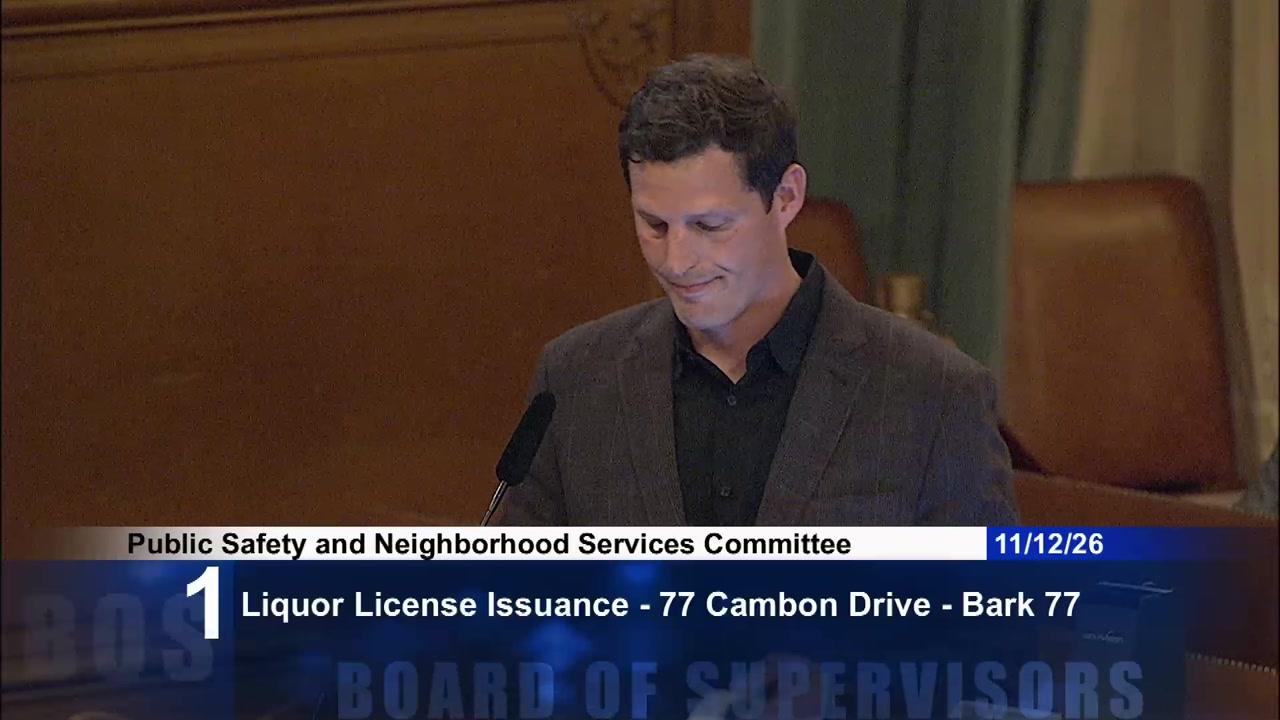
Patrick Alley, a member of the tenants association at 125 Cambon Drive, described shootings, a stabbing and after-hours gatherings with slow police response. He also alleged that residents within 500 feet were not notified.
The other side: Fergal McElhinney, the prospective owner, said the business would add security and that the required notices were mailed and posted. He blamed a landlord dispute for derailing an earlier license.
Decisions and stakeholder impacts: Sauter moved to forward a resolution finding the license would not serve public convenience or necessity.
"I do not believe that the issuance of this license serves the public necessity or convenience," said Sauter.
The motion passed. For: 3 (Sauter, Wong, Mahmood), Against: 0, Absent: 0. The vote sides with neighbors and the district supervisor over the police department's recommendation and the applicant's plans.
What's next: The full Board is expected to act Dec. 1, 2026. Adoption would effectively block the license at this location.
Looking Ahead
The full Board takes up the Bark 77 resolution Dec. 1, 2026. The illegal dumping hearing returns at the chair's call. The Treasurer's Office may bring back local rental scam policy ideas after a year of coordination with city partners.