
Public Safety and Neighborhood Services Committee - Mar 12, 2026 - Regular Meeting
Public Safety and Neighborhood Services Committee • San FranciscoMarch 12, 2026
Locunity is a independent informational service and is not an official government page for this commission.We use AI-assisted analysis and human editorial review to publish information.
Dozens Demand Deputy Firings After Mass Strip Search of Women in SF Jail
A four-hour hearing at San Francisco's Public Safety and Neighborhood Services Committee exposed harrowing accounts of abuse inside County Jail 2, as survivors, civil rights attorneys and more than 30 community organizations confronted Sheriff Paul Miyamoto over a May 2025 mass strip search of approximately 20 women — filmed by body-worn cameras while male deputies watched and, witnesses say, laughed. The committee also advanced a street sweeping data mandate and delayed a citywide dog sterilization ordinance.
Over 30 organizations demand deputy suspensions after survivors testify about mass strip search, sexual assault and years without sunlight inside SF County Jail 2
Sheriff discloses 18 sexual assault reports in 2025, confirms involved staff reassigned but not fired, and commits to strip search policy review and body scanners
Public Defender's office says strip searches deter attorney visits, violating the Sixth Amendment, as lockdowns block legal access for hours at a time
DPA director reveals his office lacked jurisdiction to investigate the May 2025 complaints until December, with roughly 40 open investigations now underway
Clean Streets Act advances to full board after audit finds sweeping routes unchanged since 2008
Citywide dog spay/neuter mandate delayed to April 9 amid equity concerns for unhoused residents
"Just to Meet Minimum Standards": Jail Conditions Hearing Exposes Systemic Failures
Supervisor Chen convened the hearing during Women's History Month, telling colleagues: "When I called for this hearing, it was in the light of atrocious allegation of sexual misconduct committed against at least 20 women being held in a San Francisco jail." (Lightly edited for clarity.) Co-sponsors included Supervisors Myrna Melgar, Shamann Walton, Jackie Fielder and Danny Sauter.
What followed was one of the most extensive public accountings of conditions facing women and transgender people in San Francisco's jails — featuring community testimony, presentations from the Sheriff's Department and oversight agencies, and more than two hours of public comment that left supervisors pledging further action.
Survivor Testimony Sets the Tone
Julia Arroyo, Executive Director of the Young Women's Freedom Center, and Zendaya Blossom, National Organizing Director of the TGI Justice Project, opened the community presentation on behalf of more than 30 organizations. Arroyo drew on her own history of incarceration to frame the stakes:
"I was sexually assaulted and I was brought into the facility. I wasn't given a rape crisis, I wasn't given a rape kit. I wasn't given any prophylactic or any medications that could help me inside of my journey."
She described being given blood-stained garments and released at midnight without services — conditions she said persist today.
Why it matters: The testimony connected a single incident — the May 2025 strip search — to a pattern of alleged Title 15 violations, retaliatory treatment, denial of medical care, and conditions that community speakers described as constitutionally deficient.
The Sheriff Responds — and Acknowledges Limits
Sheriff Paul Miyamoto presented on jail infrastructure, staffing and programming. He disclosed that the department received 18 PREA (Prison Rape Elimination Act) sexual assault reports in 2025. For 2024, he provided a breakdown: "We had 22 reports. We had 14 that were unsubstantiated, four that were unfounded, and four that were — there was an investigation completed."
On the May incident specifically, Miyamoto confirmed that involved supervisory staff had been reassigned: "The individuals involved that supervised and managed the strip search and the searches on that day are no longer at that facility. They are no longer assigned there, they were reassigned." But he stopped short of the firings community members demanded, citing labor constraints: "I've had experiences of individuals who we've terminated who through binding arbitration, come back and get their jobs back."
The sheriff committed to reviewing strip search policy with community input and said the department was pursuing body scanners: "We hope to get some body scanners so we can use that as an intermediary step before conducting a strip search."
Where things stand: The department has expanded housing for women and trans populations from one to three pods and added programming, but speakers throughout the hearing argued that programming cannot substitute for basic safety and constitutional protections.
Oversight Gaps Laid Bare
DPA Executive Director Paul Henderson revealed a critical timeline problem. When complaints about the May incident arrived, his office had no authority to act: "Those complaints were outside of the Letter of Understanding's jurisdiction. And DPA was constrained with insufficient resources to address the complaints that were coming in." Formal jurisdiction was not expanded until December 2025 — seven months after the incident.
Henderson described a novel interagency collaboration with the Human Rights Commission and Department on the Status of Women, but warned that policy changes alone are insufficient: "Oversight and accountability falls flat without a component of training being in there. You can change the rules, but if those rules aren't then reincorporated into the training practices and processes of the agency, you recreate the incidents over and over."
Approximately 37 to 40 investigations into the Sheriff's Department are currently open at DPA.
Public Defender: Strip Searches Chill the Sixth Amendment
Angela Chan, Assistant Chief Attorney in the San Francisco Public Defender's Office, delivered some of the hearing's most pointed testimony. She said the sheriff's strip search policy actively deters incarcerated people from meeting with their lawyers:
"Deputies still have discretion to decide to just conduct a strip search without approval by a supervisor and without any reasonable suspicion. And it's certainly a deterrence to our clients to be able to meet with their attorneys."
She also described routine lockdowns blocking legal access: "We often have a back and forth exchange, the sheriff's office where we are conveying a complaint from our staff who are actually sitting in the lobby of County Jail 1, 2 or 3 asking to meet with a client and being told that they need to wait, sometimes hours, sometimes the full day."
Two Hours of Public Comment, One Clear Message
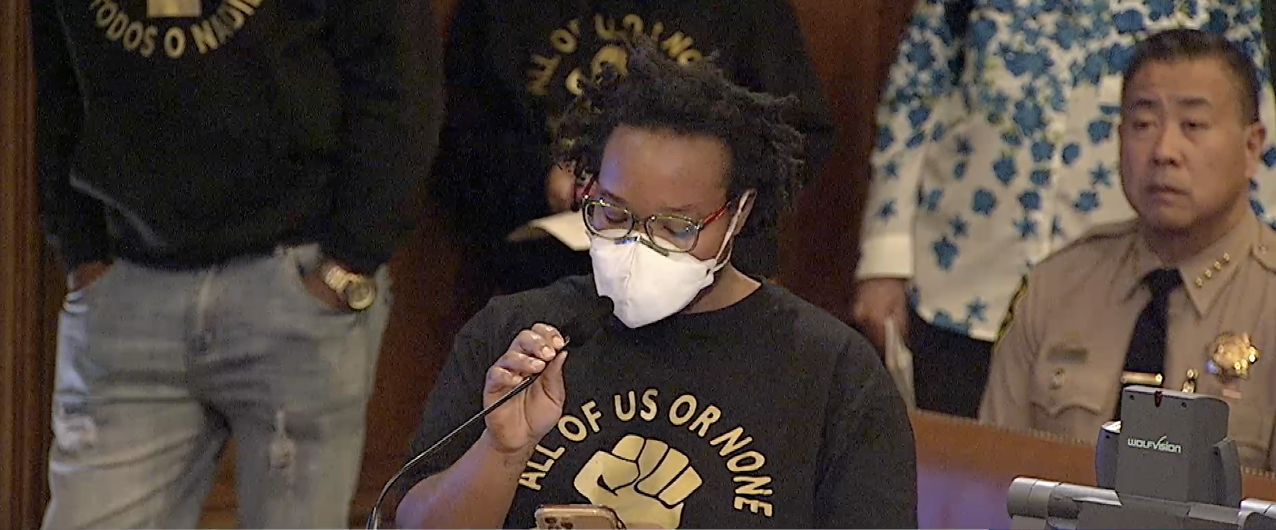
More than 30 speakers — formerly incarcerated women, civil rights attorneys, advocacy leaders and elected club officers — lined up to testify. Their demands coalesced around five points: immediate suspension and removal of all deputies involved in the May search; pretrial release of affected women; a halt to new sheriff funding; full funding of the Sheriff's Oversight Board and Inspector General; and an independent, community-informed investigation.
Mary O'Neill, a formerly incarcerated District 6 resident, described the May search in personal terms — male deputies watching, some laughing, body cameras recording. She reported PTSD symptoms, insomnia, and having spent two months in administrative segregation with only 20 to 30 minutes out of her cell per day.
Lily Pickett of the California Coalition for Women Prisoners and the SF Participatory Defense Hub testified on behalf of an affected woman, reporting that strip searches are used as punishment and that some women have been incarcerated for five to 11 years with no access to sunlight outside of hospital visits.
Elizabeth Bertolino, a civil rights attorney representing over 20 women subjected to the May searches, said her investigation found that strip searches are not isolated — they occur for hospital visits and attorney meetings, creating a normalized environment of rights violations.
Natalie Ortiz, a member of the Sheriff's Oversight Board, reported that the mayor's office paused the hiring process for an Inspector General and called on supervisors to fully fund the Oversight Board. She noted that incarcerated women who file complaints have reported retaliation.
Lucas Illa of the Coalition on Homelessness questioned DPA's capacity and flagged what he called the irony of approving $14 million for a Reset center run by the same department facing abuse allegations. Asia Nicole Duncan, Co-President of the Harvey Milk LGBTQ Democratic Club, echoed demands for deputy suspensions and independent oversight, emphasizing urgency amid national rollbacks on civil rights protections.
Tanisha Cannon, Managing Director of Legal Services for Prisoners with Children, underscored that programming cannot substitute for policies protecting women from degrading treatment, noting her organization submitted recommended revisions to the strip search policy and that the sheriff committed to prioritizing review.
Decisions
The hearing was continued to the call of the chair on a 3-0 vote (Supervisor Alan Wong, Supervisor Bilal Mahmood and Chair Matt Dorsey voting yes).
What's next: Supervisor Chen announced her intention to hold additional hearings and potentially request the sheriff convene a working group with community organizations. The 109 women currently in San Francisco jails remain at the center of what will become a test of whether this hearing produces systemic reform — or whether future funding decisions, oversight board appointments and Inspector General hiring signal a different answer.
Street Sweeping Gets Its First Checkup in 17 Years
Supervisor Danny Sauter introduced the first piece of his Clean Streets Act legislative package — an ordinance requiring the Department of Public Works to submit periodic reports on mechanical street sweeping operations, including metrics on equipment effectiveness, debris collection and public complaint data.
Why it matters: A Budget and Legislative Analyst audit found that "mechanical street sweeping in San Francisco is not currently evaluated to determine optimized route scheduling, frequency and labor needs," and that "routes have not fundamentally changed since the last optimization efforts in September 2008." Sauter noted that most of Russian Hill, Nob Hill and North Beach have lacked regular mechanical street sweeping since the 1980s.
The ordinance also amends Health Code Section 283 to provide a plain-language definition for "putrescible" waste — organic material subject to decomposition — aligning the city code with state law.
Decisions: The committee adopted a non-substantive amendment removing one subsection and forwarded the ordinance to the full Board of Supervisors with a positive recommendation, 3-0 (For: Wong, Mahmood, Dorsey; Against: 0; Absent: 0). The first DPW report is due March 31, 2027. The item is expected on the full board agenda March 24, 2026.
Minor Items
Citywide dog spay/neuter ordinance continued to April 9. The proposed ordinance would expand San Francisco's pit-bull-only sterilization requirement to all breeds, establishing an unaltered dog permit process with fees and penalties. Lucas Illa of the Coalition on Homelessness urged fee waivers for low-income and unhoused dog owners, warning the mandate could be used to remove dogs from homeless residents. The committee voted 3-0 to continue the item to allow time for amendments.