
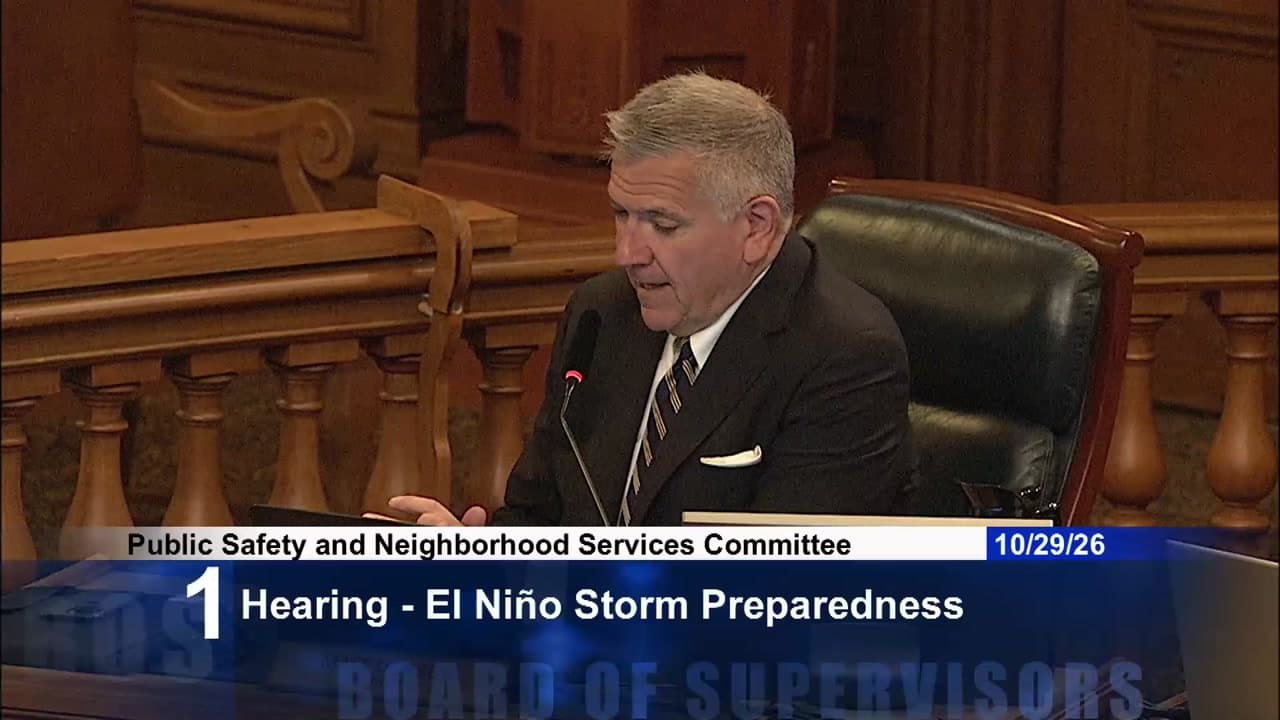
Supervisors Probe El Niño Readiness as City Braces for Season-Long Storms
Public Safety and Neighborhood Services Committee • San FranciscoOctober 29, 2026
Locunity is an independent informational service and is not an official government page for this commission. All information is sourced from public footage and an analysis of official agendas with the aid of responsible, fact-checked AI. to report an error or omission.
San Francisco is preparing for a winter of floods, not a single storm, and supervisors used a nearly 2½-hour hearing to test whether the city is ready. The Public Safety and Neighborhood Services Committee heard from emergency managers, utilities, the Port and state regulators before filing the hearing. It then voted 3-0 to send ordinances on butane torch lighters and cannabis equity status to the full Board of Supervisors.
- Emergency Management will lead the El Niño response through spring 2027 under the mayor's local emergency declaration.
- The sewer system can be overwhelmed by an inch of rain in 12 hours, utility officials warned.
- Public Works holds 27,000 sandbags against a 50,000 goal. The Port plans seasonal floodwalls at four low points.
- Autonomous vehicle companies are not required to avoid flooded areas. The city can only ask them to stay out.
- A ban on plastic locking butane lighters advances 3-0 after fire officials cited a sevenfold rise in related fires.
- Families of cannabis equity operators could inherit their status under an ordinance forwarded 3-0.
A Five-Month Emergency, Not a Weekend Storm
Supervisor Matt Dorsey, District 6, opened the hearing by pointing to record October tides, forecasts of a record El Niño, and the statewide and local emergency declarations already in place.
"This was not El Niño winter. This was just the preview," said Dorsey.
Why it matters: Officials described a sustained campaign, unlike past storms that lasted a few weeks. The emergency declaration lets the city speed purchasing and redirect staff. The hearing framed coastal and low-lying neighborhoods as at risk from Thanksgiving through January.
Where things stand: Dorsey built the hearing around command and vulnerable residents. "If a major storm lands on Thanksgiving weekend, who's in charge at 2 a.m. and what happens next?" he asked.
Mary Ellen Carroll, Executive Director, Department of Emergency Management, answered that the department, known as DEM, leads policy coordination, operational planning and public information through spring 2027. Department heads continue to direct their own operations.
"What we're looking at now is an entire season, really starting now through the spring of activations, which is a different posture than we've had in the past," said Carroll.
The local emergency declaration streamlines procurement for debris removal and flood remediation. It also lets the mayor redirect and recall staff. DEM is drafting an incident coordination plan and designing an Emergency Operations Center with a hybrid virtual structure that can last about five months. Public outreach runs through sf.gov/storms and the city's AlertSF text alerts. Carroll acknowledged the city cannot prevent every impact.
Muni, Recreation and Park, Fire, Police, and the human services and homelessness agencies also presented their plans.
The power problem: Supervisor Alan Wong, District 4, noted that the anniversary of the December 2025 outage is approaching. "Significant questions remain about the resilience of San Francisco's electrical grid," said Wong.
Carroll said DEM was sending PG&E a letter that day, responding to the utility's request for feedback on its performance. She said PG&E has not always provided timely outage communication. She added that the utility's resources could be scarce during a coast-wide event, so the city is planning its own contingencies. DEM called power loss the most dangerous effect on communities.
Robotaxis in floodwaters: Asked about autonomous vehicles, Carroll was blunt. "Any request for an AV company to stay out of an area is simply that. It is a request," said Carroll. DEM held a tabletop exercise with Waymo the day before the hearing. Zoox was not included.
The other side: Two public commenters pointed to gaps officials had not addressed. A commenter with federal emergency management experience said San Francisco lacks operable warning sirens. The commenter also criticized the disbanding of DEM's Watch Center and said airport staff expertise was excluded. Anna Savage, an oceanographer with Sofar Ocean, which has deployed sensors with the Port, argued the city cannot prepare for conditions it is not measuring.
Decisions and stakeholder impacts: The committee voted to file the hearing (For: 3, Sherrill, Wong, Sauter; Against: 0; Vice Chair Mahmood excused). Dorsey summed up his view: "I came into this hearing worried. I'm leaving encouraged and still worried."
Floodwalls, Sandbags and a Sewer at Its Limits
Why it matters: San Francisco's combined sewer system carries both stormwater and sewage. Officials said it can fail during intense short storms or storms that hit during king tides.
Where things stand: Joel Prather, Assistant General Manager, Wastewater Enterprise, San Francisco Public Utilities Commission, said the system can treat up to about 565 million gallons a day. It has roughly 200 million gallons of additional storage.
"An intense storm that brings an inch in 12 hours is going to overwhelm the system," said Prather.
Prather said backflow preventers on outfalls are under way. The utility's floodwater grant program has issued 47 grants totaling about $1.3 million. Sandbags are also headed to Ocean Beach to limit erosion.
Michael Martin of the Port of San Francisco outlined seasonal floodwalls at Pier 45, Pier 14 near Rincon Park, and Piers 80 and 96. The state Department of Water Resources is supplying the materials.
Nick Holzapfel, who oversees resilience and disaster planning at San Francisco Public Works, said the department has 27,000 sandbags on hand. Its goal is 50,000.
The standards gap: The city designs its sewers for a storm expected once every five years with a three-hour duration. Prather said there is no defined trigger to revisit that standard. "It would be a new process. There's no defined specific trigger to kick that process off," said Prather.
The state's role: Larry Goldzband, Executive Director, Bay Conservation and Development Commission, offered regulatory relief. "BCDC will not require that homeowners and businesses apply for permits to place temporary flood prevention measures," said Goldzband. Those measures should come down by April 30. He urged the city to treat this winter as a preview of sea-level rise, saying it should learn "what works now, because the future is now."
Residents' role: About 8,000 of the city's 25,000 storm drains are adopted through the Adopt-a-Drain program. "This could be a rallying cry to hit 10,000 or to make it a competition of some sort," said Supervisor Danny Sauter, Committee Chair.
What's next: Departments offered follow-up reports on sandbag usage, District 4 flood hotspots and Recreation and Park shelter sites. Officials urged residents to sign up for AlertSF, avoid floodwater and adopt a drain.
Narrow Butane Lighter Ban Heads to Full Board
The basics: The Fire Code ordinance would bar in-city sales of lockable butane torch lighters with plastic components.
Why it matters: Fire officials tie these lighters to fires that start when they are left burning near tents and wood-frame buildings.
Where things stand: Sophie Marie, Chief of Staff to Supervisor Mandelman, said the Fire Department recorded 31 butane-related fires from 2020 to 2025, causing about $3.2 million in damage.
"Those incidents went from just 3 in 2020 to 21 in 2025, which is a sevenfold increase," said Marie.
Fire Department Chief Dean Crispin reported three documented locked butane lighter fires and one death this year. He said "the methodology for drug use has shifted from needles to torch-style lighters with a pipe."
Deal terms: The ordinance does not ban unlocked lighters, metal-bodied locking lighters or online sales. It applies to all sellers. A first violation carries a $500 penalty, and later violations within a year carry $1,000. The fire chief will enforce it. Mandelman's office worked with the Golden Gate Restaurant Association and the SF Building and Construction Trades Council, and the carve-outs shield commercial kitchens. The Small Business Commission approved the ordinance Oct. 26.
Decisions and stakeholder impacts: Supervisor Sherrill framed the ban as a first step, citing other fire risks such as lithium-ion batteries and hoarding. "This should be seen, I think, as a start, if anything," said Sherrill. Wong and Sauter also backed it. The committee forwarded it with a positive recommendation (For: 3, Sherrill, Wong, Sauter; Against: 0; Mahmood excused). Retailers selling the covered lighters face new penalties, while restaurants and trades users keep their tools.
Cannabis Equity Status Could Pass to Family
Why it matters: Under current rules, cannabis equity status, permits and grant eligibility are lost when an equity applicant dies. That has already happened in San Francisco. Officials say the problem will grow as operators age.
Where things stand: "Current law does not allow for verified equity applicant status to be transferred," said Marie.
The ordinance would let an equity applicant designate up to four beneficiaries with verified family relationships. Only one could claim the status, within one year of the applicant's death or of the ordinance's effective date. The Office of Cannabis has issued 71 social equity permits since 2020 and more than $15 million in grants.
Jeremy Schwartz, Deputy Director, Office of Cannabis, said the office has disbursed about $2.5 million to more than 40 businesses since April. He said rulemaking will be publicly noticed.
Decisions and stakeholder impacts: "I think it seems like a smart improvement and wise to do this now," said Sauter. The committee forwarded the ordinance with a positive recommendation (For: 3, Sherrill, Wong, Sauter; Against: 0; Mahmood excused). Equity operators' families gain a path to keep businesses and grant access in their hands.
- Vice Chair Bilal Mahmood excused on a 3-0 vote; Supervisor Sherrill sat in his place.
Looking ahead: The clerk said both ordinances are expected on the full Board of Supervisors agenda Nov. 10, 2026. Temporary flood barriers placed under BCDC's permit waiver should be removed by April 30.