
Drug Markets Shrinking or Just Moving? San Francisco Can't Say
Public Safety and Neighborhood Services Committee • San FranciscoOctober 8, 2026
Locunity is an independent informational service and is not an official government page for this commission. All information is sourced from public footage and an analysis of official agendas with the aid of responsible, fact-checked AI. to report an error or omission.
San Francisco's drug-market officials spent nearly four hours Oct. 8, 2026, citing arrests, seizures and falling 911 calls. They also conceded they cannot tell whether dealing is shrinking or simply moving into the Mission, the Castro and Lower Polk. The Public Safety and Neighborhood Services Committee voted 2-0 to keep the hearing open, and Board President Mandelman said he is not done with the issue.
No way to measure displacement: SFPD tracks drug-activity shifts only through patrols and complaints.
The night shift is uncovered: SFPD has no midnight narcotics unit and estimates it needs about 14 more officers.
RESET Center averages under 15 admissions a day, far below capacity, under narrow arrest criteria.
Marshall Elementary families demand a 30-day safety plan after a first grader handled a bloody needle.
Mission BART plaza push cut drug-related 911 calls 78%, but serious activity shifted to evenings.
Mayor's Office declined to attend, drawing rebukes from Mandelman and Fielder.
Arrests Are Up, but Answers Are Missing
Why it matters: Without metrics, residents of the Mission, Castro and SoMa cannot tell whether their blocks are improving or absorbing activity pushed out of the Tenderloin.
Where things stand: Deputy Chief Scott Biggs, who leads SFPD's Field Operations Bureau, credited DMACC, the city's flagship drug-market operation in the Tenderloin and SoMa, with more than 16,000 arrests. He said it has seized more than 1,300 pounds of narcotics, 28% of it fentanyl and 15% methamphetamine.
The Tenderloin's share of citywide drug incidents fell from 44% to 36%. The Mission and Southern districts rose.
Fentanyl prices doubled from about $20 to $40 a gram since 2022-23.
Dealer arrests in the DMACC area peaked at 1,041 in 2023 and are now at 594, close to 2021's 561.
User arrests climbed from 187 in 2021 to 2,743 in 2025.
Biggs said dealers have adapted. They now use bag holders, sell indoors and carry an ounce or two instead of one to two pounds. He said most nighttime dealers come from the East Bay.
The nighttime gap: Vice Chair Bilal Mahmood, Supervisor, District 5, asked whether SFPD has a nighttime narcotics team. "We do not currently. We have a nighttime enforcement team, but they are younger officers and we basically use them as a maintenance team," said Biggs.
The 14-officer narcotics unit also handles higher-level cases with federal partners.
Shift changes happen only through a seniority signup every six months.
About 10 officers were moved to Mission Station.
Supervisor Matt Dorsey, District 6, cited the staffing formula voters adopted under Prop E in 2020. By that measure the department is 658 officers short, or about 720 full-duty officers, nearly one-third of the force. Biggs said staffing fell about 17% from 2021 to 2024, and 2025 brought the first annual increase since 2019.
The metrics problem: Supervisor Alan Wong, District 4, asked how the city tells reduction apart from displacement. Biggs said SFPD has no tracking mechanism beyond officers on patrol and complaints from the community, small businesses and 311. "And it still feels to me after this hearing like it's all gut," said Mandelman. He said that without numbers, the city cannot reassure neighborhoods around the RESET Center or other areas receiving displaced activity.
The other side: Carolyn Goosen of the San Francisco Public Defender's Office described a late-night DMACC operation at Jefferson Park. Police arrested 86 people, she said, and charged one with a felony. That person was acquitted after eight months in jail. She urged the city to move money into housing, treatment and health care. Justice Dumlow of the Treatment on Demand Coalition and San Francisco AIDS Foundation argued DMACC cannot be called effective when the problem just gets pushed elsewhere.
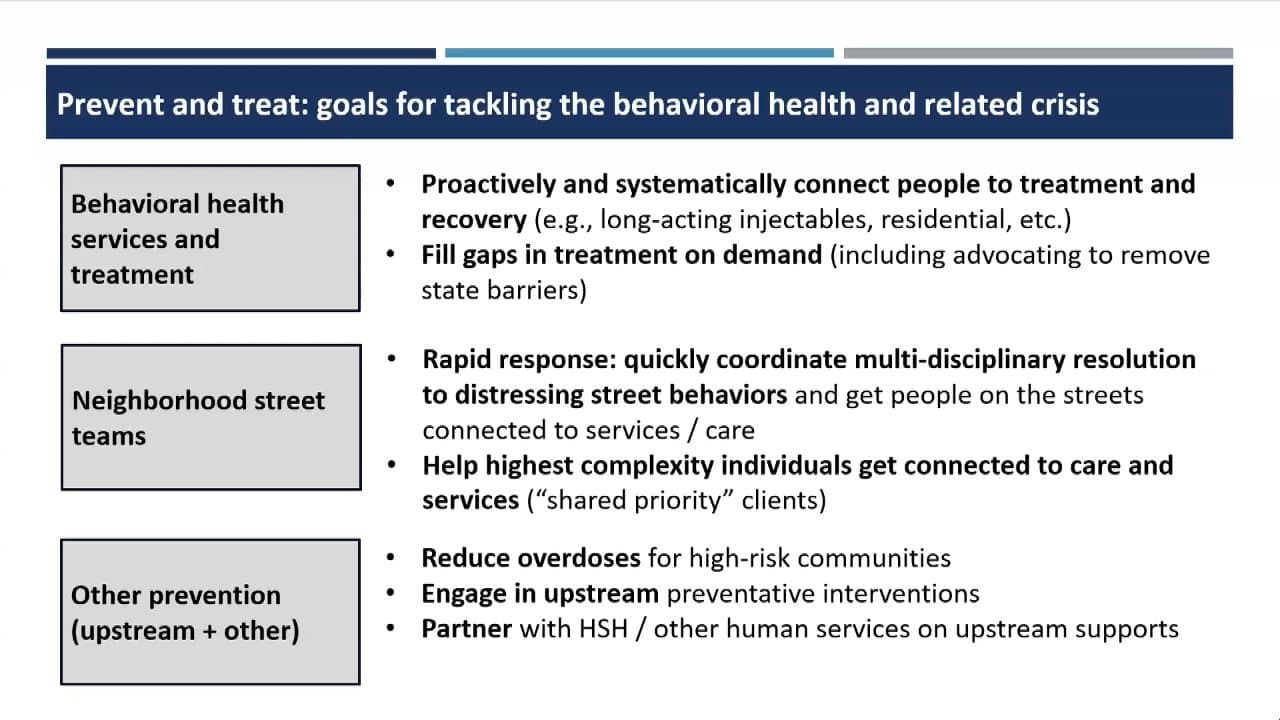
Decisions and stakeholder impacts: The committee adopted no policy. It voted to continue the hearing to the call of the chair (For: 2, Wong and Sauter; Against: 0; Absent: 1, Mahmood, excused). Mandelman called SFPD's "what's next" slide "a series of laudable goals, directionally correct, with no notion of how you would get to any of them."
What's next: Biggs asked the board for budget support, more officer hiring and extensions of pilot programs. One of those pilots, a late-night closure rule for retail businesses, has already expanded from the Tenderloin to SoMa. On Dorsey's push for criminologist David Kennedy's drug market intervention model, Biggs said the city is close, with contract issues still pending.
RESET Runs Well Below Capacity
The basics: The RESET Center opened this spring as a place where police can drop off people who are publicly intoxicated. The Sheriff's Office runs it, and the Sheriff's Office was not called to testify.
Where things stand: Biggs said officers made more than 2,300 public-intoxication arrests there from May through September, and each drop-off takes about five minutes. Dorsey counted 2,345 admissions over 158 days, just under 15 a day. He estimated the center's capacity at about four times that. Biggs blamed the gap on staffing.
Health Director Dan Tsai of the Department of Public Health (DPH) said daily arrivals in September ranged from about 15 to 36. Asked whether the center is full half the time, he said it never is, though it sometimes fills. He said 25% to 35% of clients agree to services, and transportation remains a gap.
Mandelman visited on a Wednesday afternoon and found three people there. He established that a person qualifies only if they cannot care for themselves or an officer sees them using drugs. Otherwise, officers can only cite and release.
The case for arrests: "I'd rather that we are arresting drug users because if we do this right, we might save their lives," said Dorsey. He said the Tenderloin Linkage Center referred about 1% of visitors to services, while RESET is approaching 40%. He suggested reimagining RESET as a custodial clinic near SF General.
The treatment bottleneck: Tsai reported a 30% increase in people in treatment over three years and about 200 added beds. He also said fewer than 1 in 10 people approached on the street want treatment. "41% of the time when someone raises their hand for withdrawal management or detox services, they're ready to start residential treatment, they can't get same or next day access," said Tsai.
State rules: Regulations, including a California Building Code sink requirement, bar stocking buprenorphine, an addiction medication, at RESET or shelter clinics. DPH has held three discussions with the state.
Hospital-only detox: No licensed San Francisco provider outside the hospital can handle medically complex detox, so RESET clients go to SF General. DPH is building a dual-diagnosis residential program with state funding.
Jail as an entry point: 40% of new buprenorphine starts citywide in July happened in jail.
The other side: A resident living between RESET and 6th Street described a concentration of SROs, DPH-funded services and convenience stores. The resident said police data show drug activity rising near the center and urged caution on expansion.
What's next: Any citywide RESET expansion depends on staffing, eligibility rules and state approval for on-site medication.
Marshall Elementary Families Bring the Crisis Home
Why it matters: Students and families from one Mission school made up the largest group of public speakers. They turned citywide statistics into a daily walk to school.
Where things stand: Supervisor Jackie Fielder, District 9, read a Marshall social worker's account of people using drugs under a classroom window. The social worker said an officer drove away when asked for help. "It is unacceptable for our officers not to take action when asked upon," said Biggs. Mandelman later noted that the officer could only have cited and released the users. Tsai said DPH would work with providers, including the San Francisco AIDS Foundation's syringe pickup contract, to expand needle cleanup near schools.
Voices from the school:
Ana Victoria, a 9-year-old student, said she is scared on her walk and asked for more officers like Officer Gamble.
Sarah Dominguez, a third grader, described syringes on 15th and 16th streets and asked for city ambassadors to return.
Mariana, community schools coordinator, said a first grader passed a bloody needle to classmates and someone threw a bottle from an SRO.
Yair, a parent, proposed planters on Mission Street as physical barriers.
Daphne Adam, a parent, called the conditions an emergency and invited Mayor Lurie to walk the blocks.
Emily Gazner, a former parent, described a shooting at 16th and Mission. She said the low-income, Latino school is treated as if its children don't matter.
Decisions and stakeholder impacts: Mariana asked for daily sidewalk cleaning before school starts and enforcement near Marshall and nearby SROs. She also asked for a safety plan within 30 days with one accountable official. No department committed to that timeline. Fielder said no one from the Mayor's Office attended a quarterly meeting with the school. "I think it's frankly unacceptable that no one from the mayor's office is here," said Fielder.
Mission Plazas Improve by Day, Not by Night
Where things stand: Anne Topier, executive director of the Office of Economic and Workforce Development (OEWD), said Mayor Lurie asked her office in June to coordinate the city's work at the 16th and 24th Street BART plazas. "Drug-related 911 calls are down 78%," said Topier.
Homelessness-related 911 calls fell 42%, and suspicious-person calls fell 23%.
Encampment-related 311 tickets held flat at 17 a month.
Inspectors issued more than 640 notices of violation for unpermitted vending, and 5 were escalated to misdemeanors.
Eight Sábado Gigante events drew 1,600 people.
Topier acknowledged that the daytime focus pushed serious activity into the evening.
Where the money comes from: OEWD plans to procure a $1 million plaza activation contract this month. A memorandum of understanding (MOU) with BART is nearly executed, and the effort has a $3 million state grant. Topier said OEWD aims to activate the plazas at least five days a week. Biggs said the push, which added dedicated officers and a lieutenant, has been extended beyond 90 days.
BART's role: Rod Lee, BART's assistant general manager for external affairs, called the Mission plazas BART's most challenging area across 26 cities. He said funding for permanent improvements is on the table, subject to the local BART director. Eric White, a BART Police commander, said he has four officers and a sergeant covering six downtown and Mission stations. He spends 75% of his time on the Mission.
The other side: Fielder cited Budget and Legislative Analyst figures showing about 55% of community ambassador funding goes to SoMa and the Tenderloin, compared with about 8% for the Mission. Topier said ambassadors are funded through the Department of Emergency Management's budget, not OEWD's. Chris Schulman, executive director of the Lower Polk Community Benefit District, said his neighborhood has deteriorated since losing ambassador funding north of Post Street on Jan. 1. Mahmood said Tenderloin gains have pushed activity into Lower Nob Hill and Hayes Valley.
Street teams consolidated: DPH took over the integrated Neighborhood Street Teams on July 1. It reported 70% fewer inpatient stays and 46% fewer ER visits among high-need clients.
311 drug-use reporting: Amin Lail of DPH said an option for reporting public drug use through 311 will enter testing within weeks.
Crisis team staffing: Former peer counselor Amelia Harmon said the Street Crisis Response Team has lost all its behavioral health specialists. She asked for a hearing on the San Francisco Fire Department's data accountability.
Procedural vote: The committee excused Mahmood as of 5 p.m. (For: 2, Wong and Sauter; Against: 0; Absent: 1, Mahmood).
Looking ahead: The hearing returns at the call of the chair. Mandelman suggested setting "rules of engagement" for future appearances by the Mayor's Office.