
Public Safety and Neighborhood Services Committee - Mar 26, 2026 - Regular Meeting

Public Safety and Neighborhood Services Committee - Mar 26, 2026 - Regular Meeting

Public Safety and Neighborhood Services CommitteeSan FranciscoMarch 26, 2026

Sources:

Locunity is a independent informational service and is not an official government page for this commission.We use AI-assisted analysis and human editorial review to publish information.

San Francisco Advances $72M Behavioral Health Plan Under Landmark Prop 1 Overhaul

The Public Safety and Neighborhood Services Committee unanimously forwarded a resolution authorizing San Francisco's $72 million behavioral health spending plan — the city's first under California's new Proposition 1 framework, which represents the most sweeping overhaul of state behavioral health funding in two decades. The plan, which must be submitted to the state next week, redirects money toward housing, substance use treatment and early intervention for young people under 25.

  • $72 million behavioral health plan advances to full Board under California's new Prop 1 framework, more than doubling the city's historic $30 million annual allocation

  • New state mandates require 30% of funds go to housing and 50% target early intervention for populations under 25

  • Chair Dorsey flags non-substance addictions — including social media — as emerging behavioral health frontier

  • Deadline pressure looms: late submission of the integrated plan could jeopardize future state funding


A Generational Shift in Behavioral Health Funding

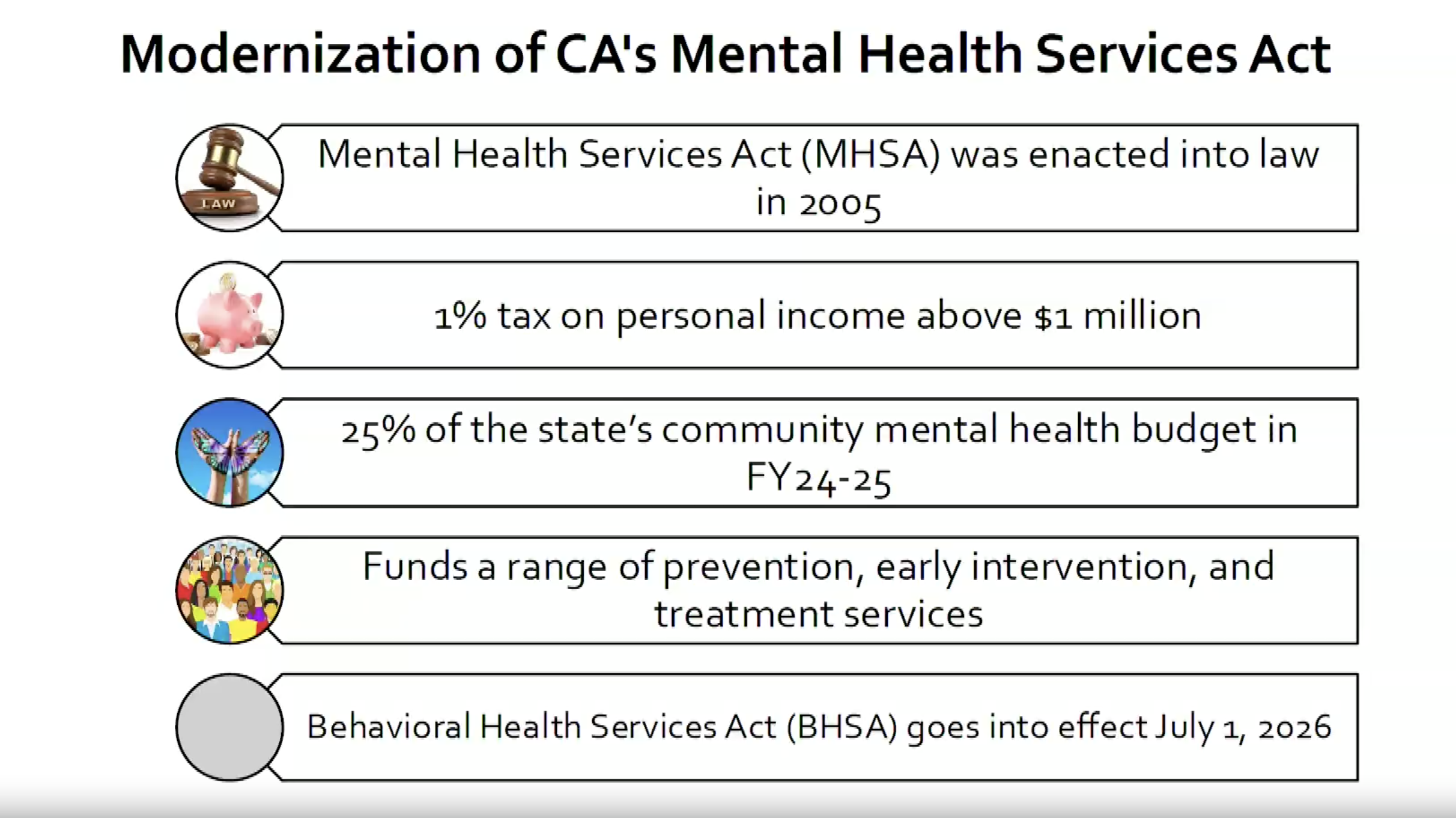
San Francisco is navigating one of the biggest structural changes to behavioral health money in a generation. The committee's 3-0 vote to forward the annual update resolution to the full Board of Supervisors sets the stage for the city's formal transition from the Mental Health Services Act to the Behavioral Health Services Act, a shift triggered by California voters' passage of Proposition 1 in March 2024.

The basics: The MHSA, in place for roughly two decades, funded county mental health programs through five separate funding categories. Prop 1 consolidates those into three buckets: 35% for full-service partnerships (intensive wraparound case management), 30% for housing, and 35% for a new "behavioral health services and support" category that covers workforce development, innovation pilots, early intervention, and capital/technology investments. Critically, the law now extends coverage to substance use disorders as co-occurring conditions — a first.

Why it matters: San Francisco historically received about $30 million per year in state behavioral health funds. That figure has surged dramatically — to $62.6 million in fiscal year 2023-24 and approximately $72 million in recent spending — flowing across roughly 95 programs and services. The Prop 1 transition will reshape how all of that money is allocated, who it serves, and how the city reports its results to Sacramento.

"San Francisco has historically got about $30 million per year. However, that has tremendously increased over the last fiscal year," said Jessica Brown, Director, Office of Justice Equity Diversity and Inclusion and BHSA Lead, Department of Public Health.

New Priorities, New Accountability

Where things stand: Under the new framework, the state now mandates that 50% of funding target early intervention for populations under 25, and explicitly designates priority populations including children and youth, chronically homeless individuals, and veterans. Full-service partnerships — the most intensive tier of care — provide wraparound case management including housing, employment support, peer services, and 24/7 clinician access.

"Under a full service partnership, we're able to provide employment services. So if a client comes in and says I want to start working, we're able to connect them under that framework of an intervention," Brown explained.

The new law also imposes significantly tougher planning and reporting requirements. The Department of Public Health must now conduct a demographic and behavioral health needs assessment and engage with 26 state-designated stakeholder groups — a roster that, for the first time, explicitly includes labor unions, law enforcement, and managed care plans.

"Now under Proposition 1, the state is very specific about who they want us to actually interact with, including labor unions, including law enforcement, including the managed community care plan," Brown said, adding that DPH has already held 12 community planning meetings with providers, consumers, its client council, and the Behavioral Health Commission.

The department plans targeted outreach to Population Health, the Department of Homelessness and Supportive Housing, the Golden Gate Regional Center, and the Independent Living Center.

Social Media, Dopamine and the Next Frontier

Chair Matt Dorsey, Supervisor, District 6, pressed for how the plan might address behavioral health challenges beyond traditional substance use — particularly social media addiction among young people. Citing Stanford professor Anna Lemke's work on dopamine and ongoing court cases against Meta, Dorsey framed the issue as potentially larger than the substance use crisis alone.

"Some of what we're seeing with substance use disorders may be just the tip of the iceberg in other areas where it all comes back to dopamine and it's often triggering the same kinds of problems," Dorsey said.

Brown confirmed that the innovation funding embedded in the behavioral health services and support category provides flexibility to pilot programs targeting emerging challenges. "We also have to provide 50% of our funding to early intervention efforts for populations under the age of 25, so we're able to actually look at different programs that may do what you're talking about," she said.

Recovery Communities and Workforce

Dorsey also raised the importance of engaging self-funded recovery organizations — spaces that largely operate outside city funding streams but serve critical roles in the recovery ecosystem.

"I think most of these organizations don't get, by and large don't get city funding. But I'm thinking of things like the Dry Dock, Castro Country Club, Gratitude Center, places where there's a lot of 12-step meetings and other kinds of meetings," Dorsey said, noting the difficulty of finding Chinese-language recovery meetings and the need for multilingual and culturally specific outreach.

He separately flagged interest in vocational services for people exiting substance use treatment. "I do think especially for people who are in early recovery or coming out of substance use treatment, they're often particularly vulnerable to relapse," Dorsey said, requesting a follow-up briefing on the topic.

Brown highlighted the department's existing workforce pipeline, noting that DPH hires people with lived experience into civil service positions. "The Behavioral Health Department has a very unique approach to actually hiring people with lived experience within our actual civil service organization," she said, also noting a 100% graduation rate in the department's iAbility vocational IT program.

The Clock Is Ticking

Decisions: The committee voted 3-0 (For: Member Wong, Vice Chair Mahmood, Chair Dorsey; Against: 0; Absent: 0) to forward the resolution to the full Board of Supervisors with a positive recommendation. No public comment was received on the item.

What's next: The integrated plan is due to the state next week and will be posted for a 30-day public comment period. DPH will return to the full Board in May for final approval. The completed plan must be submitted by June 30, 2026, and takes effect July 1, 2027.

Brown was direct about the stakes: "It is imperative that we have approval and timely submission of our plan. It does impact funding in the future if we are not able to submit this plan timely."

For residents, advocates, and service providers, the 30-day comment window represents the most immediate opportunity to shape how San Francisco spends its largest-ever behavioral health allocation. The May full-Board vote will be the final checkpoint before the plan is locked in.