San Francisco's Tree Canopy Crisis: $13M Annual Gap Exposed as SOMA Sits at 2.7% Coverage
Public Safety and Neighborhood Services Committee • San FranciscoSeptember 24, 2026
Locunity is an independent informational service and is not an official government page for this commission. All information is sourced from public footage and an analysis of official agendas with the aid of responsible, fact-checked AI. to report an error or omission.
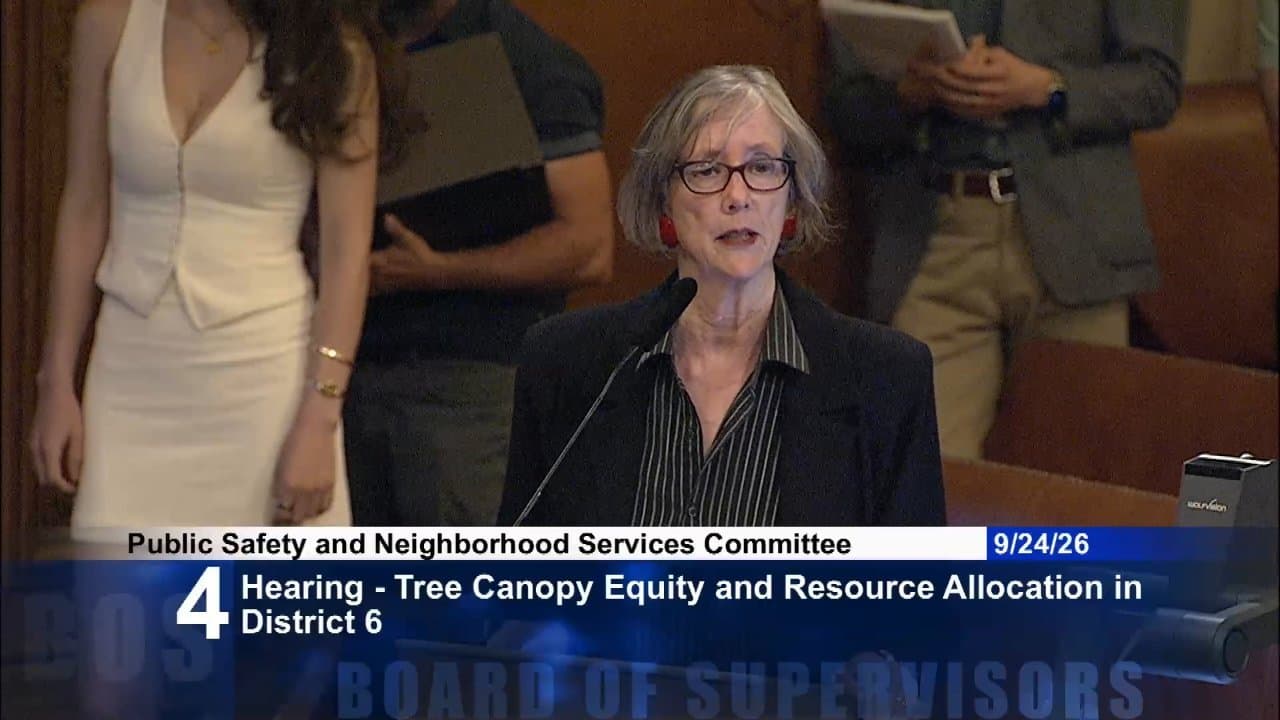
The San Francisco Public Safety and Neighborhood Services Committee spent the bulk of its Sept. 24 meeting on a sweeping hearing that laid bare the structural gap between the city's environmental justice ambitions and the Bureau of Urban Forestry's actual capacity — chronic underfunding, outdated technology, staffing at half strength, and 87 newly planted trees already vandalized or missing.
- Tree equity hearing reveals Bureau of Urban Forestry needs $13 million a year to meet planting goals but receives just $1–2 million in consistent funding
- SOMA's 2.7% tree canopy — the city's lowest — drives Supervisor Dorsey's push for binding neighborhood targets and non-volatile funding
- Record 1,880 street trees planted last year, but city still 30,000 trees short of its Urban Forest Plan goal of 155,000
- 87 of 250 trees planted under state grant vandalized or missing, underscoring hostile conditions in dense urban neighborhoods
- Eight community groups — from SOMA West CBD to Calle 24 — urge chicanes, better technology, and a 90-day follow-up
- Three liquor license transfers approved unanimously for small businesses in Districts 3, 6, and 11
The 30,000-Tree Gap
Supervisor Matt Dorsey, District 6, convened the hearing based on his letter of inquiry to Public Works, setting a deliberate tone from the outset.
"Over the years I have seen boards of supervisors, and mayors for that matter, set our city departments up for failure and then make a big production of having a hearing to blame them for failing. That is not something that I find useful," said Supervisor Dorsey.
Why it matters: South of Market has just 2.7% tree canopy — tied with the Tenderloin for the lowest in San Francisco — in a neighborhood already burdened by air pollution, excessive heat, and some of the densest development in the city. The hearing exposed how far the city's resources lag behind its stated equity goals.
Where things stand: Bureau of Urban Forestry Superintendent David Moore told the committee his department manages approximately 125,000 street trees citywide and planted a record 1,880 last year. The target for this year is 2,500. But the city's Urban Forest Plan calls for 155,000 street trees — meaning roughly 30,000 more need to go in the ground.
"On the back of a napkin it would cost about $13 million a year to plant 5,000 street trees a year," Superintendent Moore said, versus the $1–2 million the bureau receives in consistent annual funding.
The balance comes from competitive federal and state grants that are inherently volatile: a $12 million U.S. Forest Service IRA grant funds 3,500 trees through 2029, and a $4.9 million CAL FIRE grant supports the Street Tree Nursery. Moore said the Forest Service has praised San Francisco's implementation as a national model and is not retreating from its partnership. But one-time grants cannot replace a controlled funding stream.
Vandalism, Hostile Conditions, and the Equity Paradox
The most striking data point: of 250 trees planted under a California Natural Resources Agency grant in Districts 3, 5, and 6, 87 were vandalized or missing upon inspection.
"Sometimes when we go to an equity priority neighborhood, they have a different set of priorities based off of they have less of their basic needs filled, and actually a tree could be an unwelcome thing," Superintendent Moore said.
Moore used a fitness analogy to push back on calls for more ambitious targets without first securing baseline resources: "If I need to improve certain stats and my blood sugar and cholesterol, but I can't afford sneakers and a gym membership — and I say, okay, well, not only do I want to be fit, I want to be like Arnold Schwarzenegger bodybuilder. Well, it's like, well, why did I just change the goal even higher without getting the basics in place?"
The bureau recently awarded a contract for a nonprofit partner to replant 2,000 empty tree basins over the next two years, prioritized by equity scores, with work expected to begin in December.
Broken Systems and Staffing Shortfalls
Superintendent Moore disclosed that the bureau's work order database cannot link to geographic assets — a structural limitation that prevents the department from producing a tree replacement report required under Public Works Code Section 806.
"The work order database that we use to manage our requests and work orders doesn't link to geographic assets. This is a structural challenge for not just our bureau, but for other bureaus in Public Works," he said.
Staffing is similarly dire. Moore reported the inspection shop — responsible for service orders, sidewalk requests, and quality control on tree maintenance contracts — has only 5 of 9 or 10 positions filled, with no manager. The arborist crew is missing 10 members, and the landscape crew is operating at roughly half capacity due to injuries.
Supervisor Dorsey offered to work offline on the technology gap: "If there's a technology need that you have, I'm happy to take that offline. Right now the city is undertaking some big changes with its software."
Prop L Funding Diverted, Narrow Sidewalks Block Planting
Prop L funding initially earmarked for Districts 5, 6, and 10 was redirected by the San Francisco County Transportation Authority to Districts 9, 10, and 11, frustrating District 6 residents who expected the investment. Superintendent Moore explained that environmental justice scoring guides but does not rigidly determine planting priorities, and that state (CalEnviroScreen 4.0) and federal equity metrics do not perfectly align with San Francisco's own Environmental Justice Communities Map.
Supervisor Dorsey questioned whether relying on private development for tree planting disadvantages his district during economic downturns: "I worry that relying on that as a factor in where we're investing city resources may be disadvantaging the neighborhoods I represent. If we're relying on private development, who knows when that's going to pencil out, or when interest rates will come down."
A Public Works director's order (No. 187246) restricts planting on sidewalks narrower than 7.5 feet — a policy that effectively blocks new trees on many SOMA streets. Moore said exceptions can be granted case by case, and the committee discussed chicanes and curb bulb-outs as creative alternatives.
Supervisors Push for Ambition and Accountability
Vice Chair Bilal Mahmood, District 5, pressed on two fronts. He asked how the city ensures in-lieu fees under new legislation actually produce trees near the developments that generate them: "How do we know that the rate is the right amount for a tree replacement? And as well as how do we know that they're being planted in proximity to the actual development?"
He also flagged a persistent constituent complaint about 311: "What we often have heard back from constituents is that the 311 requests are often closed with a tag that just says planned maintenance. Is there a better way to communicate to 311 filers the specific reason the request relating to a tree well might not be completed?"
Supervisor Alan Wong, District 4, asked about resident notification before planting, species selection, and multilingual outreach: "Before a tree is planted outside someone's home or business, what information do they receive about the proposed species, its eventual size, and who will be responsible for its care?"
Chair Slaughter closed the supervisors' questioning with encouragement and a pledge: "I don't think anyone's going to be mad at you for putting forward an ambitious vision and putting numbers behind that. I think that's where you're going to actually see support."
The chair also signaled intent to address the funding gap directly: "I have long heard that the funding is a challenge in terms of not having a consistent, reliable stream. That's something I'd like to work with you to change."
Community Voices: Eight Groups Demand Action
Eight public commenters — representing community benefit districts, cultural districts, and neighborhood organizations — testified with a striking degree of coordination.
Alex Ludlum, Executive Director of SOMA West Community Benefit District, described a pilot watering partnership with Public Works in which the CBD maintains 83 trees using its existing fleet at relatively low cost, encouraging other CBDs to pursue similar arrangements.
Leanne, a District 6 resident and mother in SOMA West, described air pollution, excessive heat, and a lack of greenery in her car-free neighborhood, noting that proposed green space at 11th and Antoma was diverted to another neighborhood and put on indefinite pause.
Gail Ball, former president of the Hayes Valley Neighborhood Association, suggested chicanes as a solution for narrow-sidewalk planting and argued that community tree planting increases neighborhood safety by getting people onto streets.
Josh Klipp, former vice chair of the Urban Forestry Council and co-founder of Mission Verde, delivered one of the hearing's sharpest critiques: the city has not net-gained a single street tree since 2017 and has lost hundreds. He argued any equity plan is incomplete without tree preservation, noting trees in District 6 are cut down for development.
Stu Collins, a District 6 resident, described coordinating a successful block planting of 18–20 trees near Gene Friend Rec Center but noted zero additional trees were allowed on Harriet Street due to the narrow-sidewalk policy. He called for the Board to set tree count goals, find non-volatile funding, expand CBD watering partnerships, and install chicanes.
Sean Auckland, a South of Market resident, reported empty tree wells full of trash and paved over on Langton Street, asking the committee to keep the hearing file open, return in 90 days, and request canopy or tree count targets.
Peter Papadopoulos, representing the Calle 24 Latino Cultural District, supported the software dashboard idea discussed by supervisors and emphasized ensuring equity funding goes to neighborhoods building 85% of the city's housing.
Ellen Soto, representing the Midmarket Community Benefit District, showed photos contrasting a failed alley tree planting with a successful development-planted tree protected by a concrete ledge and fencing, urging the department to prioritize survivability even if it means planting fewer trees.
Decisions: The hearing was continued to the call of the chair on a 3-0 vote (For: 3 — Supervisor Slaughter, Supervisor Mahmood, Supervisor Wong; Against: 0; Absent: 0). Supervisor Dorsey closed by urging the Board to take responsibility: "Let's make sure that we as Board of Supervisors are cognizant that we have to do our part to ensure that the Bureau of Urban Forestry has the resources it needs to meet our residents' expectations."
What's next: A separate tree maintenance hearing is expected later this fall from Supervisor Wong. The committee's continuation leaves the file open for follow-up, and community members have requested a 90-day check-in.
Minor Items
-
Coit Liquors license transfer (District 3): Committee approved 3-0 a resolution finding public convenience or necessity for the transfer of Type 21 and Type 86 liquor licenses to Najwa Inc. dba Coit Liquors at 1657 Powell St. Owner Mr. Shadi is relocating temporarily after a fire destroyed his store at 585 Columbus; the business has operated in the neighborhood since 1961. No public comment. Resolution forwarded to the full Board with positive recommendation.
-
Mission Bay Community Market license transfer (District 6): Committee approved 3-0 a Type 21 license transfer for Mission Bay Community Market at 1360 4th St., where owner Redan Salah emphasized alcohol would be part of broader grocery offerings. Supervisor Dorsey noted the store serves a genuine convenience and necessity in the underserved Mission Bay neighborhood. No public comment.
-
Noriana Farmers Market license transfer (District 11): Committee approved 3-0 a Type 21 license transfer for Noriana Farmers Market at 4929 Mission St., located in a low-crime, low-concentration area. Representative David Villalobos noted the applicants purchased a POS system with ID reader at his request. SFPD Officer Brandon Erickson presented standard conditions for all three licenses with no opposition from local police stations.