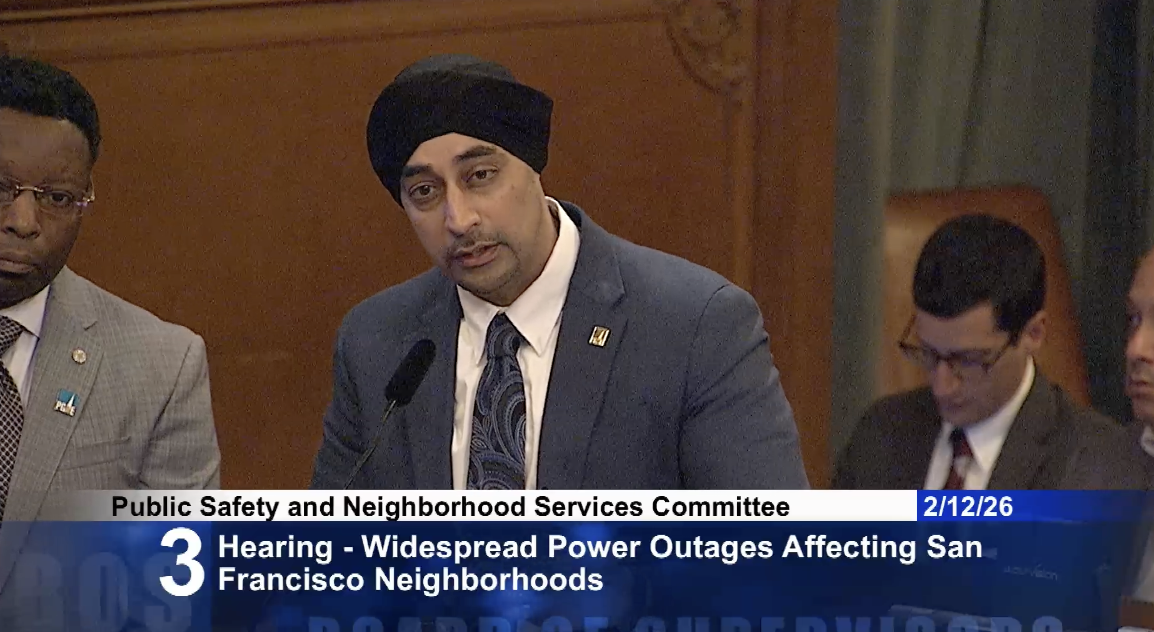
Public Safety and Neighborhood Services Committee - Feb 12, 2026 - Regular Meeting

Public Safety and Neighborhood Services Committee - Feb 12, 2026 - Regular Meeting

Public Safety and Neighborhood Services CommitteeSan FranciscoFebruary 12, 2026

Sources:

Locunity is a independent informational service and is not an official government page for this commission.We use AI-assisted analysis and human editorial review to publish information.

Committee Advances PG&E Takeover Push After Grilling Utility on Outage Failures

San Francisco's Public Safety and Neighborhood Services Committee spent more than four hours on Feb. 12 pressing PG&E executives on the December power outage that left 130,000 customers in the dark — then unanimously moved two resolutions toward a municipal takeover of the utility's electric grid to the full Board of Supervisors. In a separate, emotionally charged hearing, over a dozen Lower Nob Hill residents demanded closure of the city's largest shelter at 711 Post St., while city officials outlined plans for a new operator and reduced bed count by fall.

  • PG&E municipalization and accountability resolutions advance to the full board unanimously, with a worker protection amendment addressing union pension concerns

  • PG&E CEO acknowledges December outage response was "unacceptable"; ~130,000 customers lost power, some for three days, after a fire at the Mission substation

  • Merchants call PG&E's eight-page claims process "mission impossible" and flag problematic indemnity clauses in settlement agreements

  • Lower Nob Hill residents flood hearing demanding closure of 711 Post St. shelter; city plans new operator by April 1 and bed reduction to 250

  • Cash acceptance repeal ordinance continued to call of the chair for more community engagement


PG&E's December Outage: 'You Don't Direct Them to an 800 Number'

A circuit breaker fire at PG&E's Mission substation on Dec. 20 knocked out power to roughly one-third of the city — approximately 130,000 customers — during peak holiday week. While 75% of customers were restored within eight hours, about 33,000 waited up to three days, disproportionately in the Richmond and Sunset districts.

Why it matters: The hearing exposed systemic failures in PG&E's emergency communication, community response, and claims process — and revealed this was the third fire at the same substation, following incidents in 1996 and 2003.

Where things stand: PG&E CEO Sumeet Singh took responsibility directly. "I want to be very clear that we take responsibility for the outage that took place last December. And our response to that outage, as Sarah mentioned, is unacceptable," he told the committee. Singh described $3 billion in citywide infrastructure investments over 20 years and $200M specifically at the Mission substation since 2010. A third-party investigation into the fire's root cause is expected in March.

Supervisor Alan Wong, District 4, opened the hearing with a blistering account of the outages' toll, telling the story of a 95-year-old Sunset resident on a ventilator:

For that family, this wasn't a simple inconvenience. It was about whether a loved one could breathe," he said. He set the tone for the afternoon: *"Accountability means showing up. 130,000 people lose power. **You don't direct them to an 800 number. *You don't ask them to navigate an automated phone tree."

Communication Breakdown

**Department of Emergency Management Executive Director Mary Ellen Carroll** confirmed the city learned of the outage through its own monitoring systems — not from PG&E. "We knew about the outage before getting a proactive" contact, she said, adding that her department had to request a PG&E liaison, who arrived two hours later. Even then, that liaison struggled with internal PG&E information gaps. "If he is not connected within his organization, if he does not have information in a timely manner, if he is not getting accurate information, then that's where we have the problem. And we saw instances of that during this event," Carroll said.

Initial PG&E notifications went out in English only. Community resource centers were not proactively deployed — the city had to ask for them. Supervisor Bilal Mahmood, District 5, pressed PG&E on equity gaps, noting that the most vulnerable communities around the Tenderloin and Civic Center received support only after his office intervened. "The center near Civic Center didn't open until the day after the Richmond center. This is some of the most vulnerable communities in the entire city," Mahmood said.

Screenshot 2026 02 12 at 8.52.03 PM

The Algorithm Problem

A major focus was PG&E's repeatedly revised estimated restoration times, which fueled confusion and frustration citywide. Singh explained the system relies on a machine learning model — specifically a light gradient boosting machine — trained on roughly three years of data skewed toward smaller distribution-level outages. It was not equipped for a complex substation event.

Mahmood pushed back: "Why wouldn't the training data incorporate some of the citywide outages that happened that were more relevant to this case, which is from the exact same substation?"

PG&E committed to improving rapid escalation protocols and ETR accuracy for large-scale events.

'Mission Impossible' for Small Business

Merchant associations delivered some of the hearing's most pointed testimony. Sean Kim, vice president of the Geary Boulevard Merchant Association and owner of Jose Ice Cream, described total inventory loss from freezer failure and an onerous claims process. "PGE created eight page guideline calculate claims. In reality it is mission impossible for small business to follow," Kim said. He also revealed that initial settlement agreements contained indemnity clauses that would have waived merchants' future legal rights — language revised only after his individual pushback.

Daniel Ramirez, president of the Sunset Merchants Association and Irving Street business owner, described three full days of disruption, food spoilage, and lost wages for nine employees from lower-income households, plus a claims process that required resubmitting documents.

Deborah Murphy, president of the Coalition for San Francisco Neighborhoods, called PG&E's claim form "atrocious" even with her business and accounting background, and demanded a neutral third-party review for fairness.

PG&E said it issued approximately $50M in automatic bill credits — $200 per residential customer, $2,500 per non-residential — and resolved 90% of 2,750 claims in an average of 15 days. PG&E Chief Customer Officer Vincent Davis presented those figures.

Paper Plans at a Fire Scene

San Francisco Fire Department Operations Chief Pat Rabbit revealed that PG&E provided only paper building plans at the substation fire scene, hindering the department's emergency response. PG&E committed to digitizing those plans within a month.

Decisions: The committee voted 3-0 (Supervisors Wong, Mahmood, and Chair Matt Dorsey) to continue the hearing to the call of the chair, with a second hearing focused on root causes and infrastructure expected in late March after PG&E's investigation findings.


Municipalization Moves Forward — With a Worker Protection Clause

Chair Dorsey presented two resolutions from Supervisor Connie Chan that together represent San Francisco's most aggressive push in years to acquire PG&E's electric infrastructure.

The basics: San Francisco has held a long-standing policy interest in municipalizing its electric grid, rooted in City Charter Section 16.101 and the 1913 Raker Act, which granted the city Hetch Hetchy hydroelectric power rights. The city already generates clean power and operates Clean Power SF, but PG&E owns the distribution network.

Why it matters: Dorsey made an extensive financial and moral case, contrasting the city's AA+ credit rating with PG&E's BBB/BBB- status and reciting PG&E's criminal history — including the 2010 San Bruno pipeline explosion and 84 involuntary manslaughter pleas stemming from the 2018 Camp Fire. "San Francisco's credit rating is highly investment grade, nearly the top of municipal credits. S and P. Global ratings today is for San Francisco is AA plus. That reflects a very strong capacity to meet financial commitments. By contrast, PGE's SP ratings are BBB and BBB minus, which is considered the lowest tier of investment grade," Dorsey said.

The other side: PG&E and business groups pushed back forcefully. PG&E Government Relations Manager Sarah Chavez-Yoell argued the city's $2.5 billion offer significantly understates true costs, citing a CPUC ruling identifying additional cost categories — grid separation, a replacement substation in San Mateo County, wildfire mitigation, and statewide program obligations — potentially reaching billions more.

Peter Laro Muñoz, senior vice president of the Bay Area Council, warned the expense would divert resources from housing, homelessness, transit, and public safety, noting the cost would equal sending every San Francisco high school student to UC Berkeley for eight years amid an anticipated $1 billion city budget deficit.

Hunter Stern, assistant business manager of IBEW Local 1245, raised a concrete labor concern: ERISA-governed pension benefits for PG&E workers cannot legally transfer to a public-sector retirement plan. "We cannot move their benefits, particularly their pension, from an ERISA plan into a county, state or public sector plan. It's not possible," Stern said, warning municipalization would put workers in a "terrible place."

Decisions: Supervisor Wong moved to amend the municipalization resolution with a worker protection clause ensuring no PG&E employee would be displaced or suffer reductions in wages, benefits, pensions, or years of service in any acquisition. Both resolutions passed 3-0 (Wong, Mahmood, Dorsey) and advance to the full board with positive recommendations. Dorsey announced a separate, more substantive hearing on municipalization finances and rate impacts for the Feb. 24 board meeting.


Screenshot 2026 02 12 at 8.53.50 PM

Lower Nob Hill Residents Demand Shelter Closure at 711 Post St.

Supervisor Danny Sauter, District 3, convened what became an emotional hearing on the 711 Post St. shelter — the city's largest semi-congregate facility with 280 beds accounting for 10% of San Francisco's adult shelter capacity and 48% of its semi-congregate beds.

Why it matters: The shelter, housed in a former hotel converted during the COVID emergency, has become a flashpoint for Lower Nob Hill residents who say the concentration of homeless services — 11 shelters within 20 blocks by some counts — has overwhelmed their neighborhood with crime, drug activity, and safety concerns.

Where things stand: Sauter laid out the operational backdrop: the current operator, Urban Alchemy, was placed on the Controller's Tier 2 fiscal monitoring status. "They were placed on Tier 2 of the controller's fiscal and compliance monitoring for improper wage calculations, low cash balances, insufficient documentation reporting, and knowingly overspending on salary increases," Sauter said. HSH Deputy Director Emily Cohen confirmed Urban Alchemy has since cleared all deficiencies and been removed from elevated status.

Cohen outlined plans for a new one-year operator contract beginning April 1, a bed count reduction from 280 to 250 by fall, a 24/7 neighbor text line, an enhanced Good Neighbor policy, and a system-wide shelter reprocurement in 2027. She warned that closing the facility entirely would take 9 to 12 months and would increase unsheltered homelessness without comparable replacement beds. "Given the size of this shelter, we estimate that it would take between 9 and 12 months to wind it down responsibly, relocating people to existing shelters within the community," Cohen said.

The other side: Over a dozen Lower Nob Hill residents delivered urgent, often emotional testimony. Greg Pennington, a 50-year resident, described overdoses, fentanyl use, and fireworks, noting the neighborhood has 10 shelters in 16 square blocks. Don Malaspina called 711 Post "an ill conceived Covid era action whose time has expired" and cited 100-plus monthly incidents of trespassing and crime logged by his building. Barbara Swan, a 36-year resident, demanded collaboration with Animal Care and Control over an "anemic pet policy" that she said allows dog breeding in shelters. Todd Bartel, a 20-year resident and building manager, described people shooting meth and smoking fentanyl outside the shelter at 8 a.m. Elijah Ball, a community organizer, said the shelter "is not serving our community" and "is only helping to check off numbers of beds," adding he holds a list of 140-plus people urging closure.

Sauter conditioned any support for continued operations on strict reforms: "One thing that has to change is the weapons policy. You know, the current operator, we heard, chose not to screen or search guests upon entrance. And that very much worries me." He also demanded expanded police foot beats and more frequent power washing.

Chair Dorsey closed with a broader policy statement linking shelter impacts to the city's approach to drug use. "I believe that when the history of this era is written, I think the sin that will get this generation statues taken down and names taken off of buildings will be how we minimize the manifest harms of rampant, at least illicit, drug use," Dorsey said, pointing to the new Reset Center as a critical accountability tool.

Decisions: The hearing was filed 3-0 (Wong, Mahmood, Dorsey) with no formal action on the shelter contract. HSH will proceed with new operator negotiations for the April 1 transition.


Minor Items

  • Cash acceptance repeal ordinance (Article 55 of the Police Code), sponsored by Board President Raphael Mandelman, was continued to call of the chair (3-0) at the author's request for further community engagement. Public comment included a privacy advocate citing a $250,000 Visa donation to Mayor Lurie's ballot committee, a small business nonprofit supporting repeal for operational flexibility, and a restaurant operator noting only 3% of sales are cash while handling costs remain high.


What to Watch

The PG&E story has two fast-approaching next steps: a Feb. 24 full board hearing on municipalization finances and rate impacts, and a second committee hearing in late March on outage root causes once PG&E's third-party investigation is complete. Both will test whether the political momentum behind acquisition translates into fiscal reality — and whether IBEW's pension concerns can be resolved. At 711 Post St., HSH's April 1 operator transition deadline will be the next test of whether the city can deliver the reforms Lower Nob Hill residents are demanding — or whether closure calls grow louder.